📝 Paper Summary
Cross-Domain Recommendation (CDR)
User Modeling
Multi-TAP improves cross-domain recommendation by decomposing user preferences into multi-criteria personas to capture intra-domain heterogeneity and using a target-adaptive doppelganger mechanism for selective knowledge transfer.
Core Problem
Existing CDR methods assume user preferences are homogeneous within domains, aggregating diverse behaviors into single representations that compress context-dependent signals.
Why it matters:
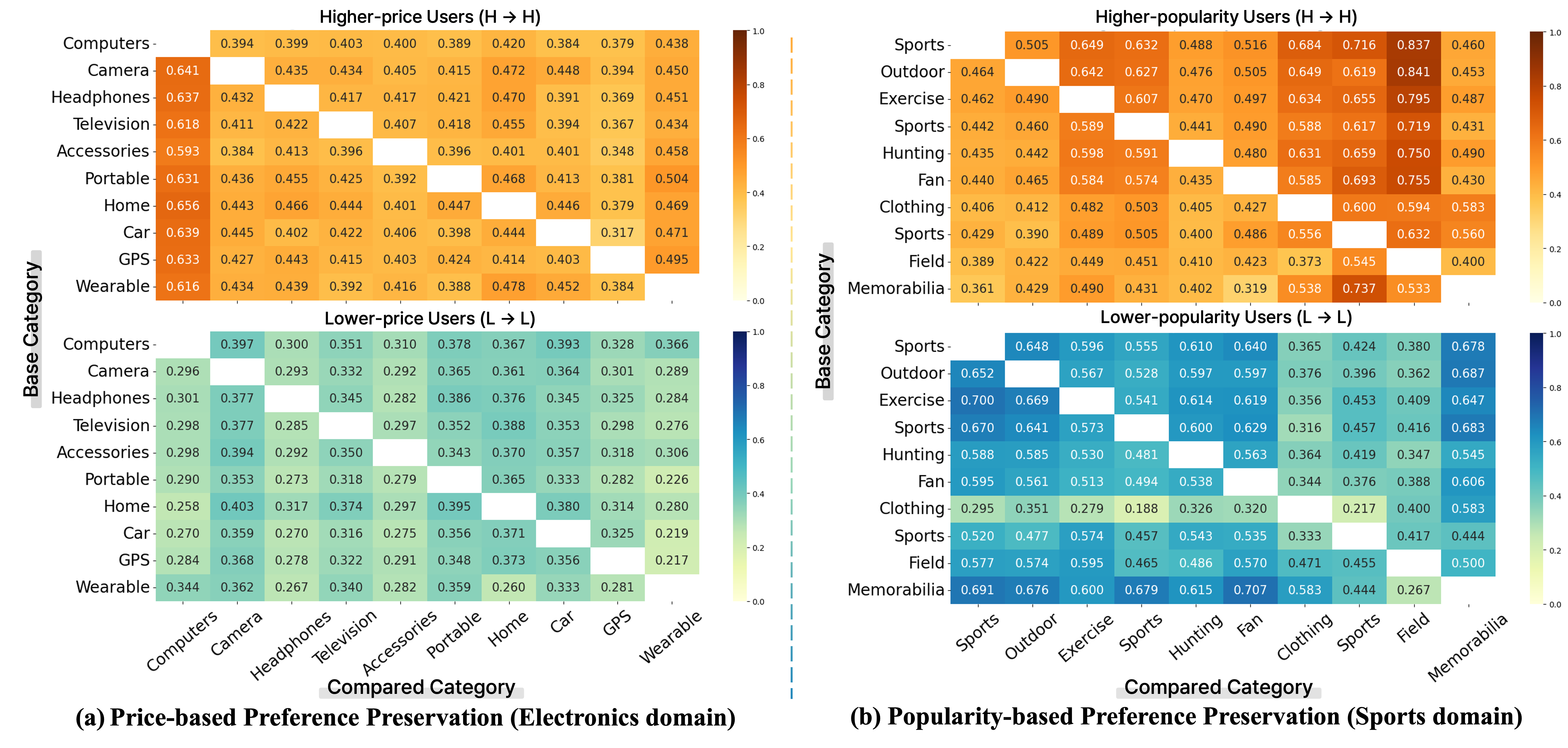
- Compressed representations mask fine-grained preference shifts (e.g., price sensitivity changes across categories), leading to information loss before transfer even begins
- Indiscriminate transfer of these coarse representations exacerbates the loss, failing to preserve domain-specific preference structures in the target domain
- Behavioral science (Theory of Planned Behavior) suggests observed behaviors arise from context-dependent intentions, which standard monolithic embeddings fail to capture
Concrete Example:
In the Electronics domain, a user might buy a high-priced 'Computer' but a budget 'Home Audio' cable. Standard methods average these into a 'medium price' preference, losing the nuance. Multi-TAP identifies distinct price sensitivities per category.
Key Novelty
Multi-criteria Target-Adaptive Persona (Multi-TAP)
- explicitly decomposes user behavior into five distinct criteria (e.g., Price Sensitivity, Popularity Bias) using an LLM to generate granular textual personas rather than a single holistic profile
- Uses a 'doppelganger' mechanism where a target-domain persona creates a proxy in the source domain; this proxy selectively absorbs only the source information relevant to the target context via attention
- Aligns the target persona with its source-derived doppelganger using contrastive learning, avoiding the rigidity of direct source-target embedding alignment
Architecture
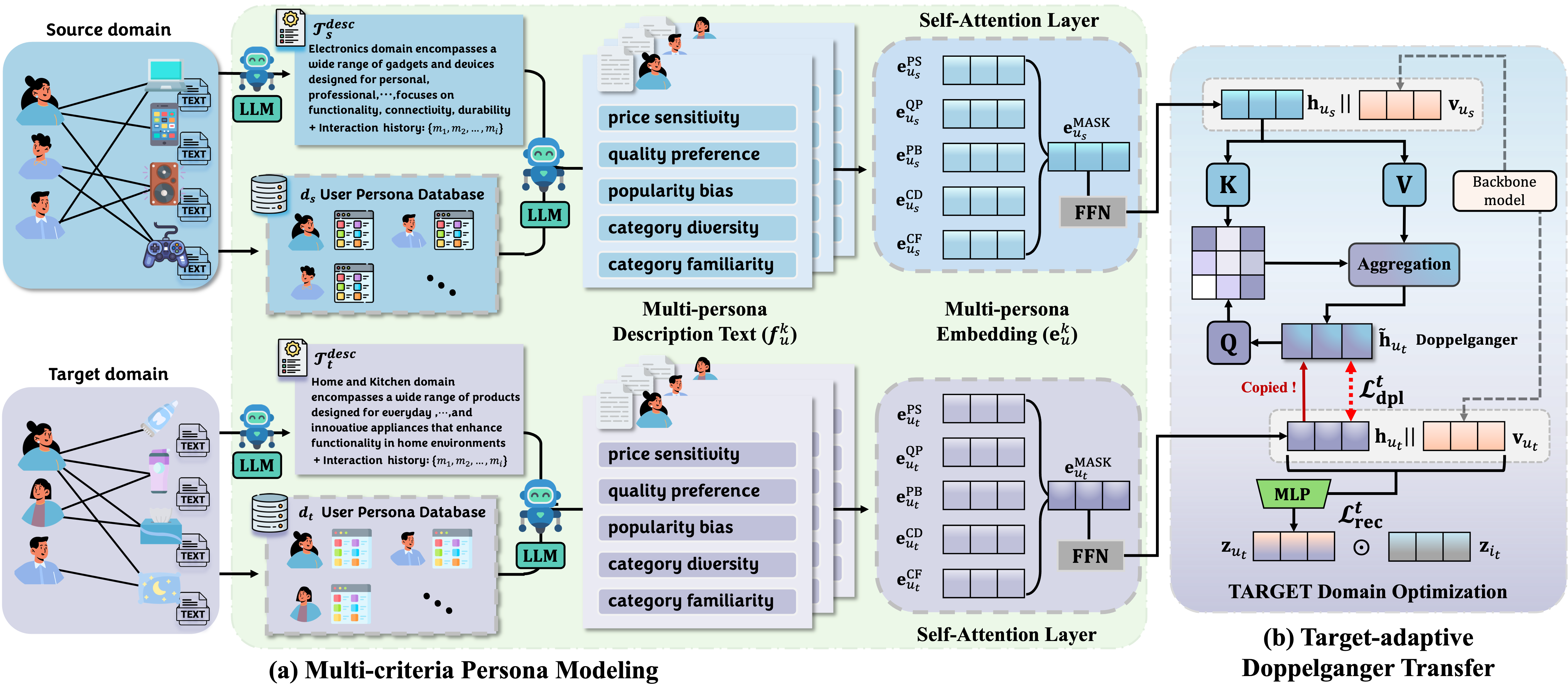
The overall architecture of Multi-TAP, divided into (a) Multi-criteria Persona Modeling and (b) Target-adaptive Doppelganger Transfer.
Evaluation Highlights
- Outperforms five state-of-the-art CDR methods by up to 36.3% in HR@5 (Hit Rate) on real-world datasets
- Empirical analysis reveals 'preservation ratio' of preferences across categories drops to ~31% in some pairs (e.g., Car vs. GPS), quantitatively proving the existence of intra-domain heterogeneity
Breakthrough Assessment
7/10
Identifies a fundamental flaw in CDR (homogeneity assumption) and proposes a coherent LLM-based solution. Strong quantitative motivation, though full experimental tables are not in the provided text.