📊 Experiments & Results
Evaluation Setup
Survival Arena simulation: 9x9 grid (survival) or 7x7 grid (sexual selection), resource gathering, trading, combat mechanics.
Benchmarks:
- Survival Arena (Internal) (Multi-agent grid-world survival) [New]
Metrics:
- Trade count
- Attack count
- Survivors
- Game duration
- Social action %
- Shannon entropy
- Statistical methodology: Not explicitly reported in the paper
Key Results
| Benchmark | Metric | Baseline | This Paper | Δ |
|---|---|---|---|---|
| Survival pressure experiments (Phase P2b) demonstrate an inverted-U relationship between upkeep cost and trade frequency. | ||||
| Survival Arena | Trade count | 11.5 | 29 | +17.5 |
| Survival Arena | Trade count | 29 | 8 | -21 |
| Survival Arena | Trade count | 29 | 0 | -29 |
| Sexual selection experiments (Phase V7) show different behavioral emergent patterns compared to survival pressure. | ||||
| Survival Arena | Attack count | Not reported in the paper | 0 | Not reported in the paper |
Experiment Figures
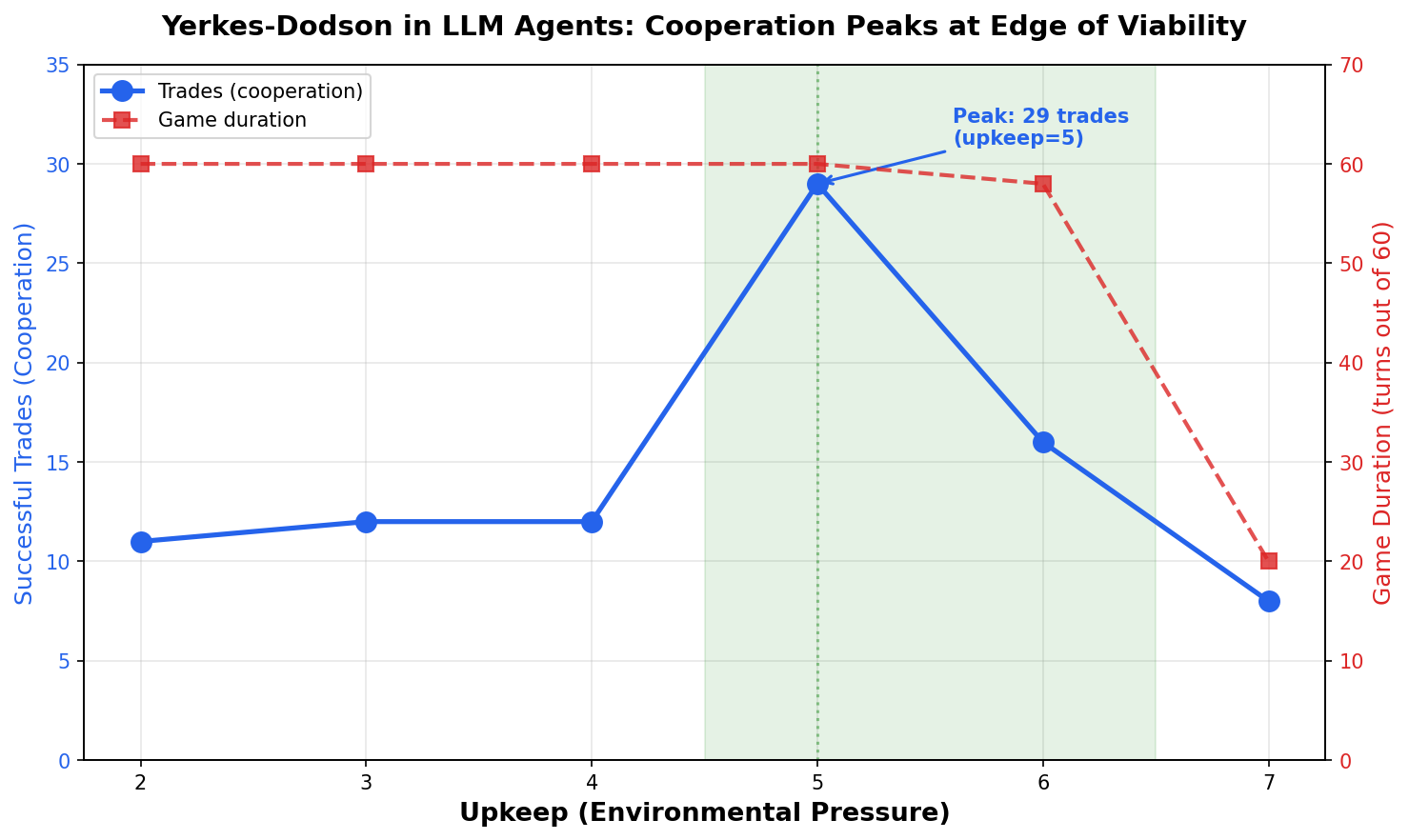
Line chart showing Trade Count vs. Upkeep Cost (Pressure)
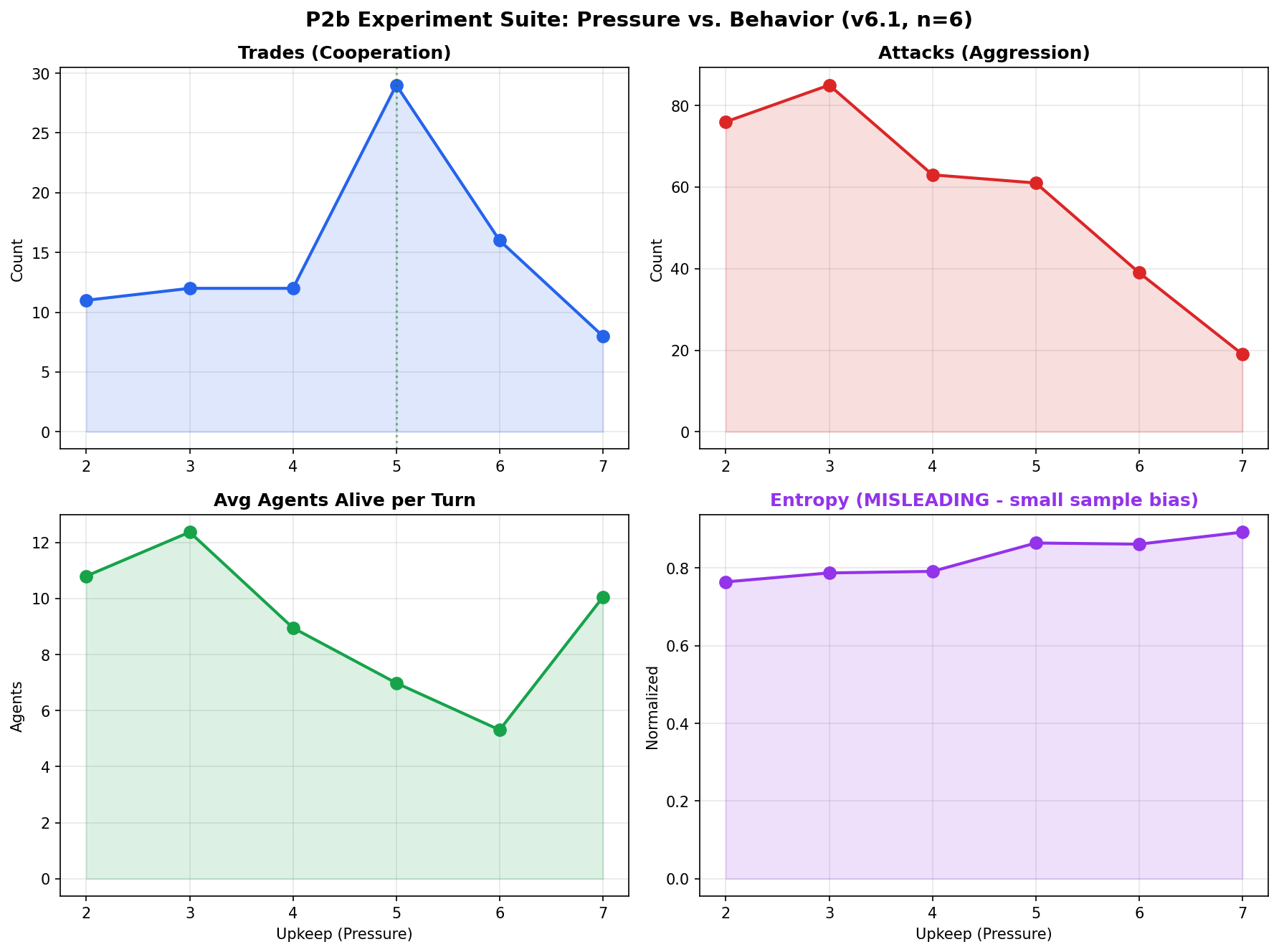
Multi-metric plots across pressure levels including Game Duration and Move %
Main Takeaways
- Trade cooperation follows a Yerkes-Dodson inverted-U curve: low pressure causes stagnation, medium pressure creates urgency for cooperation, high pressure causes collapse.
- Behavioral collapse under extreme pressure is characterized by reversion to 'movement-only' strategies (up to 68% of actions) and rapid extinction.
- Sexual selection (reproductive competition) effectively drives social complexity (communication, signaling) without the aggression and mortality associated with survival pressure.
- Whole-game Shannon entropy is a misleading metric for complexity in survival scenarios because high mortality rates artificially inflate entropy by removing repetitive gathering sequences.