📝 Paper Summary
Underwater Wireless Sensor Networks (UWSNs)
Internet of Underwater Things (IoUT)
Acoustic Communications
This comprehensive tutorial-survey systematically examines how machine learning revolutionizes underwater communications by replacing rigid protocols with adaptive systems that learn to handle severe attenuation, long delays, and dynamic environments.
Core Problem
Traditional underwater communication protocols fail because they rely on fixed rules that cannot adapt to the severe, time-varying physics of acoustic channels (200,000x slower propagation than RF) and extreme resource constraints.
Why it matters:
- Rigid protocols designed for stable terrestrial networks collapse under underwater conditions: seconds-long delays, rapid channel variation, and battery replacement costs exceeding $20,000 per day.
- Current analytical models cannot capture the complexity of ocean environments (3D temperature/salinity fields), leading to sub-optimal routing and massive energy waste.
- The 'Blue Economy' ($1.5 trillion annually) and climate monitoring depend on reliable data from environments where human maintenance is impossible.
Concrete Example:
A traditional MAC protocol with fixed backoff windows waits up to 13 seconds for worst-case propagation even for nearby nodes, wasting channel capacity. An ML approach learns actual topology, adapting backoff times to realize 200-300% throughput gains.
Key Novelty
Layer-by-Layer ML Integration for IoUT
- Replaces analytical channel models with neural networks that implicitly learn environmental physics (e.g., multipath patterns) from data, bypassing complex differential equations.
- Transforms the protocol stack from rigid rules to adaptive agents: physical layer deep learning for modulation, RL for MAC scheduling, and decision trees for interpretable routing.
Architecture
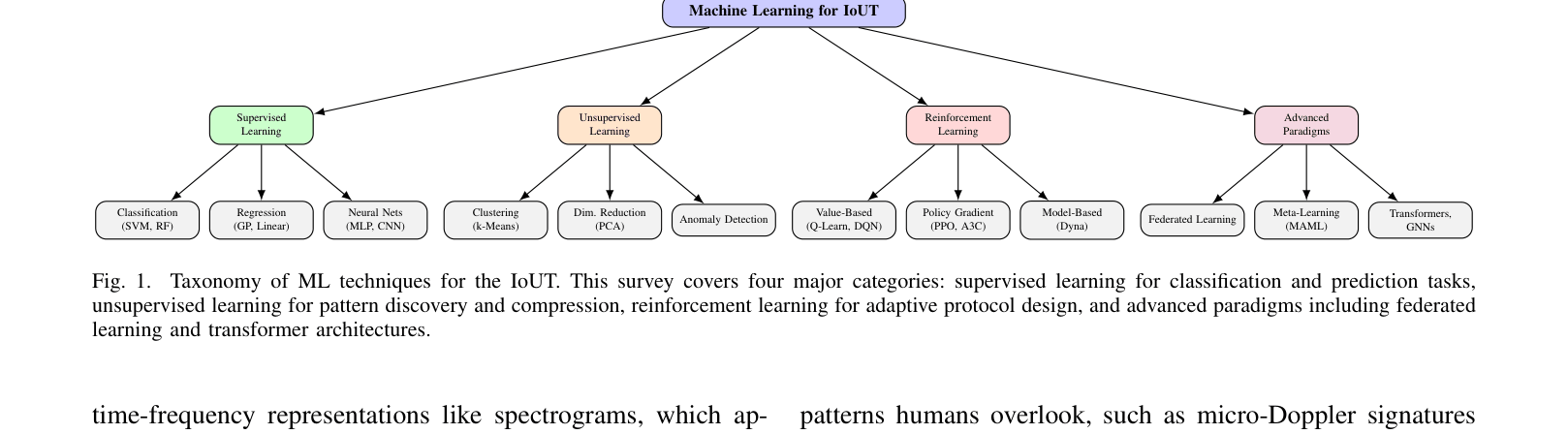
Taxonomy of ML techniques for the IoUT, categorizing algorithms into Supervised, Unsupervised, Reinforcement Learning, and Advanced Paradigms.
Evaluation Highlights
- Reinforcement learning-based MAC protocols achieve 200-300% throughput improvement over traditional ALOHA variants by learning optimal transmission schedules.
- Deep learning equalizers reduce bit error rates by factors of 100 to 10,000 compared to linear equalizers in shallow water channels.
- ML-based energy management extends network lifetime by 7-29 times in specific scenarios by learning optimal sleep/wake cycles.
Breakthrough Assessment
9/10
A definitive, foundational reference that bridges the gap between ML theory and underwater implementation. It synthesizes 300 papers and offers a forward-looking roadmap including Physics-Informed Neural Networks and Transformers.