📝 Paper Summary
AI Safety and Security
Agentic Middleware
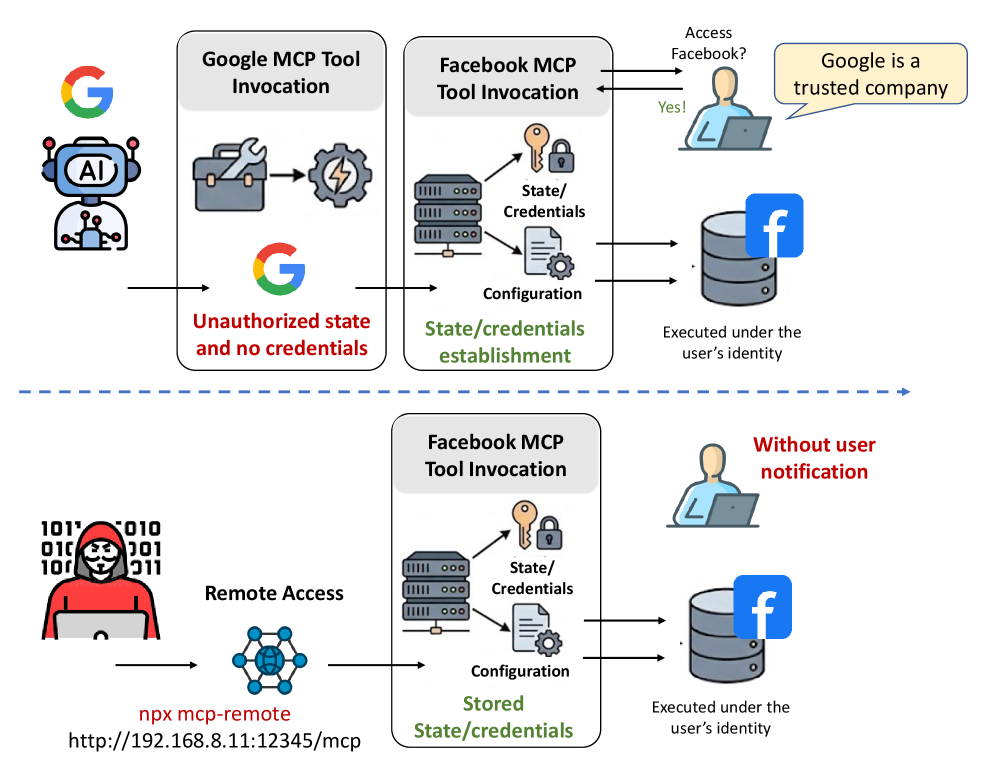
MCP servers frequently cache authorization state without binding it to the caller's identity, allowing malicious remote agents to hijack existing trusted sessions and execute unauthorized commands.
Core Problem
MCP servers decouple agent reasoning from system execution but often implement stateful authorization that fails to distinguish between different callers.
Why it matters:
- MCP is becoming a de facto standard ('USB-C of AI applications') for connecting LLMs to backend systems
- LLMs are stateless and cannot reliably preserve user identity, leading developers to rely on insecure persistent server-side authorization
- A single authorization mistake in middleware allows attackers to execute remote commands or access sensitive files without stealing credentials
Concrete Example:
A legitimate user authorizes an MCP server to access a Google Drive. Because the server caches this 'authorized' state globally, a separate malicious agent connecting to the same server can subsequently delete files on that Drive without ever authenticating.
Key Novelty
Caller Identity Confusion & MCPAuthChecker
- Identifies 'Caller Identity Confusion': a vulnerability where authorization is bound to the server process rather than the specific agent invoking the tool
- Develops a hybrid analysis framework that combines static path analysis (tracking auth checks) with dynamic validation (verifying execution success) to detect this flaw
Architecture
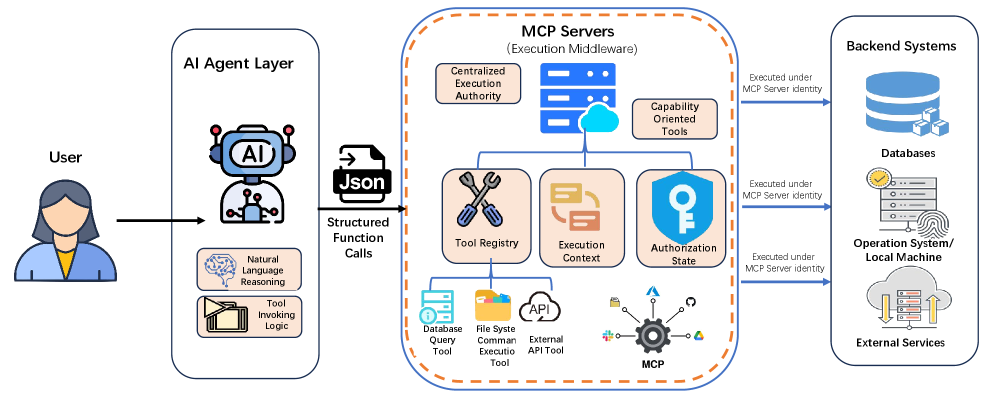
The architecture of the Model Context Protocol (MCP) ecosystem.
Evaluation Highlights
- 46.4% of 6,137 real-world MCP servers analyzed exhibit insecure authorization behavior (missing, cached, or reused)
- 8 out of 87 widely used open-source MCP projects (>1K stars) contained critical vulnerabilities allowing Remote Command Execution (RCE)
- 52% of developer-facing MCP servers are insecure, exposing dense execution interfaces to potential hijacking
Breakthrough Assessment
9/10
Exposes a pervasive, fundamental architectural flaw in a rapidly adopting industry standard (MCP). The scale of vulnerability (46%) and impact (RCE) in real-world systems is high.