📊 Experiments & Results
Evaluation Setup
Evaluation across 18 fMRI datasets covering diverse scenarios (age, disease, acquisition)
Benchmarks:
- Disorder Diagnosis (Classification (AD, PD, MDD, ADHD, ASD))
- Physiological Prediction (Regression (Age, BMI))
- Virtual Neural Modulation (Simulation/Recovery Rate Analysis) [New]
Metrics:
- Portrait Divergence (PDiv) / 1-PDiv (Consistency)
- Classification Accuracy
- R-squared (R2)
- Recovery Rate (Virtual Modulation)
- Cosine Similarity (Circuit Consistency)
- Statistical methodology: Not explicitly reported in the paper
Key Results
| Benchmark | Metric | Baseline | This Paper | Δ |
|---|---|---|---|---|
| Consistency analysis using Portrait Divergence (PDiv) shows the proposed method yields more stable subject-specific networks across various conditions. | ||||
| Consistency across Age Groups | 1 - PDiv (Consistency) | 0.60 | 0.75 | +0.15 |
| Consistency across Disorders | 1 - PDiv (Consistency) | 0.65 | 0.75 | +0.10 |
| Downstream task performance demonstrates the practical utility of personalized networks in diagnosis and prediction. | ||||
| Brain Disorder Diagnosis (Multiple) | Accuracy | 0.73 | 0.82 | +0.09 |
| Age Prediction | R2 | 0.72 | 0.90 | +0.18 |
| Motor Imagery Decoding | Accuracy | 0.75 | 0.80 | +0.05 |
| Virtual neural modulation experiments show the proposed method identifies more effective therapeutic targets. | ||||
| PD Dataset Recovery | Recovery Rate | Not reported in the paper | Not reported in the paper | +8% |
| MDD Normalization | Correlation to Healthy State | Not reported in the paper | Not reported in the paper | +0.29 |
| Abnormal circuit identification is more robust across datasets with different scanning parameters. | ||||
| ADNI2 (AD Dataset) | Cosine Similarity | Not reported in the paper | Not reported in the paper | +0.04 |
| BrainLat (AD Dataset) | Cosine Similarity | Not reported in the paper | Not reported in the paper | +0.16 |
Experiment Figures
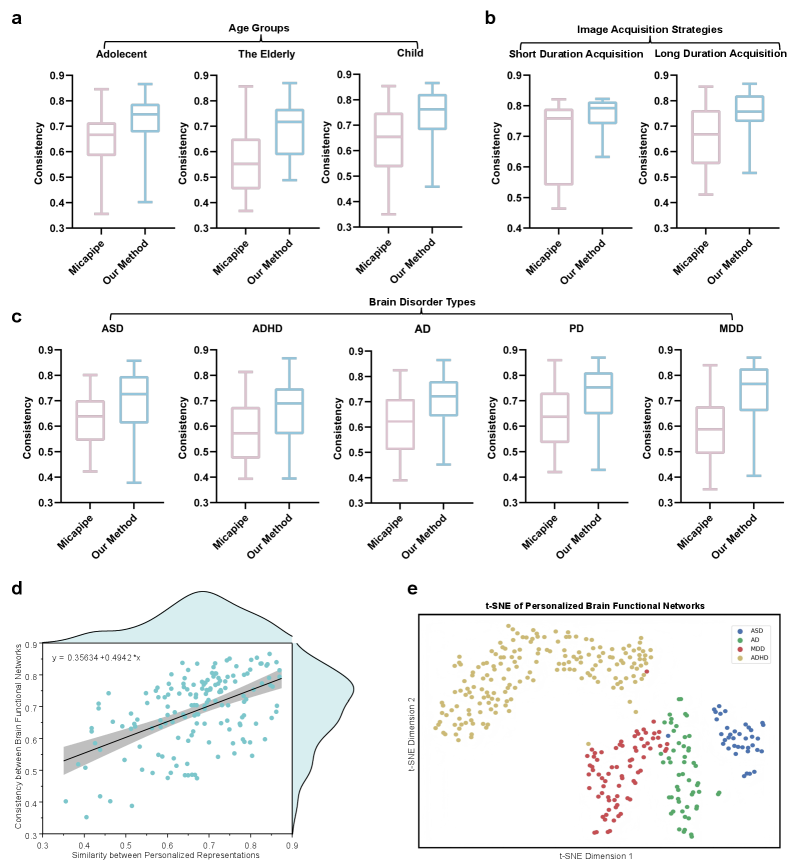
Comparison of network consistency (1-PDiv) between Personalized and Baseline networks across ages, acquisition strategies, and disorders.
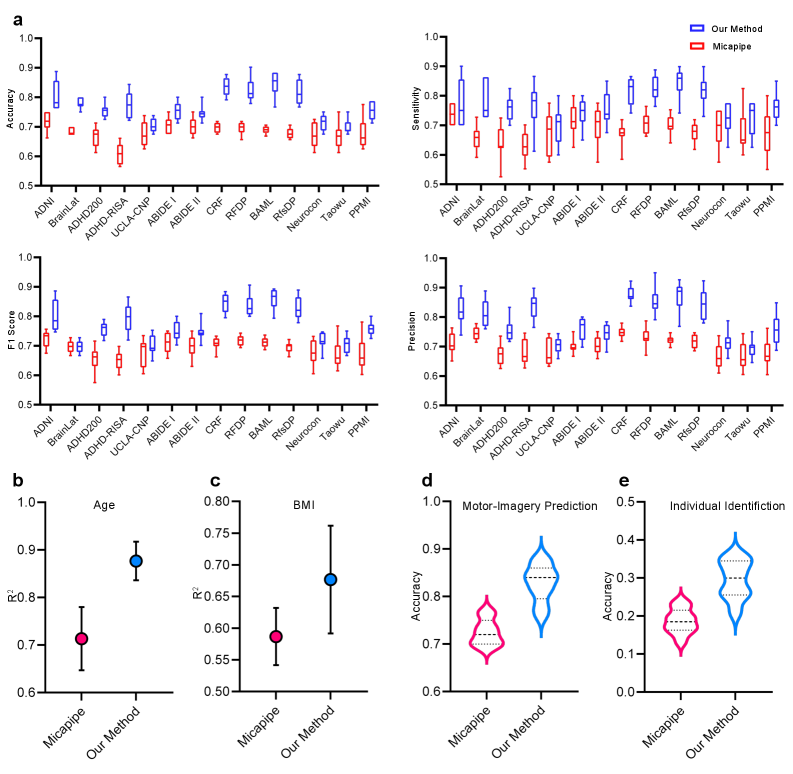
Performance comparison on diagnosis (classification accuracy) and physiological prediction (R2).
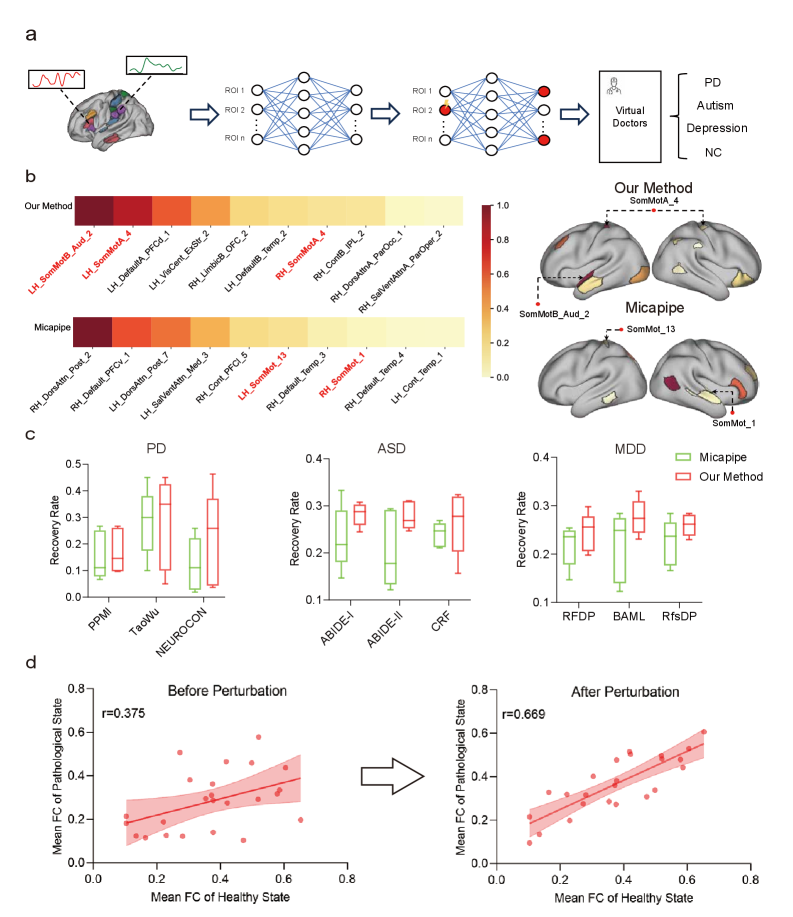
Virtual neural modulation results: target identification and recovery rates.
Main Takeaways
- Personalized brain functional networks achieve higher consistency (lower PDiv) across heterogeneous scenarios (age, disease, scanning protocols) than fixed-atlas methods.
- The framework significantly outperforms baselines in brain disorder diagnosis (AD, PD, etc.) and physiological prediction (Age, BMI), suggesting better feature extraction.
- Virtual modulation targets identified by this method (e.g., Somatomotor Network for PD) align better with empirical clinical evidence (TMS/DBS studies) than baselines.
- Identified abnormal neural circuits are robust and consistent across datasets with varying acquisition strategies (resolution, TR), addressing a major reproducibility challenge in neuroimaging.