📝 Paper Summary
Continual Learning
Edge AI / On-device Learning
Gated Adaptation enables stable continual learning on edge devices by modulating frozen pretrained features with lightweight channel-wise gates, restricting updates to diagonal scaling to prevent forgetting.
Core Problem
Human Activity Recognition models on edge devices must adapt to new users (plasticity) without forgetting previous ones (stability), but standard fine-tuning causes catastrophic forgetting.
Why it matters:
- Privacy concerns prevent transmitting raw sensor data to the cloud for centralized retraining
- Subject-specific variations in movement patterns cause significant domain shifts that degrade model performance when transferring across users
- Edge devices have strict memory and compute constraints, making high-capacity replay or architectural expansion methods impractical
Concrete Example:
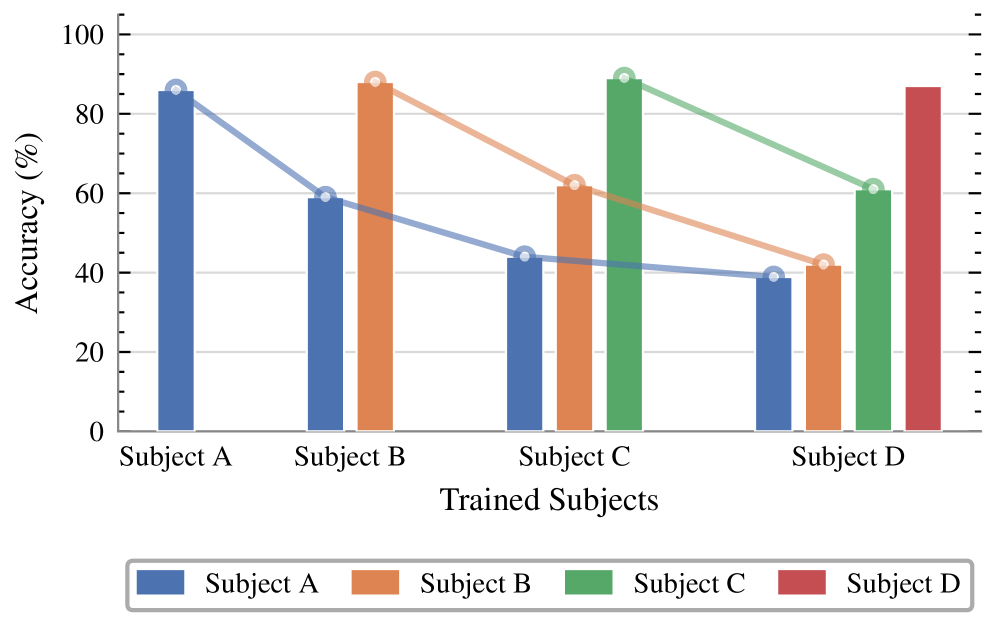
On the PAMAP2 dataset, a standard multilayer perceptron trained sequentially on subjects suffers a 45% accuracy drop (85% to 40%) on the first subject after training on just four subsequent subjects.
Key Novelty
Channel-wise Gated Modulation on Frozen Backbones
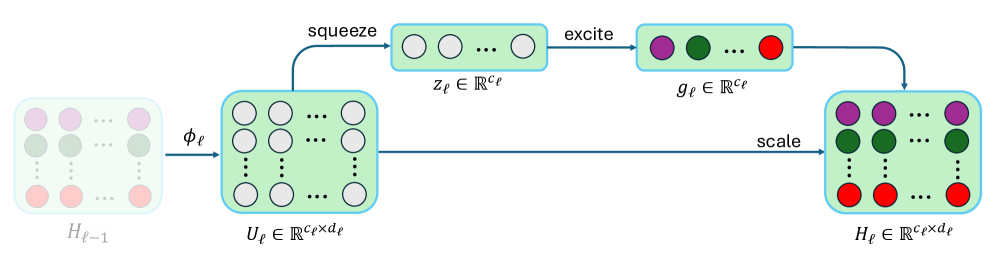
- Instead of tuning the whole model or adding dense adapter layers, the method inserts lightweight gates after frozen backbone blocks
- These gates learn to scale feature channels up or down (diagonal operator) based on the input, adapting the importance of existing features without changing their geometric direction
- By freezing the backbone and restricting updates to scaling factors, the method theoretically bounds how much the representation can drift, enforcing stability
Architecture
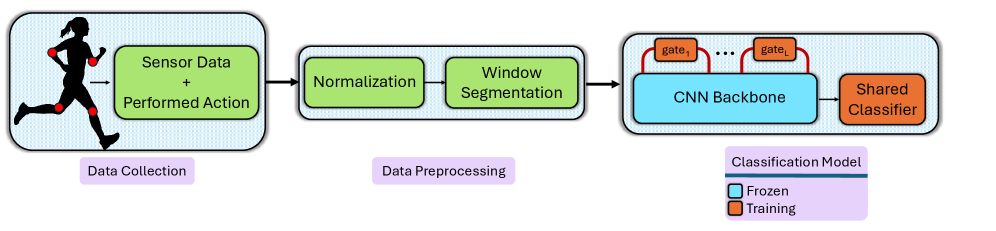
The complete system pipeline from sensor data collection to the gated continual learning model.
Evaluation Highlights
- Reduces catastrophic forgetting from 39.7% to 16.2% on PAMAP2 dataset (8 sequential subjects) compared to a trainable backbone
- Improves final average accuracy from 56.7% to 77.7% on PAMAP2 compared to a trainable backbone
- Requires training less than 2% of total model parameters, making it efficient for resource-constrained IoT devices
Breakthrough Assessment
7/10
Strong practical application of PEFT to the specific constraints of HAR (privacy, edge compute). Theoretical framing of gating as a diagonal operator provides good justification for stability gains.