This paper analyzes inference-time LLM steering through particle filtering theory, establishing bounds for Sequential Monte Carlo and proving fundamental limits on the number of particles required for myopic methods.
Core Problem
Inference-time interventions like aggregation and pruning are currently ad hoc, lacking a principled theoretical framework to explain their accuracy-cost tradeoffs or guide algorithm design.
Why it matters:
Current methods like Best-of-N or Tree Search are empirically effective but theoretically opaque, preventing systematic improvement
We lack understanding of how properties of the Process Reward Model (PRM), such as action-level coverage or accuracy, quantitatively impact final generation quality
Standard particle filtering methods can fail even with perfect reward models if not carefully tuned, wasting computational resources
Concrete Example:Even if a Process Reward Model (PRM) is perfectly accurate, standard Sequential Monte Carlo (SMC) theoretically requires roughly square-root-of-horizon particles to succeed due to interference between particles during resampling. A simple single-particle greedy method would succeed here, highlighting a pathology in standard parallel approaches.
Key Novelty
Particle Filtering Framework for LLM Inference
Models guided generation as a sampling problem from a target distribution defined by the base model and a process reward function
Applies Sequential Monte Carlo (SMC) theory to derive error bounds based on 'action-level coverage' (how well the base model covers high-reward tokens) and PRM accuracy
Introduces SMC with Rejection Sampling (SMC-RS) to fix theoretical pathologies where standard SMC fails despite having good reward models
Architecture
Pseudocode for the Sequential Monte Carlo (SMC) algorithm adapted for language models
Evaluation Highlights
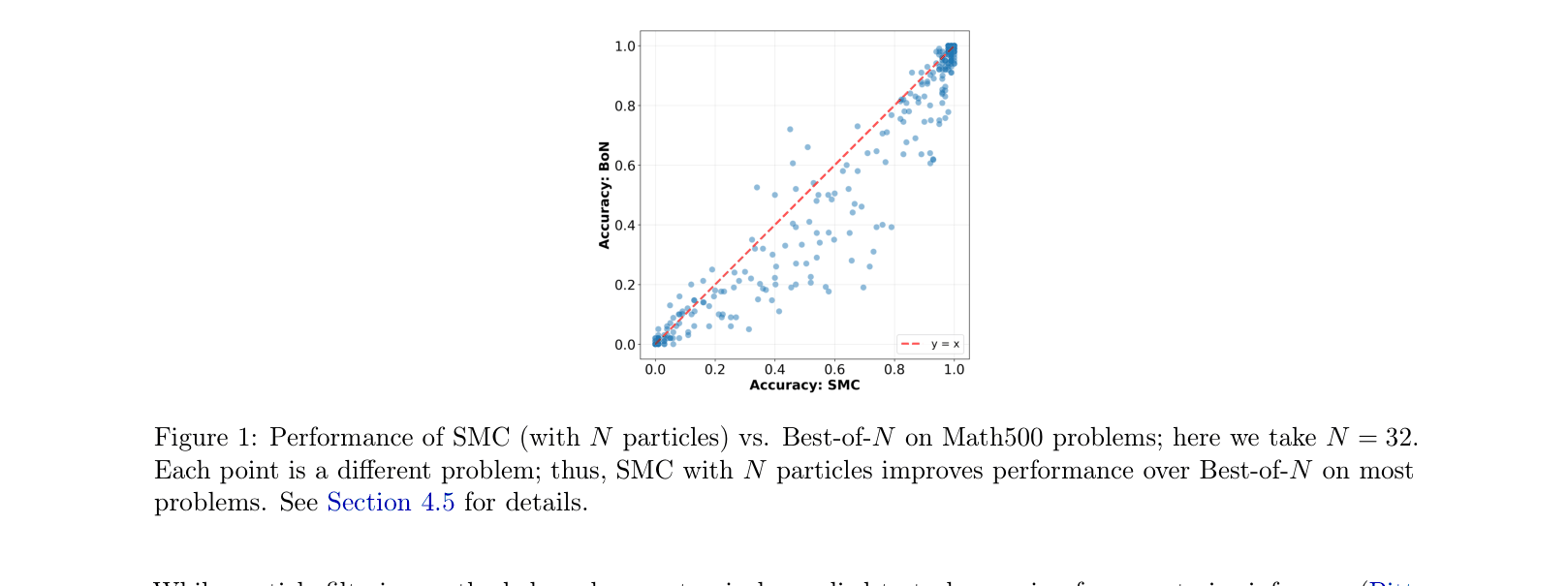
SMC with N=32 particles consistently improves accuracy over Best-of-N (with N=32) across the vast majority of problems in the Math500 benchmark
Theoretical proof establishes that any myopic particle filtering method requires at least logarithmic particles (in horizon H) to maintain non-trivial coverage, defining a fundamental efficiency limit
Empirical experiments on a prompt-switching task validate that sampling error correlates strongly with theoretical predictors like action-level coverage and KL-divergence of the PRM
Breakthrough Assessment
7/10
Provides a rigorous theoretical foundation for widely used heuristic methods. While the algorithmic improvements (SMC-RS) are theoretical, the formalization of 'myopic limits' is a significant contribution to understanding inference scaling.
⚙️ Technical Details
Problem Definition
Setting: Sampling from a tilted distribution π*_H(a_1:H) ∝ π_ref(a_1:H)r*(a_1:H) given a base model π_ref and a process reward model V_hat
Inputs: Prompt/prefix a_1:h, Base Model π_ref, Process Reward Model V_hat
Outputs: Sampled sequence a_1:H (typically a solution to a reasoning problem)
Pipeline Flow
Initialization: Start with N particles (empty sequences)
Proposal: Extend each particle by sampling tokens from base model π_ref
Weighting: Score extensions using the PRM V_hat to calculate importance weights
Resampling: Select particles to keep based on weights (Reject/Resample)
Repeat: Continue until horizon H is reached
System Modules
Base Model (π_ref)
Propose next tokens for the particles
Model or implementation: Qwen2.5-1B-Instruct (Math exp) or Qwen3-0.6B (Prompt exp)
Process Reward Model (V_hat)
Estimate the value (expected future reward) of partial generations
Model or implementation: Qwen2.5-Math-PRM-7B (Math exp)
Resampler
Prune low-weight particles and replicate high-weight particles
Model or implementation: Algorithm 1 (SMC) or Algorithm 2 (SMC-RS)
Novel Architectural Elements
SMC-RS: Incorporates a rejection sampling step inside the particle transition to decouple particles, allowing for o(1) error with O(1) particles when the PRM is near-perfect (fixing a flaw in standard SMC)
Modeling
Base Model: Qwen2.5-1B-Instruct (Math experiments), Qwen3-0.6B (Prompt-switching experiments)
Training Method: Inference-time algorithm (no training involved)
Compute: SMC runtime is O(N*H) where N is number of particles and H is horizon
Comparison to Prior Work
vs. Best-of-N: SMC interacts with the PRM at every step (sequential) rather than just at the end, allowing early pruning of bad paths
vs. VGB: SMC is a parallel algorithm (O(H) parallel time) while VGB is inherently sequential (O(H^2) time); SMC analysis strengthens VGB guarantees [not cited in paper - VGB is cited, but comparison is internal]
vs. Standard SMC: Proposed SMC-RS handles the 'perfect PRM' case more efficiently, requiring fewer particles for low-error regimes
Limitations
Theoretical bounds depend on Chi-square divergence, which can be sensitive to tail behavior (though relaxed to coverage in Theorem 3.5)
Superlinear work (poly(H) particles) is proven necessary for myopic methods, implying a fundamental efficiency barrier
Empirical disconnect: On math tasks, higher PRM error (divergence) sometimes correlated with *higher* accuracy, suggesting the theoretical framework doesn't fully capture 'correctness' vs 'distributional fit'
Reproducibility
Code availability is not provided in the paper. The paper relies on public models (Qwen series) and standard datasets (Math500, AIME). The experiments involve custom implementations of SMC algorithms described in Algorithms 1 and 2.
📊 Experiments & Results
Evaluation Setup
Evaluation of sampling algorithms on constrained generation tasks
Statistical methodology: Not explicitly reported in the paper
Key Results
Benchmark
Metric
Baseline
This Paper
Δ
Math500
Accuracy vs Best-of-N
See Note
See Note
Positive
Prompt-Switching
Sampling Error (LPDP)
Not applicable
Strong Correlation
Not applicable
Theoretical Analysis
Minimum Particles
1
Ω(log H / log log H)
N/A
Experiment Figures
Scatter plot comparing SMC (y-axis) vs Best-of-N (x-axis) accuracy on Math500 problems
Main Takeaways
SMC improves upon Best-of-N in a non-average sense: it wins on the majority of individual problems in Math500, not just in aggregate metrics
Theoretical predictors (action-level coverage, PRM divergence) accurately predict SMC sampling error in controlled settings (Prompt-Switching), validating the derived bounds
A paradox exists in real-world Math tasks: models with higher theoretical error (Chi-square divergence) sometimes yield higher accuracy, suggesting that optimizing for distributional match is distinct from optimizing for correctness
Myopic methods face a fundamental wall: they cannot be fully efficient (O(1) particles) without lookahead, requiring at least logarithmic particle counts to handle error propagation
📚 Prerequisite Knowledge
Prerequisites
Sequential Monte Carlo (SMC) / Particle Filtering
Process Reward Models (PRMs)
Markov Chains
Kullback-Leibler (KL) and Chi-square divergences
Key Terms
SMC: Sequential Monte Carlo—a class of algorithms used to estimate states of a system by maintaining a set of 'particles' (samples) that are resampled based on weights
PRM: Process Reward Model—a model that estimates the expected future reward (or correctness) of a partial text generation
Myopic method: An algorithm that determines the set of particles at step h using only information available up to step h, without looking ahead to future steps
Action-level coverage: A measure of how well the base language model's proposal distribution covers the tokens preferred by the optimal target distribution
Particle: A single hypothesis or partial generation sequence maintained by the inference algorithm
Best-of-N: A baseline strategy where N independent solutions are generated and the one with the highest reward score is selected
SMC-RS: Sequential Monte Carlo with Rejection Sampling—a novel variant proposed in this paper that uses rejection sampling within the transition step to avoid inter-particle interference