📝 Paper Summary
AI for Science (AI4Science)
Multi-agent reasoning frameworks
Scientific workflow automation
Dr. Sai is a multi-agent system that uses a domain-specific language to interpret high-level scientific intent and orchestrate complex particle physics analysis workflows under human supervision.
Core Problem
Modern scientific instruments (e.g., particle colliders) generate data of such scale and complexity that traditional, manual analysis pipelines cannot keep pace, creating a 'complexity ceiling'.
Why it matters:
- The imbalance between data generation (Exabytes) and human analysis capacity threatens to stall discovery in fields like particle physics and genomics
- Current workflows rely on brittle, labor-intensive scripts managed by scarce experts, making scaling analysis linearly with data volume economically and operationally impossible
- Without automation that preserves traceability, the next generation of experiments (like CEPC) risks producing insights too slowly or incompletely
Concrete Example:
In current collider physics, a researcher must manually configure and chain multiple independent tools (simulation, reconstruction, inference). If a parameter changes, the human must manually re-code and re-validate the entire pipeline, a bottleneck that fails when datasets span billions of events and multimodal signals.
Key Novelty
Human-Supervised Multi-Agent Scientific Reasoning (Dr. Sai)
- Replaces manual tool chaining with intelligent agents that interpret high-level goals (via a Domain-Specific Language) and autonomously plan/execute analysis workflows
- Scales 'cognitively' rather than computationally: agents handle technical orchestration (model selection, uncertainty estimation) while humans focus on strategy and logic
- Enforces accountability through a DSL contract (SaiScript) that logs every agent decision, ensuring the resulting science is traceable and reproducible
Architecture
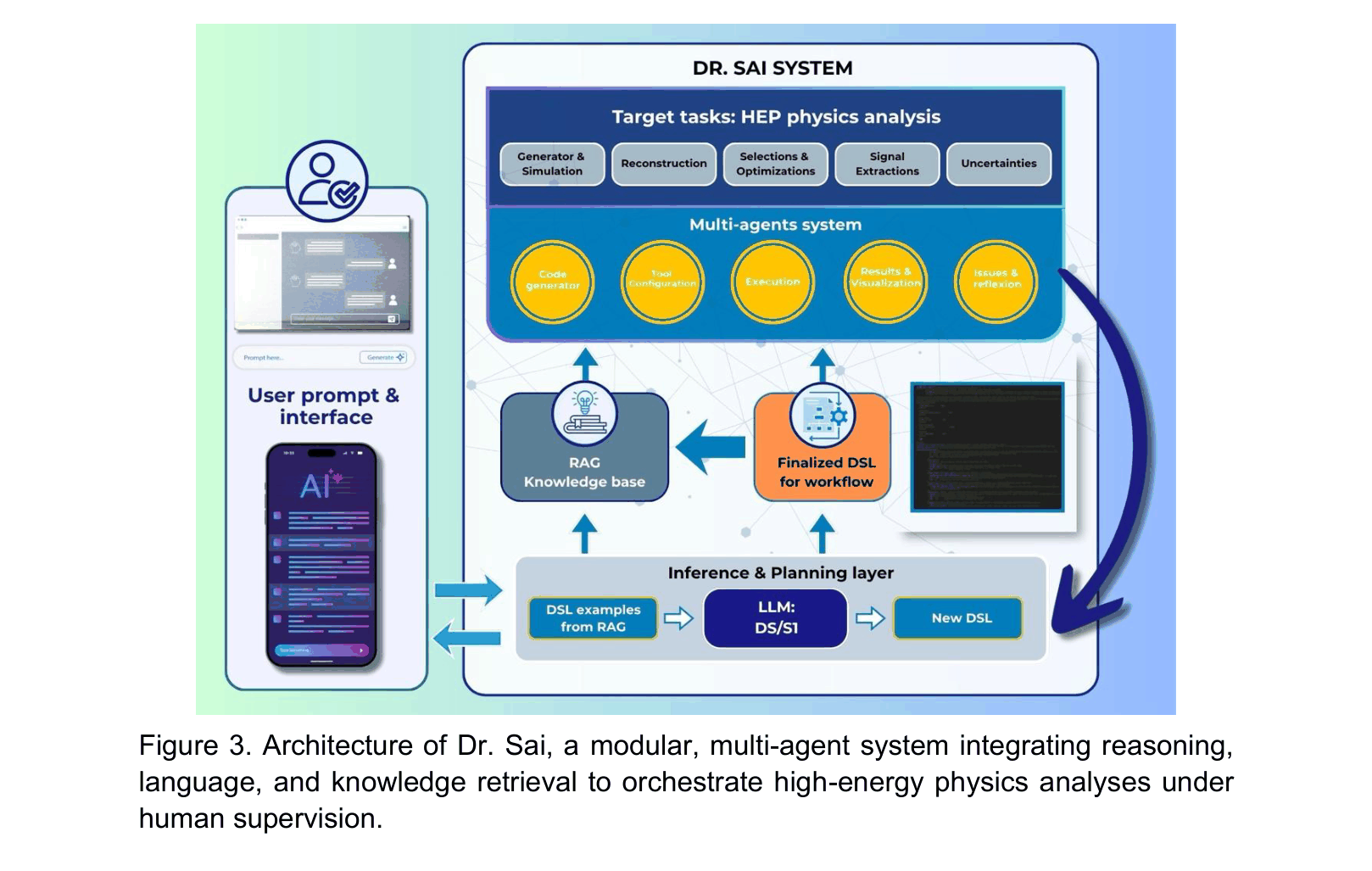
The architecture of Dr. Sai, illustrating the interaction between human input, the multi-agent system, and the underlying physics tools
Evaluation Highlights
- System deployed as a proof-of-principle at the Institute of High Energy Physics (IHEP) for the CEPC collider project
- Demonstrates successful orchestration of simulation, reconstruction, and statistical inference workflows from high-level human prompts
- Establishes a transferable blueprint for agentic science, moving from manual data analysis to 'reasoning orchestration' in large-scale experiments
Breakthrough Assessment
7/10
Strong visionary framework for the next era of scientific method, enabling scaling of reasoning. While the architectural proposal is robust and grounded in a major physics institute, quantitative performance metrics vs. human baselines are not yet detailed in this position paper.