📝 Paper Summary
Self-evolving Agentic reasoning
Automated Algorithm Design
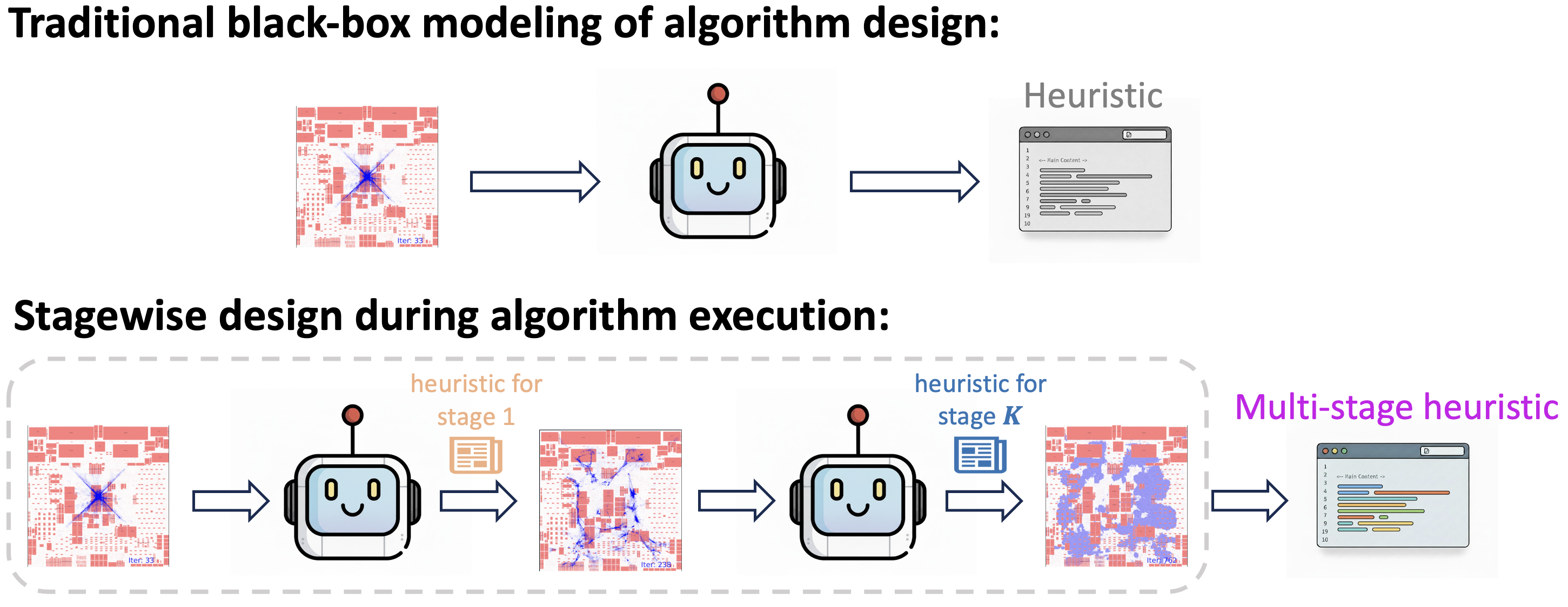
EvoStage automates algorithm design by decomposing the process into evolutionary stages where multi-agent LLMs utilize intermediate execution feedback to iteratively refine designs, rather than relying solely on black-box final rewards.
Core Problem
Current LLM-based algorithm design methods treat the target problem as a black box, providing feedback only after full execution. This lack of intermediate guidance leads to hallucinations and requires excessive evaluations, which is infeasible for industrial problems with limited budgets.
Why it matters:
- Industrial scenarios like chip placement have expensive evaluation costs (hours per run), making data-hungry black-box optimization impractical
- Real-world problems lack high-quality training samples and vary significantly between instances, causing LLMs to hallucinate ineffective designs without grounded feedback
- Traditional expert-driven design is tedious and creates a bottleneck in productivity for complex pipelines like VLSI physical design
Concrete Example:
In chip placement, simply asking an LLM to generate a full optimizer configuration often fails because the LLM cannot see that an aggressive learning rate early on causes cell overflow. EvoStage receives intermediate overflow metrics after each stage, allowing it to dynamically adjust the schedule.
Key Novelty
Evolutionary Stagewise Algorithm Design (EvoStage)
- Decomposes algorithm design into sequential stages where agents receive real-time intermediate feedback (e.g., current wirelength) to ground their reasoning, unlike black-box approaches
- Global-Local Perspective mechanism: Balances 'local' stage-by-stage generation (for precision) with 'global' one-shot generation (for exploration), analogous to fast/slow thinking, to avoid local optima
Architecture

Overview of EvoStage showing the interaction between the Evolutionary Framework and the Stagewise Design process.
Evaluation Highlights
- +9.24% improvement in half-perimeter wirelength (HPWL) on a commercial-grade industrial 3D chip placement tool compared to original expert settings
- +52.21% improvement in optimization iterations (efficiency) on a real-world industrial 3D chip design
- Outperforms state-of-the-art human-tuned placers (DREAMPlace, Xplace) on open-source benchmarks within only 25 evaluations
Breakthrough Assessment
9/10
EvoStage successfully bridges the gap between LLM-based algorithm design and strict industrial requirements (limited budget, high complexity), demonstrating massive gains in a real-world commercial chip design setting.