📝 Paper Summary
Web agents
Multi-agent systems
UIS-Digger addresses the inability of current agents to access unindexed web content by employing a multi-agent framework with dual-mode browsing and fine-tuning on a mix of real and simulated interaction data.
Core Problem
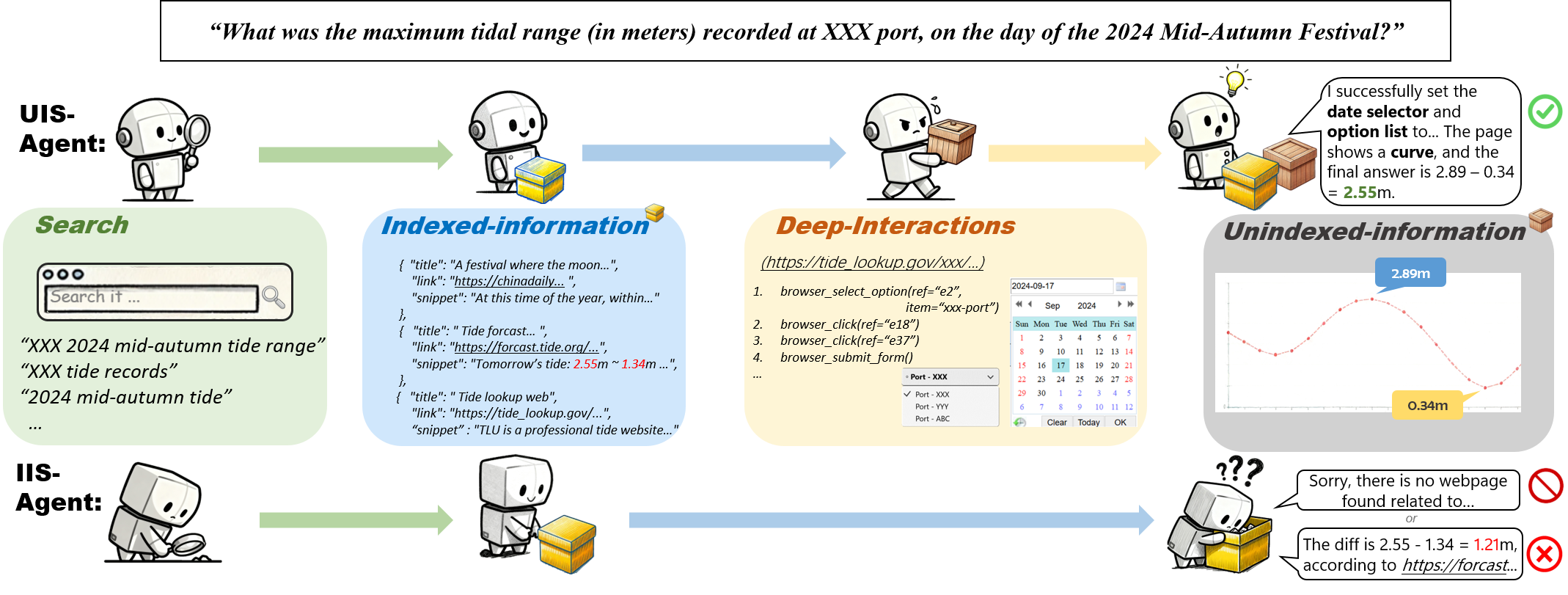
Current information-seeking agents rely heavily on search engine indices (Indexed Information Seeking), failing to retrieve vital information hidden in unindexed pages, files, or dynamic web elements.
Why it matters:
- Search engines cannot index deep web content, dynamic forms, or obscure files, leaving a critical blind spot for AI agents
- Existing benchmarks (GAIA, BrowseComp) do not distinguish between indexed and unindexed tasks, masking the severity of agent failure in real-world exploration
- Sole reliance on search APIs limits agents to surface-level information, preventing them from solving complex tasks like verifying flight prices or parsing specific corporate reports
Concrete Example:
For a UIS question requiring specific historical data, a standard agent uses Google Search and fails because the answer is inside a downloadable Excel file or behind a date-picker widget, whereas UIS-Digger navigates the site, interacts with the widget, and parses the file.
Key Novelty
UIS-Digger Multi-Agent Framework
- Formalizes 'Unindexed Information Seeking' (UIS) as a distinct problem where answers exist on the web but are not retrievable via search engine snippets
- Introduces a dual-mode web surfer that shares memory between textual (HTML) and visual (screenshot) modes to handle both efficient reading and complex visual interactions
- Utilizes a training pipeline mixing real-world deep web exploration and 'virtual websites' (simulated environments like booking systems) to bootstrap interactive capabilities
Architecture
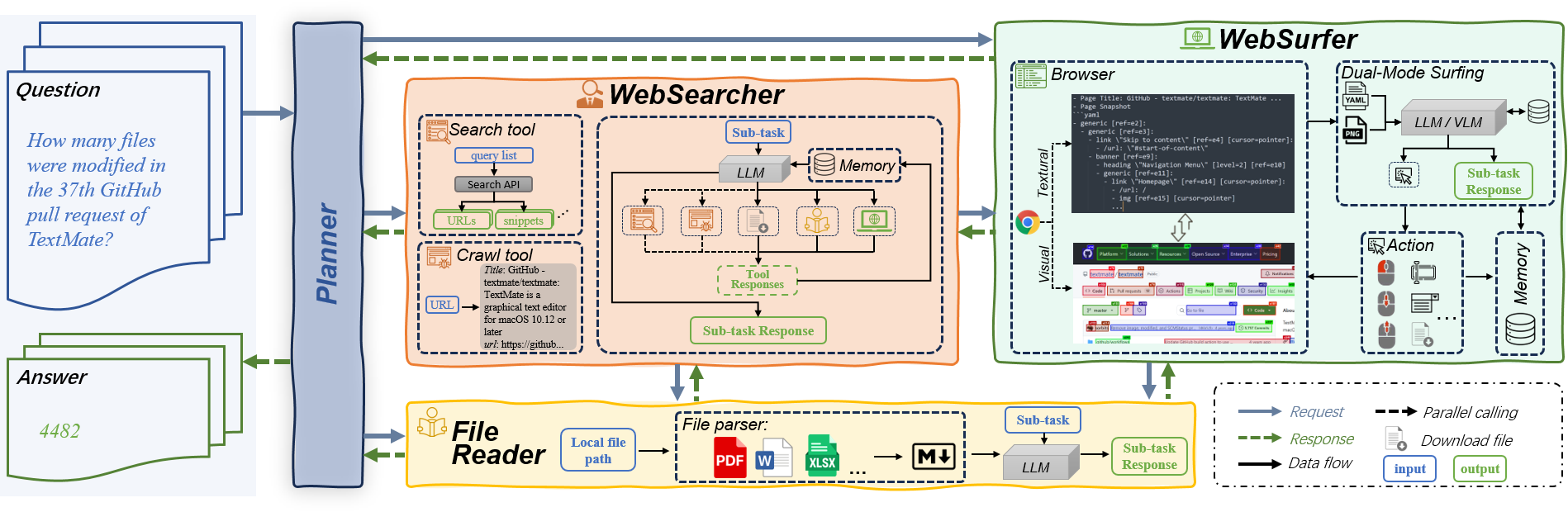
The UIS-Digger architecture, detailing the multi-agent collaboration between Planner, Searcher, Surfer, and Reader
Evaluation Highlights
- Achieves state-of-the-art performance of 27.27% on the newly introduced UIS-QA benchmark, surpassing baselines integrated with GPT-4.1 and O3
- Demonstrates that even top agents suffer massive performance drops on UIS tasks (e.g., from 70.90% on GAIA to ~25% on UIS-QA), highlighting the benchmark's difficulty
- Outperforms the strongest baseline by +1.82 percentage points using a significantly smaller ~30B parameter backbone model compared to proprietary giants
Breakthrough Assessment
8/10
Identifies a critical, under-explored gap in agentic web search (UIS) and provides both a rigorous benchmark and a novel architectural solution that beats larger models.