📝 Paper Summary
Self-evolving Agentic reasoning
Multi-agent scientific discovery
EvoScientist employs three specialized agents and persistent memory modules to evolve scientific idea generation and code execution strategies by learning from accumulated successes and failures.
Core Problem
Existing AI scientists rely on static pipelines that do not learn from interaction histories, leading them to repeatedly explore known failure patterns, overlook promising directions, and pursue infeasible ideas.
Why it matters:
- Current systems waste substantial resources repeating previously failed experiments
- Static decision strategies fail to adapt to the complexity of end-to-end scientific discovery, limiting idea quality and novelty
- The vast search space of scientific concepts limits human exploration speed, and AI agents without memory cannot effectively accelerate this process
Concrete Example:
A static AI scientist might repeatedly propose a specific model architecture modification that has failed in previous runs because it treats every task as a fresh execution without recalling the prior failure analysis.
Key Novelty
Multi-Agent Evolution via Persistent Memory
- Decomposes discovery into Researcher, Engineer, and Evolution Manager agents (RA, EA, EMA) to handle ideation, execution, and learning separately
- Utilizes two distinct persistent memories: Ideation Memory (M_I) for feasible/failed research directions and Experimentation Memory (M_E) for reusable code/training strategies
- Implements continuous self-evolution where the EMA distills insights from every run to update memories, which RA and EA retrieve to improve future performance
Architecture
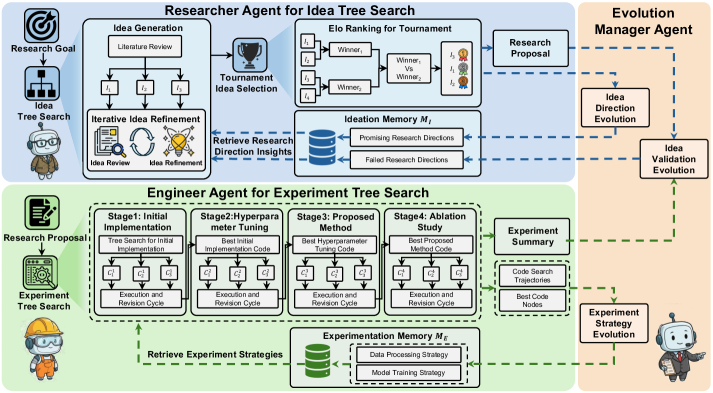
The overall framework of EvoScientist showing the three agents (RA, EA, EMA) and their interaction with the two persistent memory modules (Ideation Memory, Experimentation Memory).
Evaluation Highlights
- 100% acceptance rate (6 out of 6) for full papers generated by EvoScientist at ICAIS 2025 (AI Scientist Track)
- Received Best Paper Award and AI Reviewer’s Appraisal Award for generated papers at ICAIS 2025
- Outperforms 7 open-source and commercial state-of-the-art systems in idea generation quality (novelty, feasibility, relevance, clarity)
Breakthrough Assessment
9/10
Demonstrates a closed-loop evolutionary system where agents actually improve over time via memory, achieving validated success (accepted papers/awards) in a realistic scientific discovery setting.