📝 Paper Summary
Industrial AI
Agentic AI
Decision support systems
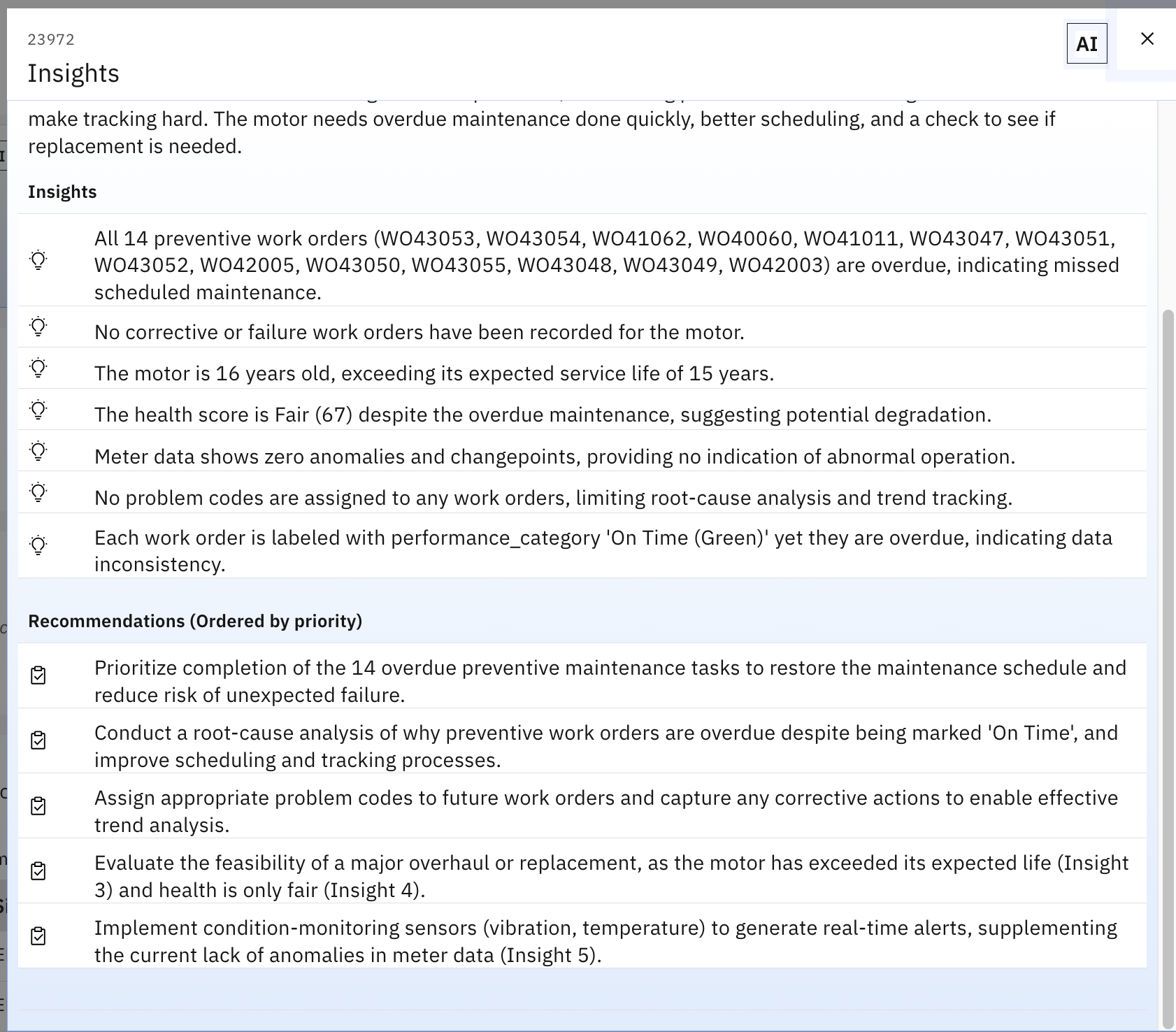
Condition Insight separates deterministic evidence construction from constrained LLM synthesis to produce auditable industrial maintenance explanations that adhere to rigorous engineering failure semantics.
Core Problem
Industrial maintenance data is fragmented across unstructured work orders, heterogeneous sensors, and engineering knowledge, making it difficult for standard LLMs to reason without hallucinating or violating physical constraints.
Why it matters:
- Practitioners currently spend 20–30 minutes manually reconciling data across disjoint CMMS, SCADA, and IoT platforms for a single asset
- Unconstrained generative agents in reliability-critical settings pose safety risks by producing fluent but unsupported recommendations
- Existing predictive maintenance systems produce alerts but lack the conditional reasoning to explain *why* an action is warranted based on history
Concrete Example:
Operational indicators often have inconsistent naming across IoT platforms. A naive agent might misinterpret a 'runtime' counter as a 'fault' count. This system abstracts raw meters into behavioral summaries (e.g., 'drift') and aligns them with failure modes via Optimal Transport before the LLM reasons, preventing misinterpretation.
Key Novelty
Trajectory-Controlled Evidence-Driven Reasoning
- Decouples reasoning into two distinct stages: deterministic evidence construction (math/rules) and constrained LLM synthesis (narrative)
- Uses Unbalanced Optimal Transport to mathematically align unstructured work orders with structured Failure Modes (FMEA) before the LLM sees the data
- Implements a post-generation deterministic verification loop that cross-checks LLM conclusions against hard operational rules
Architecture
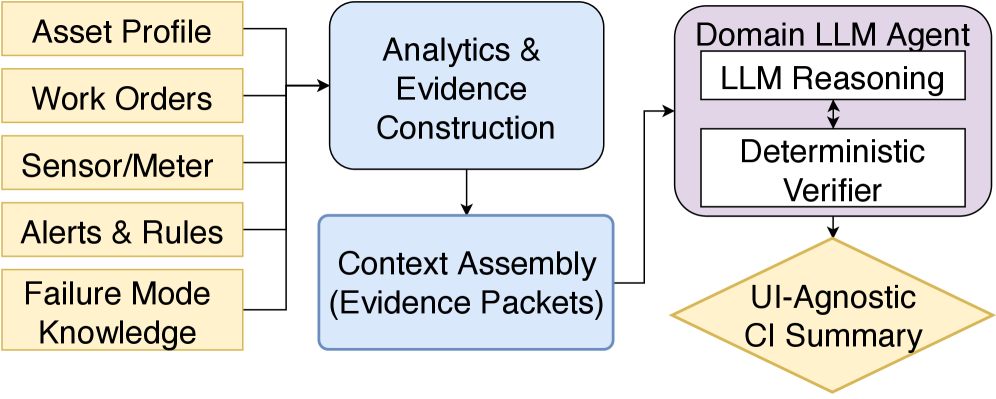
The Condition Insight reasoning pipeline illustrating the separation of deterministic processing and LLM reasoning
Evaluation Highlights
- Condition Agreement Rate (CAR) with operational rules improved from 0.70 to 0.91 by switching from naive to constrained prompting
- Analysis time per asset reduced from 20–30 minutes (manual) to 15–30 seconds (automated)
- Unsupported Claim Rate (UCR) maintained at extremely low levels (0.003–0.008) while increasing rule compliance
Breakthrough Assessment
8/10
Strong practical contribution demonstrating how to operationalize LLMs in high-stakes industrial environments by strictly bounding generative capabilities with deterministic engineering physics and rules.