📝 Paper Summary
Privacy-preserving AI
Distributed Agent Architecture
Enterprise AI
SplitAgent enables secure enterprise-cloud collaboration by separating sensitive data handling from reasoning, using a local agent for context-aware sanitization and a cloud agent for logic.
Core Problem
Enterprise adoption of cloud AI agents faces a binary choice: share sensitive data with the cloud (risking privacy) or keep processing local (sacrificing capability).
Why it matters:
- Current frameworks like MCP (Model Context Protocol) and A2A (Agent-to-Agent) assume complete trust and plaintext data sharing, which violates enterprise security requirements
- Different tasks require different privacy strategies (e.g., hiding names in contracts vs. hiding credentials in code), which static masking tools fail to address
- Enterprises cannot leverage powerful cloud-hosted LLMs (Large Language Models) for confidential documents without risking data leakage or compliance violations
Concrete Example:
In a contract review, a standard cloud agent requires the full text including party names and amounts. A static masker might redact all numbers, making the contract unreadable. SplitAgent abstracts '$150,000' to 'AMOUNT_LARGE', preserving the reasoning capability ('is the amount within limits?') while hiding the value.
Key Novelty
Two-Tier Split Architecture with Context-Aware Dynamic Sanitization
- Separates the system into an Enterprise Privacy Agent (holds raw data, performs sanitization/execution) and a Cloud Reasoning Agent (performs logic on abstractions)
- Introduces dynamic sanitization that adapts based on task semantics rather than static rules (e.g., preserving syntax for code review but legal structure for contracts)
Architecture
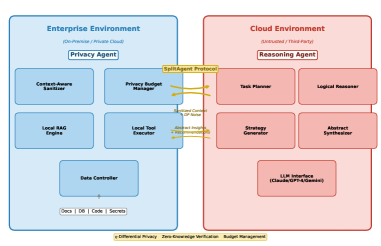
The SplitAgent architecture illustrating the separation between the Enterprise Environment (Privacy Agent) and Cloud Environment (Reasoning Agent).
Evaluation Highlights
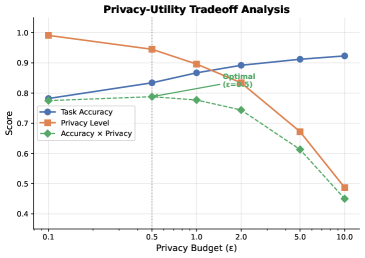
- 83.8% task accuracy vs. 73.2% for static sanitization approaches across six enterprise scenarios
- 90.1% privacy protection rate vs. 79.7% for static methods, minimizing information leakage
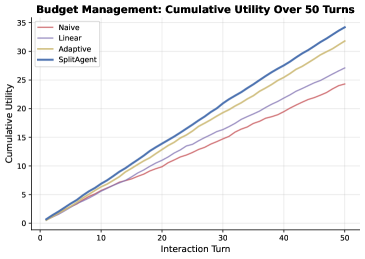
- 24.1% improvement in task utility compared to static regex-based masking methods
Breakthrough Assessment
8/10
Addresses a critical barrier to enterprise AI adoption (privacy vs. utility) with a practical, architecturally distinct solution that significantly outperforms static baselines.