📊 Experiments & Results
Evaluation Setup
Classification robustness evaluation on Out-of-Distribution (OOD) benchmarks after minimal fine-tuning.
Benchmarks:
- ImageNet-A (Natural Adversarial Examples)
- ObjectNet (Viewpoint/Background Variation)
- SI-Score (Synthetic Invariance (Scale/Rotation))
- ImageNet-R (Art/Renditions)
Metrics:
- Top-1 Accuracy
- Top-5 Accuracy
- mIoU (for relevance map alignment)
- Statistical methodology: Not explicitly reported in the paper
Key Results
| Benchmark | Metric | Baseline | This Paper | Δ |
|---|---|---|---|---|
| ImageNet-1K Subset | Samples per Class | 1300 | 3 | -1297 |
| Concept Validation | Total Concepts | 0 | 1852 | 1852 |
Experiment Figures
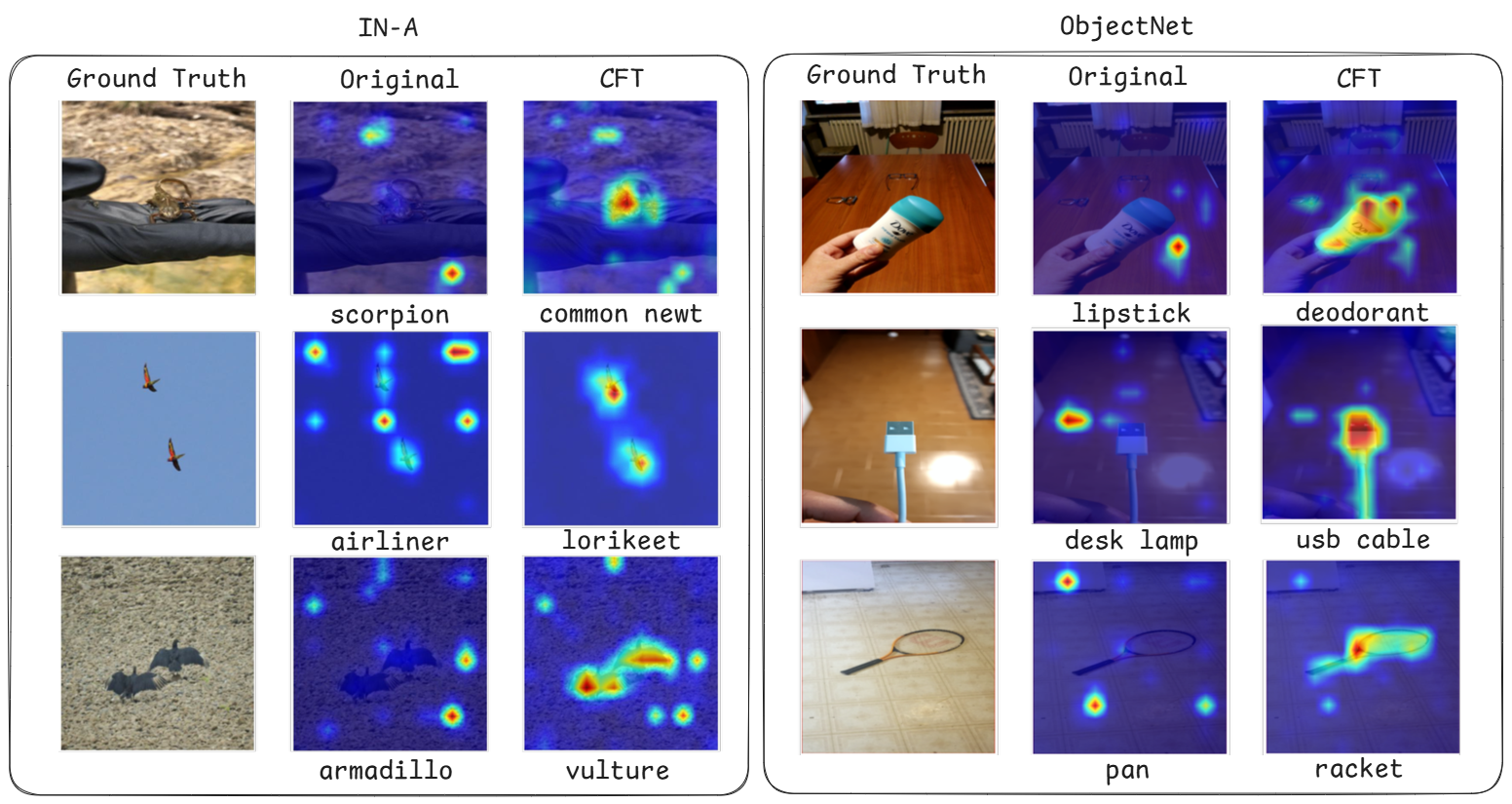
Qualitative comparison of relevance maps and predictions on ImageNet-A and ObjectNet.
Main Takeaways
- CFT improves robustness on real-world OOD benchmarks (ImageNet-A, ObjectNet) where background cues are misleading, correcting specific failure modes like misclassifying objects due to texture.
- The method is highly data-efficient, showing gains with only 3 images per class (1,500 images total), making it suitable for adapting large pretrained models.
- Relevance maps fine-tuned with CFT align significantly better with ground-truth object segmentation masks compared to baselines (GradMask, RRR), validating that the model is learning to look at the object.
- Gains are less pronounced on abstract datasets (ImageNet-Sketch, ImageNet-R) where background correlations are naturally minimized.
- Robustness improvements generalize to held-out classes not seen during the fine-tuning process, suggesting the model learns a generalizable reasoning mechanism.