📝 Paper Summary
Clinical Decision Support (CDS)
Traditional Chinese Medicine (TCM) AI
Neuro-symbolic AI
CORE-Acu combines structured chain-of-thought fine-tuning with a knowledge-graph-based symbolic veto mechanism to enforce strict safety constraints and eliminate hallucinations in acupuncture clinical decision support.
Core Problem
General LLMs act as black boxes that bypass critical diagnostic logic and often hallucinate safety-critical entities (like acupoints) or violate contraindications (like pregnancy restrictions), posing severe patient risks.
Why it matters:
- Acupuncture involves invasive physical interventions where minor terminology errors (e.g., confusing acupoint names) can lead to medical malpractice
- Standard LLMs optimized for next-token prediction lack the deterministic constraints needed to adhere to strict medical 'red lines' (contraindications)
- Existing TCM models often learn direct symptom-to-prescription mappings, missing the auditable intermediate reasoning required for physician trust
Concrete Example:
In a pregnancy-related case, a standard model might prescribe Hegu (LI4)—an acupoint strictly contraindicated because it promotes uterine activity—increasing the risk of adverse outcomes.
Key Novelty
Neuro-Symbolic Governance with Structured Reasoning
- Constructs a Structured Chain-of-Thought (S-CoT) dataset that forces the model to output a complete causal chain (Diagnosis → Pathology → Principle → Acupoints) rather than just a prescription
- Implements a 'Generate-Verify-Revise' loop where a symbolic Knowledge Graph checks outputs against deterministic safety rules (e.g., pregnancy contraindications) and forces revisions if violations occur
- Uses Lexicon-Matched Entity-Reweighted Loss (LMERL) to amplify gradient signals for rare but critical acupoint names, preventing them from being drowned out by common words during training
Architecture
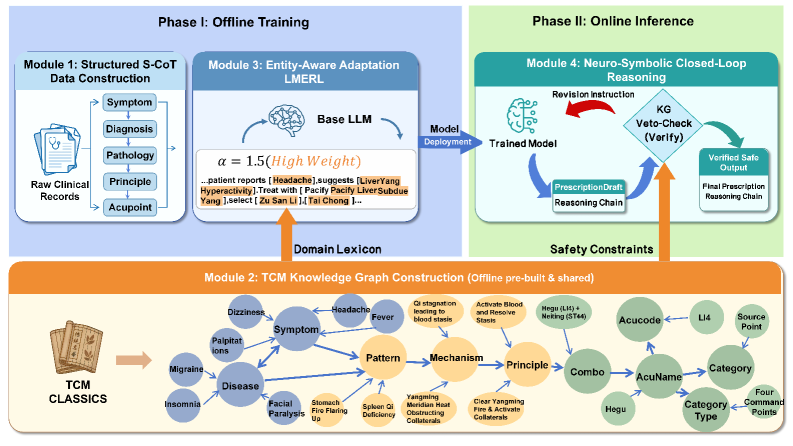
The overall framework of CORE-Acu, illustrating the construction, adaptation, and verification lifecycle.
Evaluation Highlights
- Achieved 0/1,000 observed safety violations (0% rate) on held-out cases, compared to an 8.5% violation rate for GPT-4o
- Constructed 'Acu-Reasoning', the first large-scale acupuncture S-CoT dataset with 42,512 samples containing explicit causal chains
- Built a specialized TCM safety Knowledge Graph with 4,628 nodes and over 1,200 explicit constraint edges (e.g., ProhibitedFor)
Breakthrough Assessment
8/10
Strong neuro-symbolic application that effectively solves the critical 'safety boundary' problem in generative medical AI, achieving 0% violations where SOTA models fail.