📝 Paper Summary
Scientific Autonomous Agents
Laboratory Automation
HAL is an LLM-based agent that automates superconducting qubit experiments by dynamically generating Python code tools and interpreting numerical measurement data through a flexible text-based signal mechanism.
Core Problem
Superconducting qubit experiments require complex, constantly evolving hardware and software control, making fixed-tool automation brittle; additionally, LLMs struggle to interpret raw floating-point experimental data directly.
Why it matters:
- The rapid evolution of quantum hardware renders static software tools obsolete quickly, requiring constant manual updates
- Conducting experiments requires extensive multidisciplinary expertise in physics, hardware, and software, creating a high barrier to entry
- Standard agents (like MCP) lack the dynamic ability to interpret inconclusive experimental results (e.g., microwave scattering parameters) which typically require human intuition
Concrete Example:
When characterizing a resonator, an instrument returns raw floating-point scattering parameters that confuse standard LLMs. A fixed-tool agent might fail to parse this, whereas HAL generates code to process the data and returns a text 'Signal' (e.g., 'Found 4 resonators') to the planner.
Key Novelty
Heuristic Autonomous Lab (HAL) with Schema-less Tool Generation
- Replaces pre-defined agent tools with a 'Plan and Develop' cycle where the LLM writes its own Python tools (functions) on the fly to address specific experimental needs
- Introduces a 'Signal' pathway where the generated code summarizes complex numerical data into text descriptions (e.g., 'found X resonators') defined dynamically by the planner
- Implements 'Memorization' by converting successful short-term execution history into long-term knowledge base examples for self-improvement
Architecture
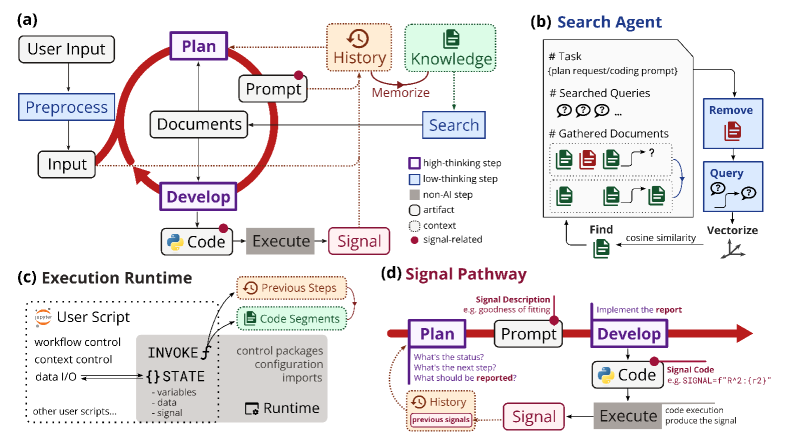
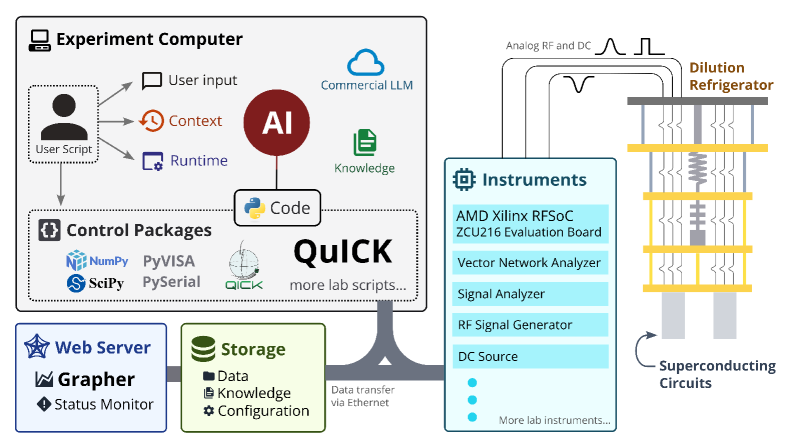
The architecture of the Heuristic Autonomous Lab (HAL) system
Evaluation Highlights
- Qualitative success: Demonstrated autonomous characterization of superconducting resonators without human intervention
- Qualitative success: Reproduced a Quantum Non-Demolition (QND) characterization experiment solely from a knowledge base and a description in a published journal article
- System efficiency: Search agent converges on relevant documents in ~5 iterations using an iterative RAG approach
Breakthrough Assessment
8/10
Significant step in scientific agents by removing the dependency on fixed tool schemas and enabling the agent to 'write its own manual' via code generation and signal definition.