📊 Experiments & Results
Evaluation Setup
12 policy scenarios across immigration, health, income, climate, speech, and AI governance.
Benchmarks:
- HL-01 (Health Policy) (Multi-round committee deliberation) [New]
- IM-01 (Immigration) (Multi-round committee deliberation) [New]
- CL-01 (Climate) (Multi-round committee deliberation) [New]
- SP-03 (Speech) (Multi-round committee deliberation) [New]
- AI-01 (AI Governance) (Multi-round committee deliberation) [New]
Metrics:
- Empirical Lyapunov exponent (lambda_hat)
- Statistical methodology: Bootstrap confidence intervals computed by replicate resampling.
Key Results
| Benchmark | Metric | Baseline | This Paper | Δ |
|---|---|---|---|---|
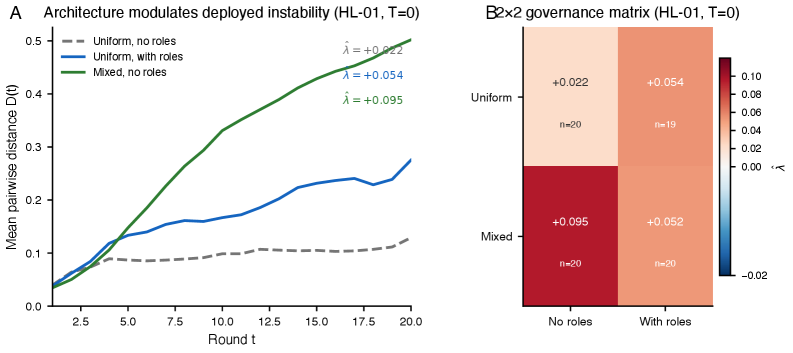
| Results demonstrating the impact of committee composition (Roles vs. NoRoles and Homogeneous vs. Mixed) on stability in the HL-01 benchmark. | ||||
| HL-01 | Lyapunov Exponent (lambda_hat) | 0.0221 | 0.0541 | +0.0320 |
| HL-01 | Lyapunov Exponent (lambda_hat) | 0.0221 | 0.0947 | +0.0726 |
| HL-01 | Lyapunov Exponent (lambda_hat) | 0.0947 | 0.0519 | -0.0428 |
| Average across 4 scenarios | Lyapunov Exponent (lambda_hat) | See Notes | See Notes | Negative |
Experiment Figures
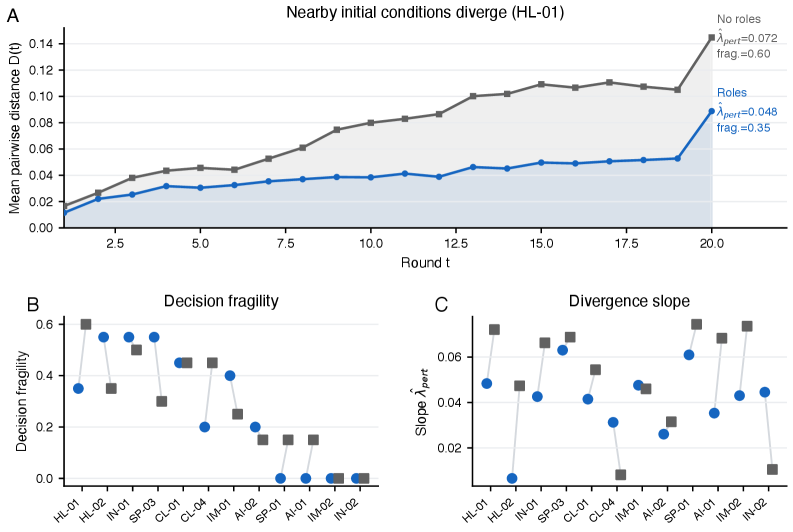
Trajectories and divergence rates for HL-01 under different conditions (Homogeneous/Mixed x Roles/NoRoles)
Impact of Role Ablation on stability
Main Takeaways
- Instability is design-induced via two routes: institutional differentiation (Roles) and compositional heterogeneity (Mixed Models).
- These routes interact non-additively; adding roles to a mixed committee actually reduced instability compared to the mixed, no-role condition.
- The Chair role is a dominant amplifier of instability; ablating the Chair role yielded the largest reduction in divergence for the HL-01 scenario.
- Reducing the memory window (context length) functions as an effective intervention to attenuate divergence.