📊 Experiments & Results
Evaluation Setup
Causal ablation study on ETT benchmark forecasting tasks
Benchmarks:
- ETT (Multivariate Time Series Forecasting (treated as univariate))
- Synthetic Diagnostic Suite (Feature Taxonomy Validation) [New]
Metrics:
- CRPS (Continuous Ranked Probability Score)
- Delta CRPS (Change in CRPS after ablation)
- Statistical methodology: Not explicitly reported in the paper
Key Results
| Benchmark | Metric | Baseline | This Paper | Δ |
|---|---|---|---|---|
| Single-feature ablation experiments demonstrate the heavy-tailed distribution of feature importance in the mid-encoder layers. | ||||
| ETT | Max Delta CRPS | 0 | 38.61 | +38.61 |
| ETT | Max-to-Median Impact Ratio | 1.0 | 30.5 | +29.5 |
| Progressive ablation reveals a paradoxical improvement in the final encoder layer, contrasting with catastrophic failure in earlier layers. | ||||
| ETT | CRPS | 2.61 | 25.32 | +22.71 |
| ETT | CRPS | 3.62 | 2.73 | -0.89 |
Experiment Figures
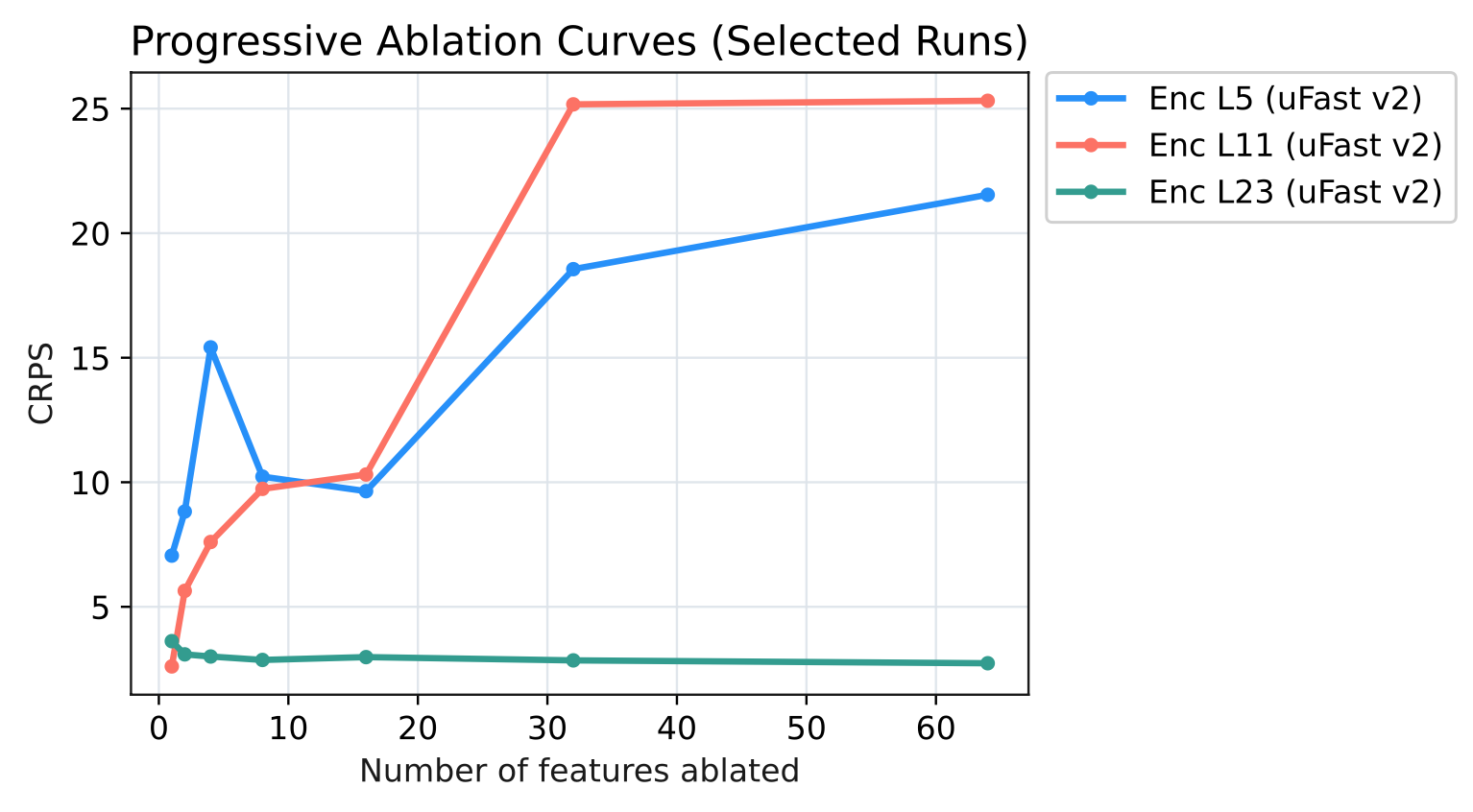
Progressive ablation curves (CRPS vs Number of Ablated Features) for Encoder Blocks 5, 11, and 23
Main Takeaways
- Mid-encoder layers (Block 11) act as a 'causal bottleneck', containing the most critical features for forecasting accuracy, specifically those related to level shifts and noise.
- Final encoder layers (Block 23) contain rich semantic features (seasonality, frequency) that are less causally relevant or even redundant; removing them can improve performance on specific benchmarks like ETT.
- Causal importance follows a power law in middle layers, where a tiny fraction of features carries the vast majority of the forecasting capability.