Jingtao Wang, Yucong Wang, Jun Ding, Rui Cai, Xun Wang
Meakins-Christe Laboratories, Research Institute of McGill University Health Centre,
McGill University,
The College of Computer Science and Technology, Zhejiang Gongshang University,
Mila-Quebec AI Institute
ARACH augments decoder-only Transformers at inference time with a parallel 'context hub' stream that aggregates historical context into a summary token, regulated by a logit offset to prevent attention collapse.
Core Problem
Post-training enhancement of LLMs typically requires expensive parameter updates or superficial input/output engineering (prompting/reranking), while the model's internal computation remains a black box inefficient at long-context utilization.
Why it matters:
Further training (fine-tuning/alignment) is computationally expensive and requires complex engineering pipelines
Prompt-based methods incur significant test-time overhead (longer sequences) without improving the model's intrinsic reasoning capabilities
Standard attention mechanisms often suffer from 'attention sinks' (over-focusing on early tokens), reducing the effective utilization of relevant context
Concrete Example:In standard autoregressive decoding, the 'attention sink' phenomenon causes models to disproportionately attend to the first few tokens (like start-of-sentence) regardless of their semantic value. ARACH provides a dedicated 'hub' pathway to absorb and summarize this global information, allowing the verbal tokens to focus on semantically relevant retrieval.
Key Novelty
Adaptive Context Hub (ARACH)
Introduces a parallel stream of 'hub tokens' alongside the standard verbal tokens; these hubs do not encode position but serve as a dynamic aggregation point for the causally available prefix
Modifies the attention mask to create specific routing: verbal tokens can attend to the current hub (to read the summary), and the hub attends to all past verbal tokens (to write the summary)
Uses a scalar 'logit offset' to calibrate the strength of the hub's influence, preventing the hub from overpowering standard attention (routing collapse)
Architecture
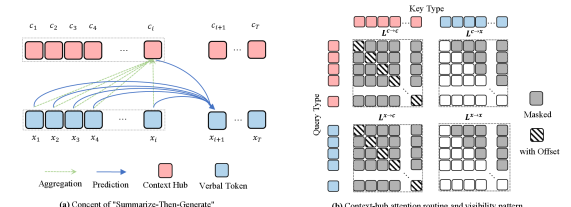
Schematic of the ARACH framework, contrasting standard decoding with the Hub-augmented decoding
Breakthrough Assessment
5/10
A clever engineering intervention that modifies attention routing without training. While theoretically interesting for memory management, the impact is likely incremental compared to architectural changes.
⚙️ Technical Details
Problem Definition
Setting: Autoregressive language modeling with a pretrained decoder-only Transformer
Model or implementation: Gaussian sampling (Mean-resizing initialization)
ARACH Attention Mechanism
Compute self-attention with specific visibility rules between verbal and hub streams
Model or implementation: Modified Dot-Product Attention
Novel Architectural Elements
Two-stream token layout (Verbal + Hub) processed simultaneously in the same attention layers
Four-quadrant block attention mask enabling specific 'summary-read' (Verbal->Hub) and 'summary-write' (Hub->Verbal) pathways
Inference-time logit calibration (offset b) to regulate attention routing without weight updates
Modeling
Base Model: Pretrained decoder-only Transformer (model-agnostic)
Comparison to Prior Work
vs. Prompt Engineering: ARACH modifies internal attention computation rather than just inputs, providing a deterministic 'context hub' mechanism
vs. PEFT: ARACH is completely training-free and does not require managing adapter weights
vs. StreamingLLM [not cited in paper]: ARACH creates a dynamic summary token rather than just caching fixed sink tokens to handle long context
Limitations
Increases computational cost slightly due to processing the auxiliary hub stream (doubles sequence length in the conceptual full-attention view, though sparse masking mitigates this)
Relies on a scalar logit offset hyperparameter that may need tuning for different models or tasks
Quantitative performance gains and benchmarks are claimed but specific numbers were not available in the provided text snippet
Reproducibility
No code URL provided in the text. The method is training-free and relies on modifying the attention mask and adding a scalar offset, which is conceptually straightforward to implement in standard Transformer codebases (e.g., HuggingFace). Hub tokens are initialized via simple Gaussian sampling matching the pretrained embedding statistics.
📊 Experiments & Results
Evaluation Setup
Paired evaluation with fixed model weights/decoding, toggling ARACH on/off
Benchmarks:
Language Modeling tasks (Next-token prediction)
Cloze-style benchmarks (Fill-in-the-blank)
Metrics:
Not explicitly reported in the paper snippet
Statistical methodology: Not explicitly reported in the paper
Main Takeaways
ARACH yields consistent gains across language modeling and cloze-style benchmarks compared to the base model without the plugin (qualitative result from text)
Attention analysis suggests ARACH successfully mitigates the 'attention sink' phenomenon, where models irrationally focus on early tokens
The method demonstrates that internal computation can be effectively engineered at inference time without parameter updates, offering a third path distinct from prompting and fine-tuning
context hub: A proposed parallel stream of tokens that aggregates history into a summary representation for the model to use
attention sink: A phenomenon where attention heads disproportionately focus on specific tokens (often the first token) that act as 'sinks' for attention mass
logit offset: A scalar value added to the attention scores (logits) before the softmax operation to increase or decrease the probability of attending to specific tokens
verbal tokens: The standard input/output tokens representing the actual text, as opposed to the auxiliary hub tokens
causal mask: A matrix used in self-attention to ensure a token can only attend to previous tokens (preserving the arrow of time)
prefill: The initial phase of processing the input prompt in parallel before token-by-token generation begins