📝 Paper Summary
Multimodal Medical Image Segmentation
Missing Modality Robustness
CLoE improves missing-modality segmentation by training experts to agree globally and regionally, then using this agreement to weight features during fusion.
Core Problem
Multimodal medical segmentation models fail when modalities are missing at inference because individual modality experts disagree, and standard fusion mechanisms amplify these conflicting predictions.
Why it matters:
- Clinical settings frequently have missing MRI sequences due to protocol variations or quality issues, rendering standard full-modality models unusable.
- Existing methods like zero-imputation or passive spatial attention fail to distinguish reliable experts from unreliable ones, leading to errors in small, critical tumor regions.
- Generative imputation adds heavy computational overhead, while simple dropout training improves average robustness but lacks case-specific reliability control.
Concrete Example:
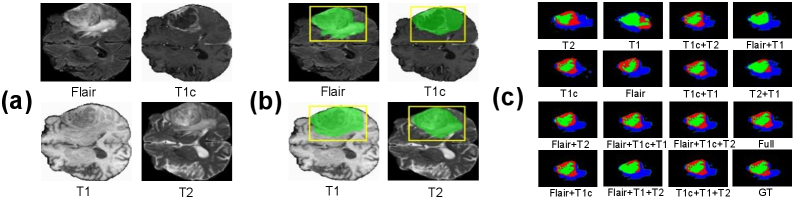
In brain tumor segmentation, if the T1ce modality (which best shows the tumor core) is missing, a standard model might fuse conflicting predictions from T2 and FLAIR equally, resulting in a fuzzy or missed tumor core boundary.
Key Novelty
Expert Consistency Learning (ECL) with Reliability-Aware Gating
- Treats robustness as a consistency problem: forces all available modality experts to agree with each other during training (both globally and on foreground regions).
- Uses the degree of agreement at inference time as a direct measure of reliability: if an expert's prediction aligns with others, its features are upweighted; if it deviates, it is suppressed.
Architecture
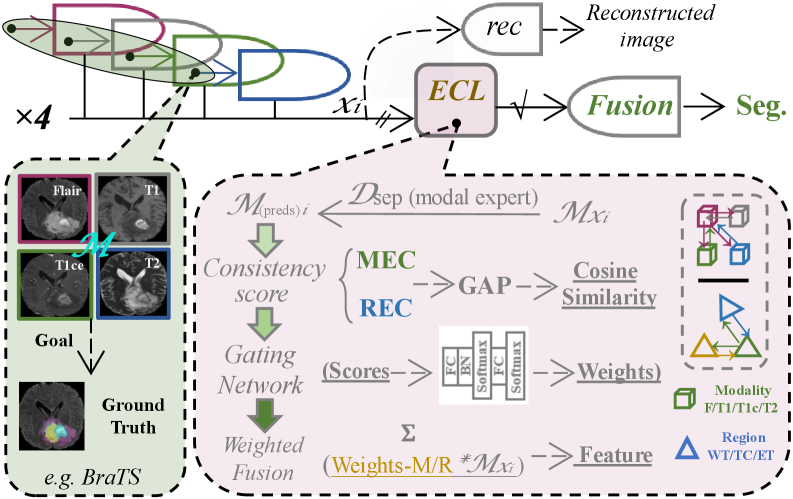
The overall CLoE framework showing parallel encoders, the expert decoder branch, consistency calculations (MEC/REC), the gating network, and the final fusion decoder.
Evaluation Highlights
- Outperforms state-of-the-art methods (M³AE, DC-Seg) on BraTS 2020 Whole Tumor segmentation with 88.09% Dice (vs 87.54% best baseline).
- Achieves 80.23% Dice on Tumor Core segmentation, surpassing specialized methods like DC-Seg (79.63%) and large models like M³AE (79.10%).
- Improves Prostate (Task05) segmentation by 2.77% Dice over RFNet under missing modality settings, demonstrating strong cross-dataset generalization.
Breakthrough Assessment
8/10
Strong conceptual advance by framing missing modality robustness as a consistency problem rather than just data imputation. consistently outperforms SOTA on standard benchmarks.