📝 Paper Summary
Self-evolving Agentic reasoning
Memory organization
Multi-agent collaboration
AutoAgent enables autonomous agents to continuously refine their understanding of tools and peers through experience while dynamically managing memory to make efficient, context-aware decisions without external retraining.
Core Problem
Current autonomous agents rely on static, hand-written prompts for tools/peers and rigid pre-defined workflows, leading to inability to learn from mistakes and inefficient context management that slows reasoning.
Why it matters:
- Static descriptions cause agents to repeatedly misuse tools or overlook capable collaborators because initial prompts are incomplete or outdated
- Fixed reasoning loops fail in non-stationary environments where optimal actions depend on evolving context rather than pre-set plans
- Linear memory growth leads to token redundancy and high costs, as agents treat history as raw text rather than structured, reusable knowledge
Concrete Example:
An agent may repeatedly fail to use a specific tool because the provided documentation omits a critical precondition. In standard frameworks, this error repeats endlessly; AutoAgent would analyze the failure, update the tool's internal description to include the missing precondition, and succeed in future attempts.
Key Novelty
Closed-Loop Evolving Cognition with Elastic Memory
- Formalizes agent state as 'Cognition' (internal self-knowledge and external peer models) that is explicitly rewritten and updated based on interaction outcomes, rather than remaining static.
- Unifies action selection into a single space containing both 'Emic' (self-reliant tool use) and 'Etic' (help-seeking) actions, replacing rigid workflow graphs with on-the-fly decision making.
- Introduces an Elastic Memory Orchestrator that actively compresses history into episodic abstractions and reusable skills, reducing token overhead while preserving decision-critical evidence.
Architecture
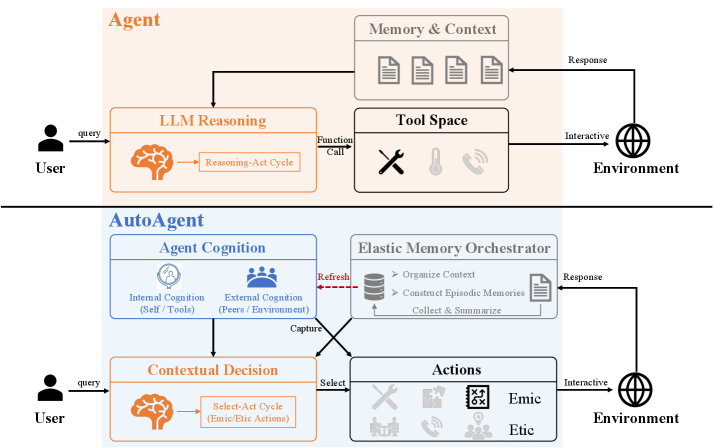
The AutoAgent architecture illustrating the interaction between Cognition, Decision, Memory, and Evolution components across two cycles (Execution and Evolution).
Evaluation Highlights
- Consistent improvements in task success and tool-use efficiency across retrieval-augmented reasoning and embodied task environments compared to static baselines.
- Demonstrates robust collaborative performance by dynamically updating peer expertise models, outperforming fixed-role multi-agent systems.
- Reduces token overhead significantly through elastic memory compression while maintaining or improving reasoning accuracy in long-horizon tasks.
Breakthrough Assessment
8/10
Strong contribution in unifying memory management with continuous self-improvement. The explicit rewriting of agent prompts (cognition) based on experience is a practical step toward truly adaptive agents.