Gaoling School of Artificial Intelligence, Renmin University of China,
JD.com
arXiv
(2026)
RecommendationAgentReasoningRL
📝 Paper Summary
Agentic RecommendationTool-Augmented Reasoning
RecThinker is an investigator agent that actively assesses information gaps in user profiles and item data, autonomously calling specialized tools to bridge these gaps before making recommendation decisions.
Core Problem
Existing recommendation agents operate passively with static workflows or constrained information, failing to identify when they lack sufficient evidence for accurate reasoning.
Why it matters:
Passive agents rely on uncertain or opportunistic tool use rather than driven by information deficiency, leading to ineffective actions
Current frameworks typically use generic search tools not tailored for recommendation, resulting in incomplete or one-sided evidence
Fragmented user profiles and sparse item metadata lead to suboptimal recommendations when agents cannot proactively seek missing context
Concrete Example:When a user has a sparse history, a standard agent might hallucinate preferences or make a generic guess. RecThinker detects this 'information gap,' actively calls a 'Similar Users Search' tool to infer preferences from collaborative data, and then ranks items.
Key Novelty
Agent-as-Investigator with Analyze-Plan-Act Workflow
Adopts an 'Analyze-Plan-Act' paradigm where the agent explicitly assesses the gap between available knowledge (user/item info) and what is needed for ranking
Uses a suite of recommendation-specific tools (e.g., collaborative filtering signals via similar user search, item relation graphs) rather than just generic web search
Optimizes policy via a two-stage process: Self-Augmented SFT on high-quality filtered trajectories followed by Reinforcement Learning (GRPO) for tool efficiency
Architecture
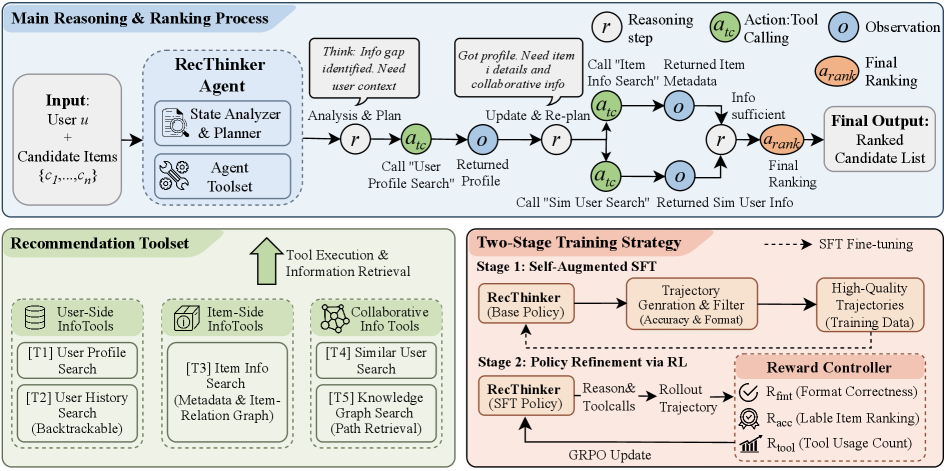
The overall architecture and Analyze-Plan-Act workflow of RecThinker.
Breakthrough Assessment
8/10
Moves beyond the standard 'Agent-as-Assistant' model to a proactive 'Investigator' model that self-diagnoses information needs. The integration of specialized recommendation tools with an explicit 'Analyze-Plan-Act' loop is a significant methodological advance.
⚙️ Technical Details
Problem Definition
Setting: Ranking task where an agent ranks a candidate item set for a user
Inputs: User u, Candidate item set C = {c1, ..., cn}
Outputs: Ranked list of items
Pipeline Flow
Analysis: Assess information sufficiency of User and Item data
Planning: If gap exists, select tools from User/Item/Collaborative sets; if sufficient, Rank
Action: Execute tools (Profile Search, History Search, etc.) or output Ranking
Observation: Integrate tool outputs into trajectory and repeat
System Modules
Reasoning Agent
Central controller that performs sufficiency analysis, plans tool calls, and generates final ranking
Model or implementation: Large Reasoning Model (LLM-based)
User Tools (Tools)
Retrieve user-side evidence
Model or implementation: Search Interfaces
Item Tools (Tools)
Retrieve item-side evidence and context
Model or implementation: Search/Graph Interfaces
Collaborative Tools (Tools)
Retrieve collaborative filtering signals and high-order relations
Model or implementation: Embedding Search / Knowledge Graph
Novel Architectural Elements
Explicit 'Information Gap Analysis' step (Delta_t) within the reasoning loop
Integration of collaborative filtering tools (Similar Users, KG) directly into the agent's action space
Modeling
Base Model: Large Language Model (specific architecture not detailed in text, likely Llama or DeepSeek class based on context)
Training Method: Two-stage: Self-Augmented SFT followed by GRPO (Reinforcement Learning)
Objective Functions:
Purpose: SFT Objective.
Formally: Standard next-token prediction loss on agent-generated tokens only (masking environment observations).
Purpose: RL Format Reward.
Formally: Binary reward checking if trajectory follows reasoning/tool-calling format.
Purpose: RL Tool Utilization Reward.
Formally: Piecewise linear function rewarding 3-8 calls, penalizing 0 calls or >12 calls.
Purpose: RL Accuracy Reward.
Formally: NDCG@10 of the final ranking list.
Purpose: GRPO Objective.
Formally: Expected advantage optimization using importance sampling ratio and normalized group rewards.
Training Data:
Generate trajectories using base LLM
Filter trajectories based on Ranking Accuracy (ground truth at top) and Format Validity
RL samples selected via difficulty-aware sampling (instances where only small portion of rollouts are correct)
Key Hyperparameters:
tool_reward_no_calls: -1.0
tool_reward_optimal_range: 3 to 8 calls (Reward = 1.0)
tool_reward_excessive_penalty: Decay for >8 calls, heavy penalty for >12
vs. RecMind: RecThinker explicitly analyzes information sufficiency (gaps) before acting, whereas RecMind is opportunistic; RecThinker uses recommendation-specific tools (collaborative/KG) vs. generic search.
vs. RAH: RecThinker actively retrieves missing info via tools rather than relying on passive user input analysis.
vs. AgentCF: RecThinker acts as the recommender system itself (Investigator) rather than simulating data for a separate model.
Limitations
Experimental results and quantitative performance metrics are not included in the provided text.
The specific base LLM architecture is not identified.
Dependence on the quality and coverage of external tools (e.g., Knowledge Graph completeness).
Reproducibility
No replication artifacts mentioned in the paper (code URL and model weights are not provided in the text). Training data construction logic is described (filtering by accuracy/format), but specific datasets are not named in the provided text snippet.
📊 Experiments & Results
Evaluation Setup
Ranking candidate items for users
Benchmarks:
Not reported in the paper (Recommendation / Ranking)
Metrics:
NDCG@10
Statistical methodology: Not explicitly reported in the paper
Main Takeaways
The paper claims RecThinker consistently outperforms strong baselines (quantitative details unavailable in provided text).
The framework shifts recommendation from passive processing to autonomous investigation.
Specialized tools (User/Item/Collaborative) enable the agent to bridge information gaps in sparse data scenarios.
📚 Prerequisite Knowledge
Prerequisites
Agentic AI patterns (ReAct, Chain-of-Thought)
Reinforcement Learning (specifically GRPO)
Recommender Systems basics (User/Item representations)
Key Terms
SFT: Supervised Fine-Tuning—training the model on a dataset of high-quality examples to internalize reasoning patterns
GRPO: Group Relative Policy Optimization—a reinforcement learning algorithm that optimizes policies by comparing a group of outputs generated for the same input
NDCG: Normalized Discounted Cumulative Gain—a measure of ranking quality that accounts for the position of relevant items in the list
Information Gap: The difference between the currently available evidence (user/item knowledge) and the evidence required to make a confident recommendation decision
Chain-of-Thought (CoT): A prompting technique where the model generates intermediate reasoning steps before the final answer