📝 Paper Summary
Medical Image Synthesis
Multimodal Learning
Missing Data Imputation
ACADiff synthesizes missing brain imaging modalities by conditioning a latent diffusion model on available scans via adaptive fusion and clinical metadata encoded by GPT-4o.
Core Problem
Multimodal Alzheimer's disease datasets frequently suffer from missing imaging modalities (MRI, PET) due to cost or patient dropout, which limits diagnostic accuracy and research utility.
Why it matters:
- Single modalities (like just MRI) miss complementary pathological markers available in PET scans (glucose metabolism, amyloid deposition)
- Existing generative methods (GANs, standard diffusion) lack adaptive mechanisms to handle varying combinations of missing inputs (e.g., handling both 1→1 and 2→1 generation with one model)
- Current approaches rarely integrate rich semantic clinical metadata (diagnosis, cognitive scores) to guide the generation process toward biologically plausible results
Concrete Example:
A patient may have an MRI and clinical scores but lack FDG-PET due to cost. A standard diffusion model might generate a generic PET scan that looks realistic but ignores the patient's specific cognitive decline (e.g., MMSE=22), whereas ACADiff uses the clinical scores to generate a PET scan reflecting the appropriate hypometabolism patterns.
Key Novelty
Adaptive Clinical-Aware Diffusion (ACADiff)
- Adaptive Image Conditioning: A dynamic fusion module switches between cross-attention (for multiple inputs) and projection (for single input) based on availability masks, allowing one model to handle any combination of missing modalities.
- Semantic Clinical Guidance: Instead of simple class labels, patient metadata (MMSE, ADAS13) is converted into natural language prompts and encoded by GPT-4o to guide the diffusion process toward disease-consistent patterns.
- Hierarchical Conditioning: Combines early fusion of image features with late fusion of text embeddings in the diffusion U-Net to preserve both structural details and high-level semantic disease information.
Architecture
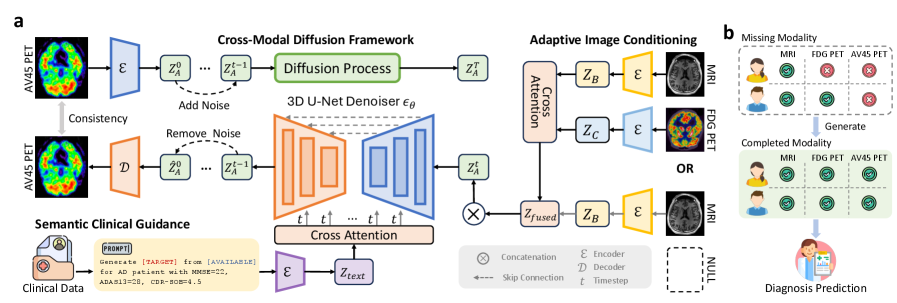
The ACADiff framework illustrating the latent diffusion process with hierarchical adaptive conditioning.
Evaluation Highlights
- Achieves 89.4% diagnostic accuracy with 20% missing data (97.2% of the performance of complete real data).
- Maintains 77.5% diagnostic accuracy even under extreme 80% missing data scenarios, outperforming the best baseline (LDM) which achieves 76.4%.
- Outperforms state-of-the-art baselines (LDM, PASTA, Pix2Pix) across all generation metrics, achieving PSNR of 27.9 and SSIM of 0.911.
Breakthrough Assessment
8/10
Strong practical contribution solving the specific problem of variable missing modalities in medical imaging. The integration of LLM-encoded clinical text for guidance is a novel and effective addition to standard latent diffusion.
