📝 Paper Summary
Synthetic Data Generation
Agentic Tool Use
Generalization
Dive improves agent generalization by inverting the synthesis process: it executes diverse real-world tools first to generate grounded evidence, then reverse-derives verifiable tasks from the resulting traces.
Core Problem
Current tool-using agents struggle to generalize to new tasks and toolsets because synthetic training data is confined to narrow templates and fixed tool combinations (e.g., only web search).
Why it matters:
- Agents trained on rigid routines (e.g., search-browse loops) fail when faced with open-ended diversity in real-world deployments
- Existing synthesis methods cannot scale diversity without sacrificing validity: manual pipelines are costly, while simulated environments often yield unverifiable or unsolvable tasks
Concrete Example:
An agent trained primarily on web search tasks may over-rely on a 'search-then-browse' routine. When asked to perform clinical diagnosis using a specific 'PatientLookup' tool, it fails to adapt its pattern, leading to negative transfer.
Key Novelty
Evidence-Driven Inverted Synthesis
- Inverts the standard 'Query first, Check later' synthesis order. Instead, it executes random tool combinations first to create a valid 'evidence' trace, then writes a question that this trace answers.
- Ensures 'grounding by construction': because the task is derived from an actual successful tool execution, the task is guaranteed to be solvable and verifiable.
Architecture
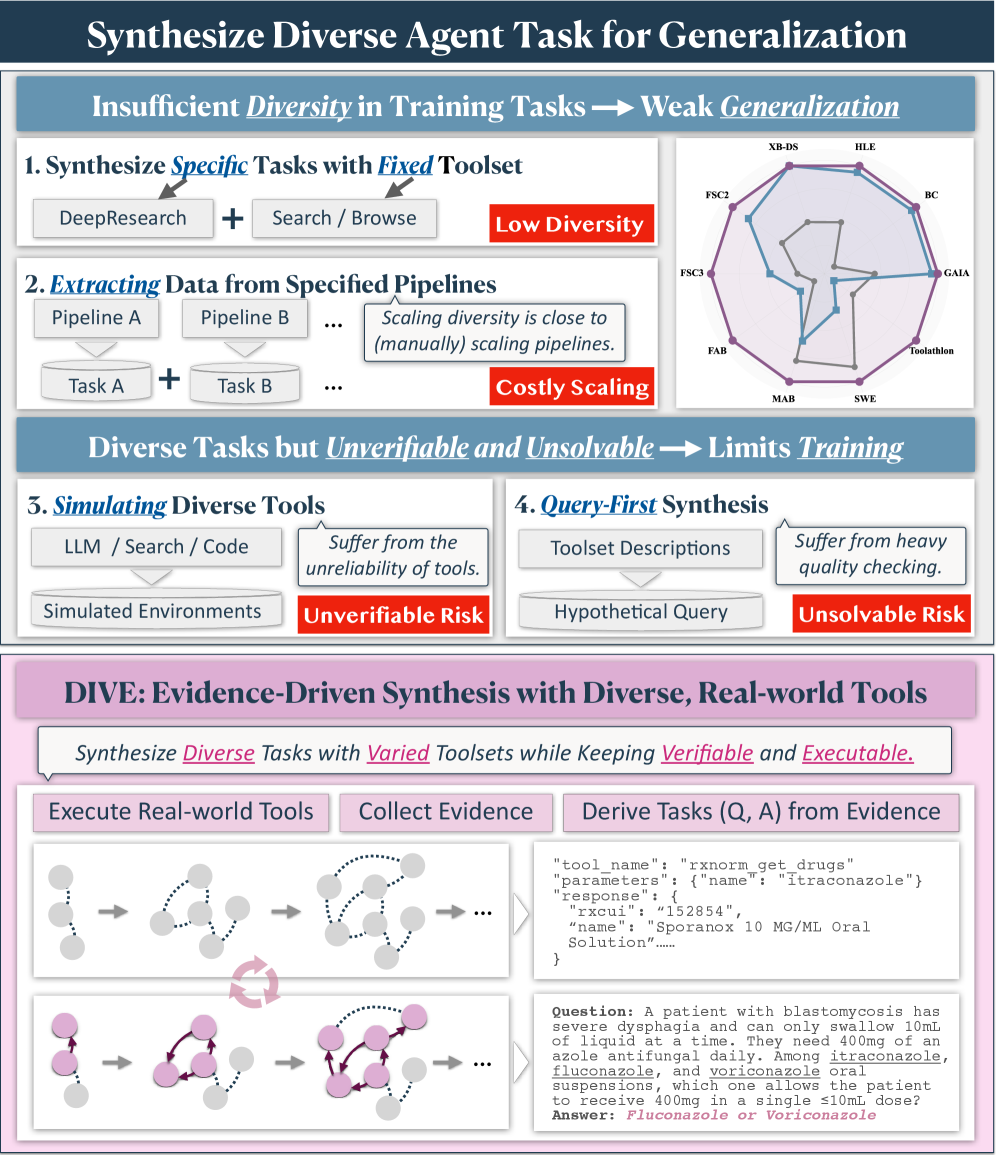
The Dive synthesis pipeline: Evidence Collection followed by Task Derivation.
Evaluation Highlights
- +22 average points improvement across 9 Out-of-Distribution (OOD) benchmarks compared to baselines when training Qwen3-8B on Dive data
- Outperforms the strongest 8B baseline by +68% on tool-use generalization tasks
- Diversity scaling proves more effective than quantity scaling: Dive data achieves better OOD generalization even with 4x less data than quantity-focused baselines
Breakthrough Assessment
9/10
The 'inverted synthesis' approach elegantly solves the tension between diversity and executability in synthetic data. Significant gains (+68%) suggests this is a major step forward for generalizable agents.