📝 Paper Summary
AI-driven Networking
Congestion Control
Code Generation
GenCC utilizes Large Language Models within an evolutionary feedback loop to automatically generate and refine C++ utility functions for congestion control protocols, optimizing for specific network conditions and application requirements.
Core Problem
Modern applications impose conflicting network requirements (e.g., low latency vs. high bandwidth) that single, fixed utility functions in existing congestion control protocols cannot satisfy without complex, manual parameter tuning.
Why it matters:
- Emerging applications like 4K video conferencing require simultaneous high bandwidth and low latency, which traditional TCP-friendly protocols fail to deliver
- Current state-of-the-art learning-based protocols (e.g., Proteus, Hercules) rely on carefully engineered utility functions that do not adapt well to dynamic, heterogeneous environments like 5G or satellite links
Concrete Example:
In interactive video services, the control channel needs low latency while the video stream needs high bandwidth. A standard CC protocol with a fixed utility function might optimize for throughput, causing lag in the control channel, or optimize for latency, degrading video quality. GenCC generates a function specifically balancing these based on observed performance.
Key Novelty
GenCC (Generative Congestion Control Framework)
- Replaces manual mathematical derivation of utility functions with an automated LLM-driven evolutionary process
- Closes the loop between code generation and real-world performance by testing generated C++ functions in a network testbed and feeding performance metrics back to the LLM for refinement
Architecture
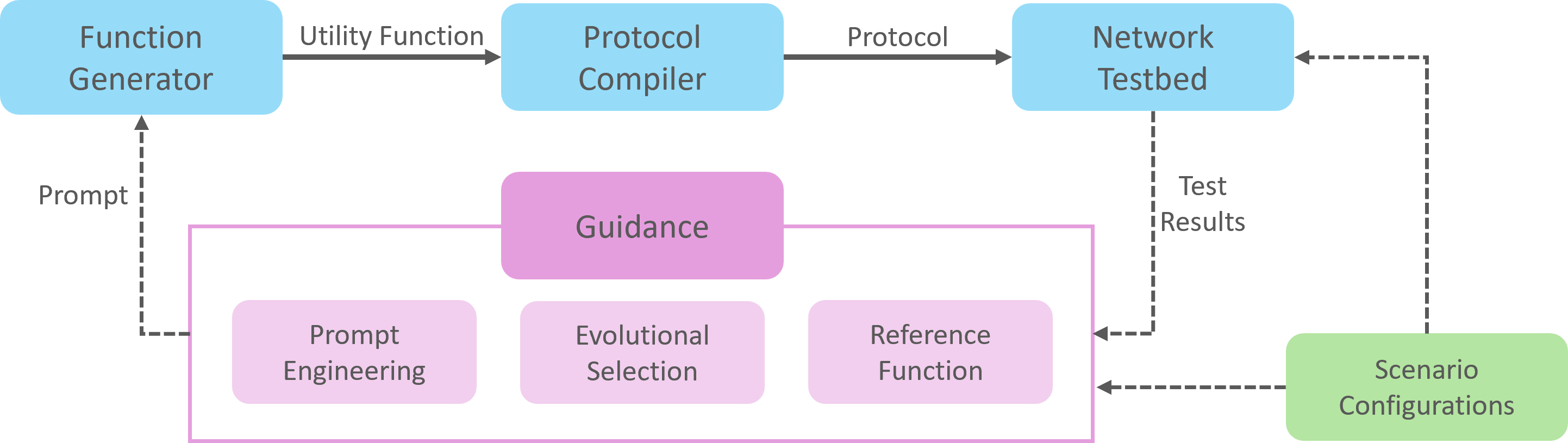
The GenCC cyclic workflow connecting the LLM to the network testbed.
Evaluation Highlights
- Achieves up to 2.4x (142%) throughput improvement over the state-of-the-art Hercules protocol in broadband scenarios
- Outperforms Hercules by 37% in cellular (5G-like) scenarios and 67% in satellite scenarios using the 'Evolve' guidance strategy
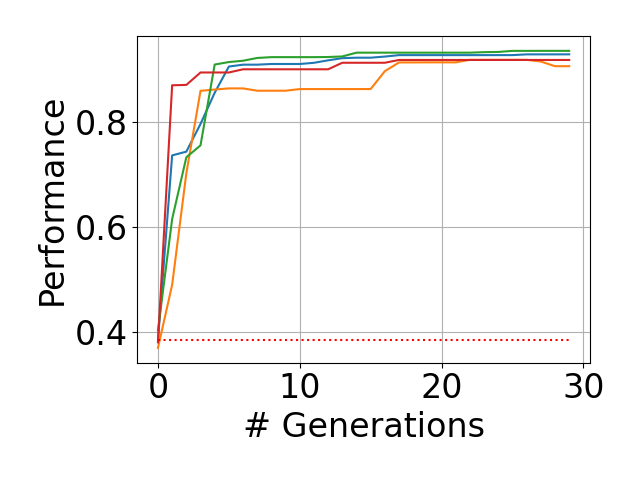
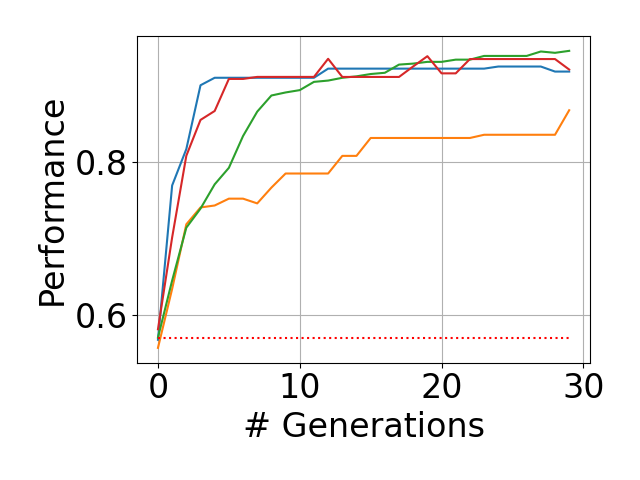
- Leading strategies (Evolve and Math-CoT) reach near-optimal performance within 10 generation trials per scenario
Breakthrough Assessment
8/10
Significantly outperforms SOTA by treating protocol design as a code-generation search problem. The shift from manual tuning to LLM-driven evolutionary design for core networking components is a strong methodological advance.