📝 Paper Summary
Agent-based Recommender Systems
Multi-Stakeholder Fairness
TriRec transforms items from passive entities into active agents that generate personalized self-promotion, regulated by a platform agent to balance user relevance, item survival, and fairness.
Core Problem
Current agent-based recommenders are predominantly user-centric, optimizing user utility while treating items as passive, which leads to exposure concentration (Matthew effect) and reduced creator incentives.
Why it matters:
- The 'Matthew effect' concentrates exposure on popular items, leaving long-tail creators invisible and causing creator churn due to lack of incentives
- Excessive optimization for short-term user engagement homogenizes the content pool, eroding supply-side diversity and harming the platform's long-term ecosystem health
- Prior multi-agent methods focus on user utility, treating item agents merely as information carriers rather than active stakeholders advocating for their own visibility
Concrete Example:
A CD player might be generically recommended based on category, but under this system, it actively emphasizes 'high audio fidelity' to a musician user versus 'easy playback' to a senior user to win exposure.
Key Novelty
Tri-party LLM-agent Recommendation (TriRec)
- **Item Agency:** Unlike passive item embeddings, item agents actively generate personalized 'self-promotion' content tailored to specific users to advocate for their own exposure
- **Tri-Party Alignment:** Explicitly coordinates three distinct utility functions: User (relevance), Item (exposure/survival), and Platform (fairness/stability)
- **Decoupled Regulation:** A two-stage architecture where Stage 1 maximizes semantic matching via promotion, and Stage 2 regulates the global list for fairness constraints
Architecture
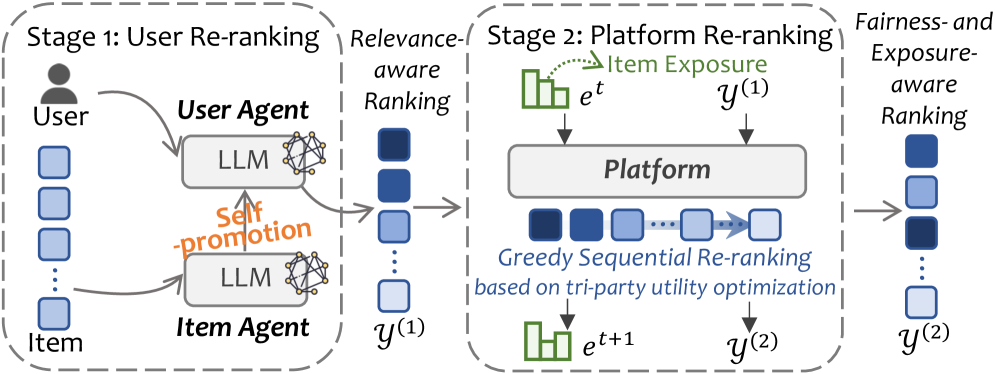
The TriRec framework overview, illustrating the two-stage pipeline: (1) Generative item self-promotion and (2) Platform-led multi-objective re-ranking.
Evaluation Highlights
- Item self-promotion simultaneously increased average exposure and click-through probability, challenging the trade-off assumption between fairness and effectiveness
- The introduction of personalized persuasive content enhanced recommendation accuracy on the user side compared to passive item descriptions
Breakthrough Assessment
8/10
Significant conceptual shift from user-centric to multi-stakeholder agency in LLM-based recommendation. The idea of items actively 'campaigning' for exposure via generated text is novel.