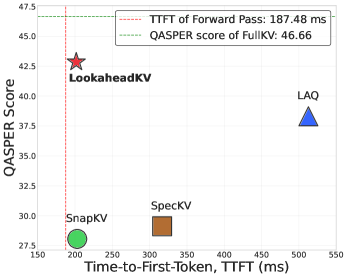
LookaheadKV predicts the importance of cached key-value pairs using learnable tokens and specialized adapters, achieving the accuracy of draft-based methods without the latency of explicit draft generation.
Core Problem
Existing KV cache eviction methods face a trade-off: heuristics (like SnapKV) are fast but inaccurate, while draft-based methods (like LAQ) are accurate but suffer high latency due to the cost of generating draft tokens.
Why it matters:
KV cache grows linearly with sequence length, causing memory bottlenecks for long-context tasks (e.g., 128K tokens require 40GB memory for LLaMA-3.1-70B)
Draft-based methods improve accuracy by glimpsing the future but incur prohibitive computational overhead, limiting deployment on latency-sensitive devices like mobile phones
Maintaining high accuracy in eviction is critical to prevent performance degradation in long-document understanding and generation tasks
Concrete Example:In a long-context summarization task, a heuristic method might evict tokens that seem unimportant now but are needed later, ruining the summary. A draft-based method would generate a dummy summary first to check importance, but this doubles the processing time. LookaheadKV predicts importance instantly without generation.
Key Novelty
Implicit Future Glimpsing via Lookahead Tokens
Instead of generating a draft response token-by-token, the model appends a fixed set of learnable 'lookahead tokens' to the prompt.
These tokens interact with the cache via a specialized 'Lookahead LoRA' module to predict the attention pattern of the *true* future response.
The system calculates importance scores based on these predicted patterns and evicts unimportant KV pairs before decoding begins.
Architecture
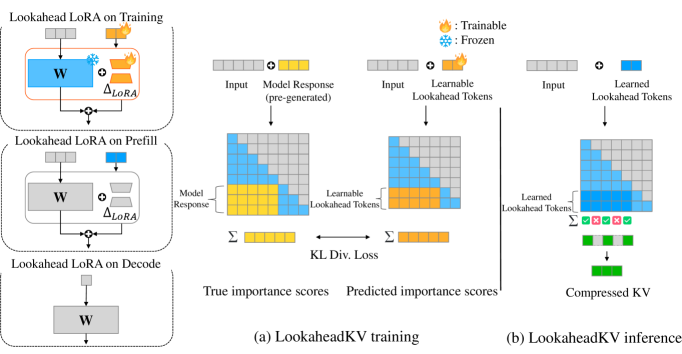
The LookaheadKV framework during the prefill phase, showing how lookahead tokens and specialized LoRA modules are used to compute importance scores.
Evaluation Highlights
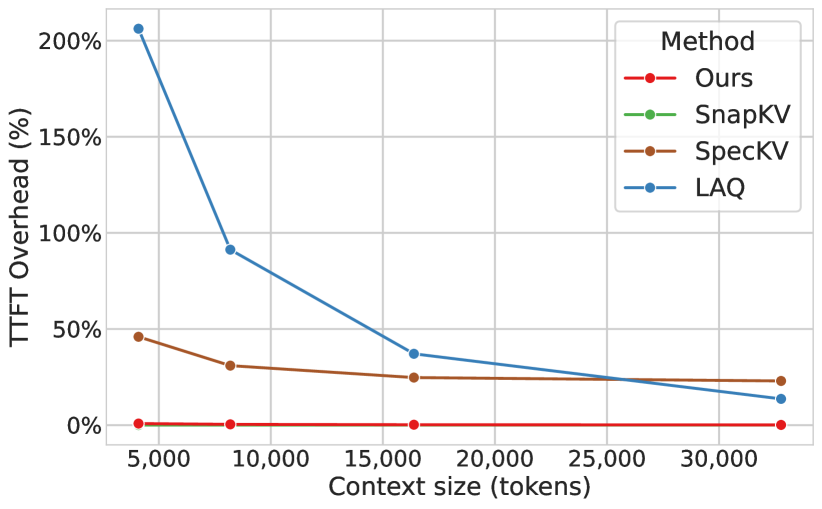
Reduces eviction cost by up to 14.5x compared to draft-based approaches while maintaining comparable accuracy
Incurs negligible runtime overhead of less than 2.16% at 32K context length
Consistently outperforms baseline heuristics (SnapKV, PyramidKV) and draft-based methods (LAQ) across LongBench, RULER, and MT-Bench benchmarks
Breakthrough Assessment
8/10
Ideally solves the accuracy-latency trade-off in KV cache eviction by replacing expensive autoregressive draft generation with a parallelizable, learnable prediction module.
⚙️ Technical Details
Problem Definition
Setting: Identify and evict unimportant Key-Value (KV) pairs from the cache to reduce memory usage while preserving model performance on the target task.
Inputs: Input token sequence X and the current KV cache
Outputs: A subset of the KV cache (Top-K important pairs) to be retained for future generation
Provide a set of learnable query vectors that serve as an 'observation window' to estimate future attention
Model or implementation: Learnable Soft Tokens (n_lookahead=32)
Lookahead LoRA
Enhance the representation of lookahead tokens to accurately predict true importance scores without altering base model weights
Model or implementation: Low-Rank Adapter (Rank=8, Alpha=32)
Eviction Mechanism
Compute attention scores from lookahead tokens to prompt keys and evict low-scoring KV pairs
Model or implementation: Top-K Selection
Novel Architectural Elements
Introduction of 'Lookahead LoRA', a selectively activated adapter module specifically for auxiliary lookahead tokens during the prefill phase
Modeling
Base Model: LLaMA-3.1-8B-Instruct, LLaMA-3.2 (1B/3B), Qwen3 (1.7B/4B/8B)
Training Method: Supervised learning of attention patterns (Distillation)
Objective Functions:
Purpose: Minimize difference between predicted importance scores and ground-truth future attention.
Formally: KL Divergence loss equivalent to ListNet ranking loss between normalized Lookahead attention scores and Ground-Truth response attention scores.
Adaptation: LoRA applied to all projection/feed-forward modules (rank=8, alpha=32)
vs. SnapKV: LookaheadKV learns to predict future utility rather than relying solely on local prompt attention.
vs. LAQ/SpecKV: LookaheadKV uses implicit learned tokens instead of expensive explicit token generation, reducing latency significantly.
vs. H2O [not cited in paper]: H2O evicts based on accumulated attention scores during generation; LookaheadKV predicts importance *before* generation to compress the prompt.
Limitations
Requires fine-tuning of specific Lookahead modules for each target model
Lookahead tokens add a small amount of compute to the prefill phase (though negligible compared to draft generation)
Performance depends on the training data covering diverse attention patterns
LongProc (HTML to TSV) (Long-form output generation)
MT-Bench (Multi-turn conversation)
Metrics:
Average Score (LongBench, RULER)
Eviction Latency / Overhead
Statistical methodology: Not explicitly reported in the paper
Key Results
Benchmark
Metric
Baseline
This Paper
Δ
Eviction Cost
Eviction Overhead (relative to inference)
31.32
2.16
-29.16
Experiment Figures
Comparison of LongBench and RULER scores across different KV cache budgets.
Trade-off between Accuracy (QASPER score) and Overhead (Latency) for different methods.
Main Takeaways
LookaheadKV solves the latency bottleneck of draft-based eviction methods, achieving up to 14.5x faster eviction while matching or exceeding their accuracy.
The method is robust across varying cache budgets (from 64 to 2048 tokens), often outperforming baselines significantly in low-budget settings.
Despite being trained on 16K context, the method generalizes effectively to 32K context lengths (demonstrated on RULER).
Lookahead LoRA is efficient, adding less than 0.5% additional parameters, and its selective activation preserves the original model's behavior for normal tokens.
📚 Prerequisite Knowledge
Prerequisites
Transformer Attention Mechanism
Key-Value (KV) Caching
Low-Rank Adaptation (LoRA)
Key Terms
KV Cache: A memory optimization that stores Key and Value matrices of past tokens to avoid recomputing them during autoregressive generation
Eviction: The process of removing less important tokens from the KV cache to save memory
Lookahead Tokens: A set of learnable soft tokens appended to the prompt solely to probe the attention mechanism for importance scoring, not used for actual output
Lookahead LoRA: A Low-Rank Adapter module that is selectively activated only for lookahead tokens to help them predict future attention patterns
SnapKV: A baseline heuristic method that selects important KV pairs based on attention weights observed in the prompt's suffix
ListNet: A ranking loss function used here to minimize the KL divergence between predicted attention scores and ground-truth attention scores
FlashAttention: An IO-aware exact attention algorithm that speeds up attention computation and reduces memory footprint