📝 Paper Summary
Continual Learning (CL)
Parameter-Efficient Fine-Tuning (PEFT)
CoRe adapts pre-trained Vision Transformers to continuous data streams by intervening in the low-rank linear subspace of hidden representations rather than modifying model weights, explicitly controlling drift to prevent forgetting.
Core Problem
Traditional parameter-efficient fine-tuning (PEFT) methods update weights via black-box optimization, lacking explicit control over how representations change, which leads to catastrophic forgetting and sensitivity to domain shifts.
Why it matters:
- Pre-trained models (like ViT) require adaptation for downstream tasks but full finetuning is parameter-inefficient and prone to forgetting previously learned information
- Existing PEFT methods (Adapters, Prompts) operate in weight space without interpretability, making it difficult to prevent interference between sequential tasks
- Real-world applications like autonomous systems require learning from non-stationary data streams without losing past knowledge, which current weight-based tuning struggles to balance
Concrete Example:
If a model classifies a 'Samoyed' (new task) based on visual features similar to a 'spotted dog' (old task), weight-based tuning might overwrite the 'spotted dog' weights to accommodate the 'Samoyed'. CoRe instead applies a linear correction to the 'Samoyed' representation to align it with its true feature within a constrained subspace, preserving the original structure.
Key Novelty
Continual Representation Learning (CoRe)
- Shifts the finetuning paradigm from weight space (updating parameters) to representation space (intervening on hidden activations)
- Defines task-specific interventions within a low-rank linear subspace, governed by an orthogonality constraint to bound the magnitude of representation updates
- Uses an explicit optimization objective to align the transformed representations with target features, rather than relying on implicit black-box weight optimization
Architecture
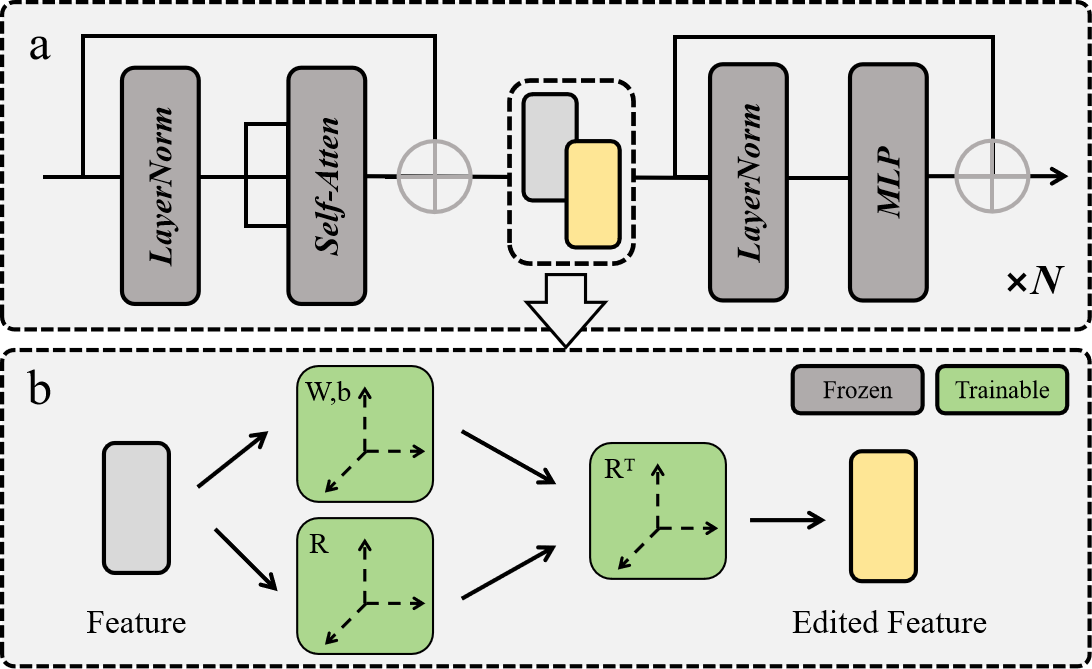
Conceptual illustration of the CoRe framework applied to a Vision Transformer. It compares traditional weight tuning with representation intervention.
Evaluation Highlights
- Consistently outperforms representative PEFT methods (Adapter, Prompt, SSF) across Task-Incremental Learning benchmarks including fine-grained (Aircraft) and large-scale (SUN397) datasets
- Demonstrates superior performance in Domain-Incremental Learning settings (CDDB, DomainNet), effectively handling domain shifts while maintaining class discriminability
- Achieves state-of-the-art results in Class-Incremental Learning (CIFAR100, ImageNet-R), the most challenging setting where task IDs are unavailable
Breakthrough Assessment
7/10
First application of Representation Finetuning (ReFT) to Continual Learning. Theoretically grounded with bounds on representation drift, though the paper relies on established backbones.