📝 Paper Summary
Lifelong Model Editing
Knowledge Internalization
SoLA enables continuous model editing by assigning frozen, independent LoRA modules to specific knowledge edits via semantic routing, preventing interference and allowing precise rollback of changes.
Core Problem
Existing lifelong editing methods suffer from catastrophic forgetting and semantic drift because they continuously update shared parameters or clustering centers, causing new edits to overwrite or mismatch old ones.
Why it matters:
- LLMs need continuous updates for dynamic real-world knowledge (e.g., new laws or events) without expensive re-training.
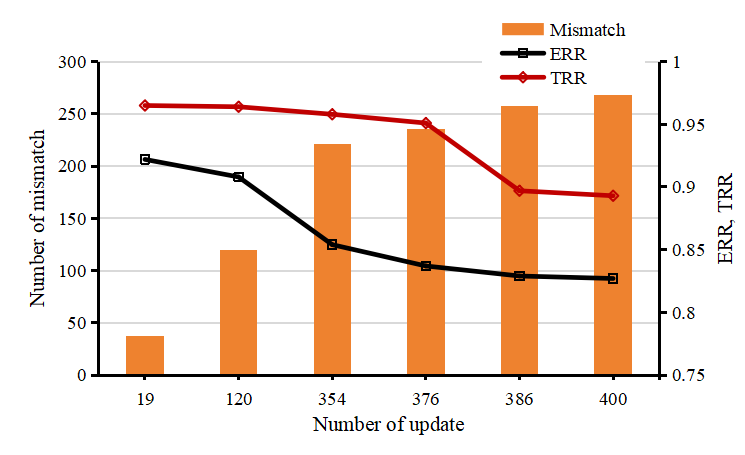
- Current methods like MELO update cluster centers, leading to 'semantic drift' where previous knowledge becomes inaccessible.
- Safety and reliability require the ability to 'undo' specific edits (rollback) if an update introduces hallucinations or harmful content, which current shared-parameter methods cannot easily do.
Concrete Example:
In MELO, as more edits are added, the cluster centers shift. An input that originally mapped to 'Cluster A' (correct edit) might later map to 'Cluster B' (incorrect/new edit) due to this drift, causing the model to forget the original update.
Key Novelty
Semantic Routing-Based LoRA (SoLA)
- Encapsulates every edit into a discrete, independent LoRA module that is trained once and then frozen, preventing future edits from corrupting it.
- Uses a 'semantic routing' mechanism where input embeddings are matched against stored keys (previous input representations) to dynamically activate the correct frozen LoRA module.
- Achieves reversibility by simply deleting the key-value pair from the routing table, effectively removing the edit without affecting others.
Architecture
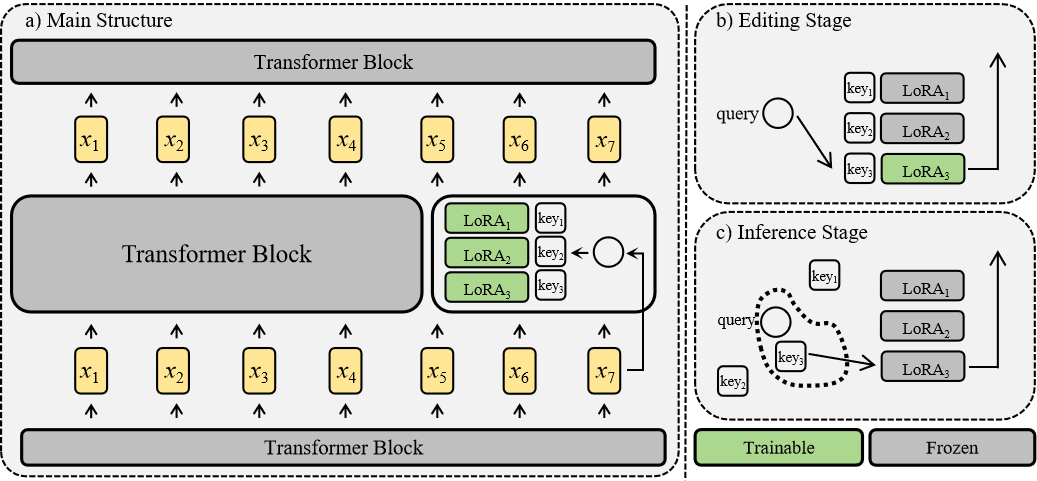
The SoLA framework pipeline: (a) insertion of LoRA, (b) editing process where key-value pairs are stored, and (c) inference process using semantic routing.
Evaluation Highlights
- +3.0% improvement in Edit Reliability Rate (ERR) over the strongest baseline (MELO) on the SCOTUS dataset.
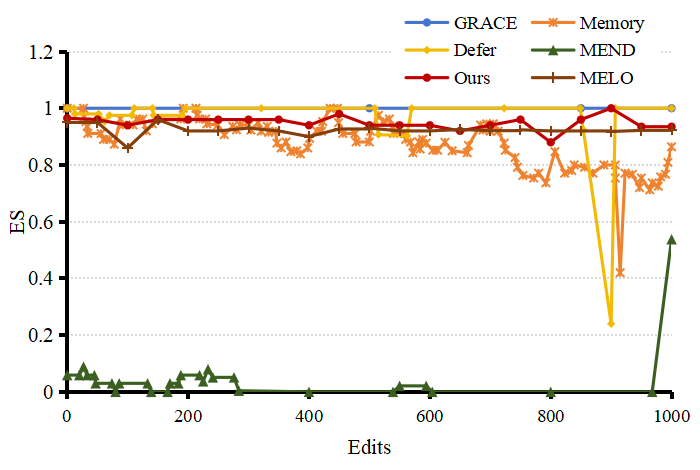
- Maintains near-perfect performance (high stability) across sequential editing tasks where baselines like MEND and SERAC degrade significantly.
- Requires only ~0.08M additional parameters to achieve optimal performance, demonstrating high parameter efficiency compared to baselines.
Breakthrough Assessment
7/10
Solid advancement in lifelong editing stability and the first to claim controllable rollback via routing. However, the scalability of storing a LoRA module per edit needs scrutiny for massive edit volumes.