📝 Paper Summary
Human-AI Interaction
AI Adoption
Trust in AI
This study establishes that user adoption of the autonomous agent OpenClaw is primarily driven by positive attitudes derived from perceived intelligence and personalization, while being significantly inhibited by distrust stemming from privacy and opacity concerns.
Core Problem
While conversational AI adoption is well-studied, there is limited empirical evidence regarding how users evaluate and accept *autonomous* AI agents that execute real-world actions.
Why it matters:
- Autonomous agents (like OpenClaw) introduce new risks (execution errors, loss of control) compared to passive chatbots, potentially altering adoption dynamics.
- Understanding the dual role of enabling factors (e.g., intelligence) and inhibiting factors (e.g., privacy risk) is crucial for designing trustworthy agentic systems.
Concrete Example:
A user might want OpenClaw to automate a workflow but hesitates because they perceive the decision-making process as opaque (algorithmic opacity) or fear data misuse (privacy concern), leading to distrust despite the tool's efficiency.
Key Novelty
CAC Framework for Agentic AI
- Applies the Cognition–Affect–Conation (CAC) framework to autonomous agents, mapping user psychology into three sequential stages: beliefs (Cognition), emotional responses (Affect), and behavioral intent (Conation).
- Separates antecedents into two distinct paths: an 'enabling' path where positive perceptions build Attitude, and an 'inhibiting' path where negative perceptions generate Distrust.
Architecture
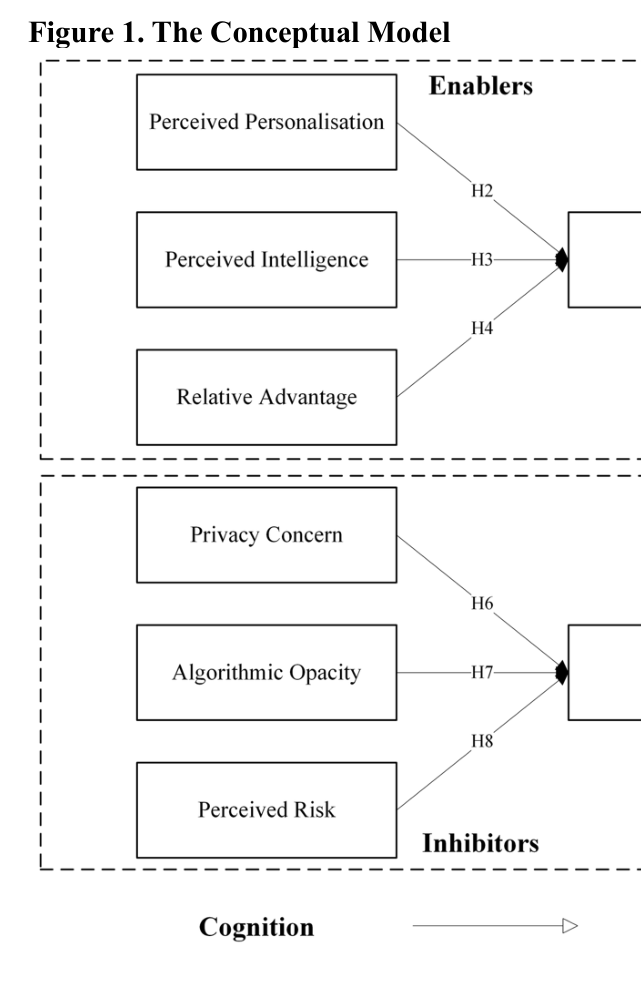
The Conceptual Model (CAC Framework) applied to OpenClaw adoption.
Evaluation Highlights
- Attitude is the strongest predictor of behavioural intention (β = 0.49), indicating that positive affect is the primary driver of adoption.
- Relative Advantage (β = 0.32) is the most influential cognitive factor for building a positive attitude, surpassing perceived intelligence and personalization.
- Perceived Risk (β = 0.28) is the strongest contributor to Distrust, which subsequently reduces usage intention (β = -0.22).
Breakthrough Assessment
4/10
Solid empirical validation of user psychology regarding agents. It confirms expected relationships (risk -> distrust) rather than proposing a new technical method, but provides necessary ground truth for HCI.