📝 Paper Summary
3D Scene Generation
Embodied AI Simulation
Procedural Content Generation
MANSION combines large language models with geometric solvers to generate interactive, building-scale multi-floor environments from text, enabling the evaluation of long-horizon embodied agents in complex spatial settings.
Core Problem
Existing embodied AI benchmarks are confined to single-floor, residential layouts that lack the vertical structure and scale required to test long-horizon spatial reasoning and planning.
Why it matters:
- Real-world tasks (delivery, hospital transport) are inherently building-scale and multi-floor, requiring agents to navigate elevators and stairs
- Current scene generation methods focus on single rooms or apartments, failing to model vertical constraints or cross-floor connectivity
- Scanned 3D datasets are expensive to collect, hard to modify for specific tasks, and lack interactive semantic elements needed for simulation
Concrete Example:
A standard generator might create a house where the second floor's footprint doesn't align with the first, or stairs lead to a ceiling. MANSION enforces vertical alignment and connectivity, allowing an agent to successfully navigate from a first-floor lobby to a second-floor office.
Key Novelty
Hybrid MLLM-Geometry Pipeline for Vertical Structures
- Decouples high-level semantic planning (via MLLMs) from low-level geometric validity (via constrained solvers) to ensure structural correctness
- Enforces vertical alignment as a hard constraint, ensuring elevator shafts and stairwells physically connect across multiple floors
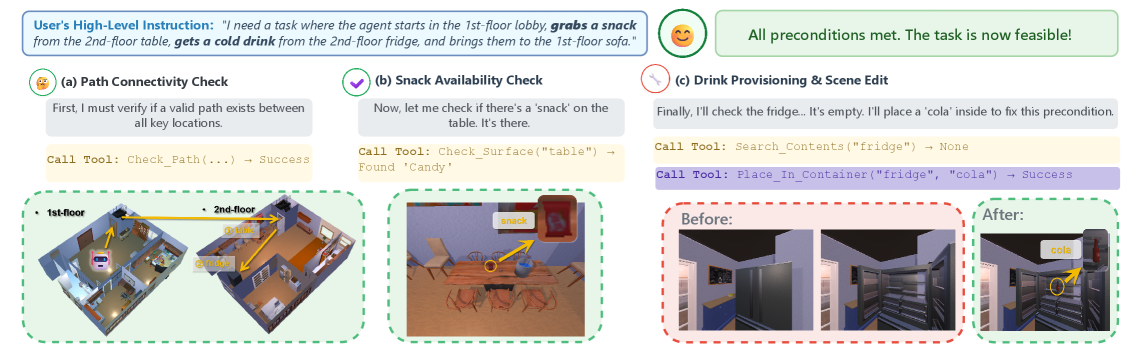
- Introduces a Task-Semantic Scene Editing Agent that modifies static environments via tool usage to satisfy preconditions for specific language-defined tasks
Architecture
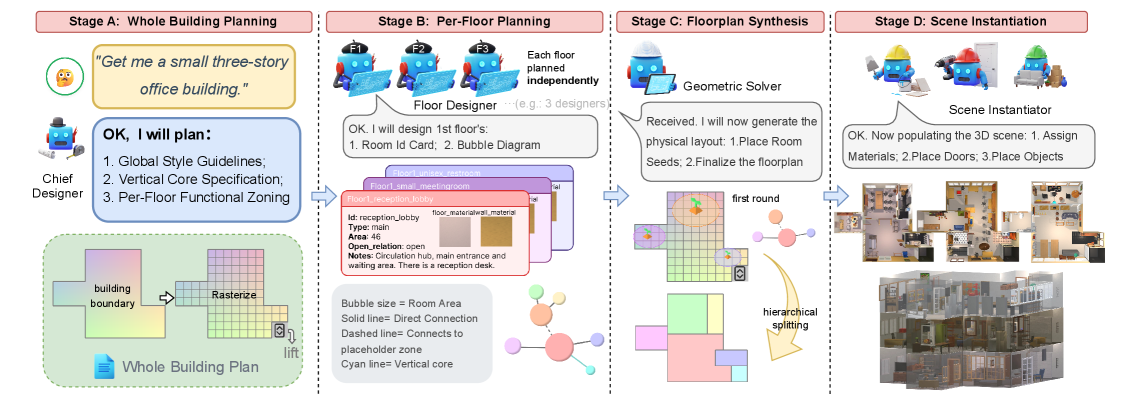
The hierarchical multi-agent framework of MANSION, showing the flow from user instruction to final 3D scene.
Evaluation Highlights
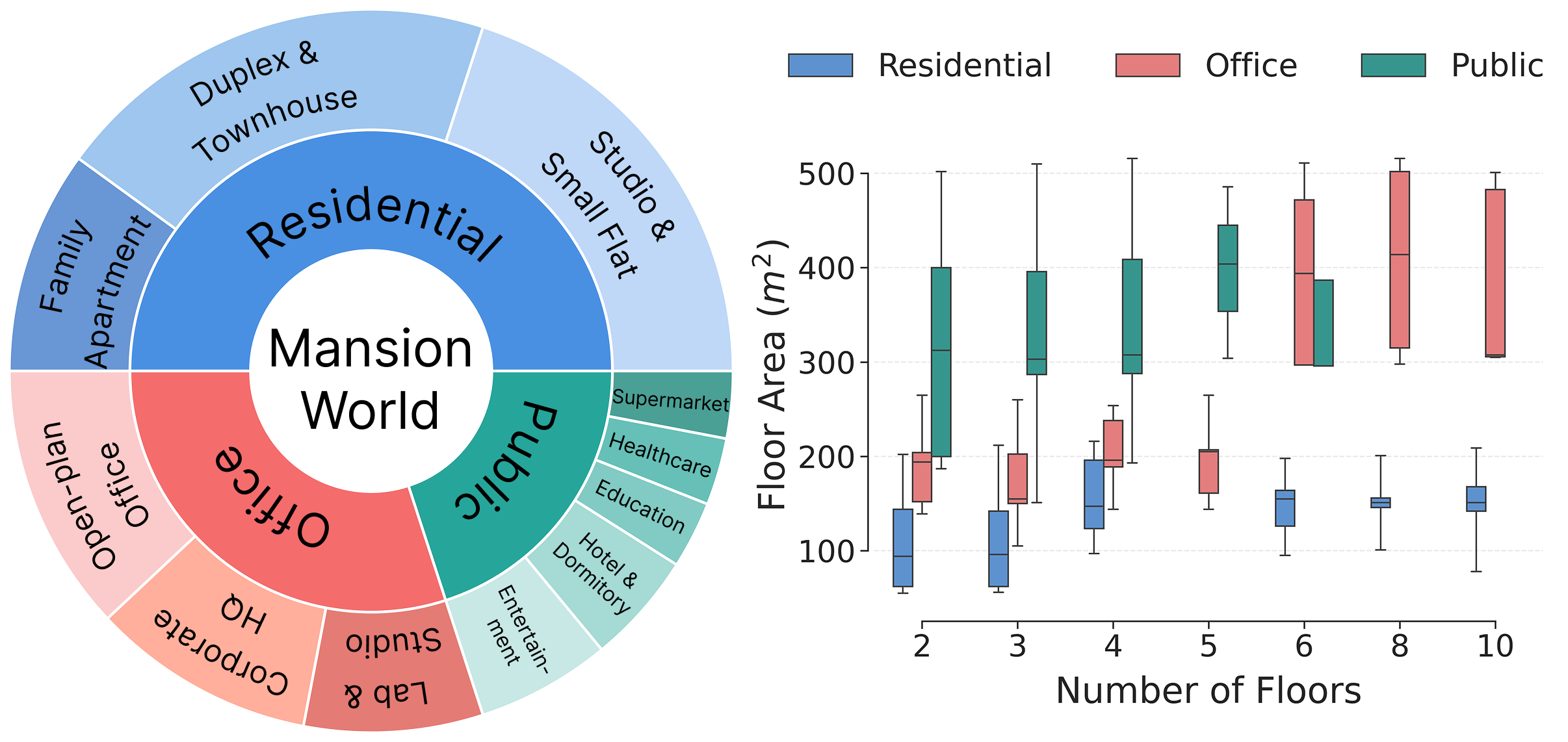
- Generated MansionWorld dataset containing over 1,000 diverse multi-floor buildings (offices, hospitals, schools) with >10,000 rooms
- State-of-the-art embodied agents show sharp performance degradation when moving from single-floor to multi-floor tasks in MANSION
- Framework supports export to AI2-THOR, Blender, and NVIDIA Isaac Sim for broad simulator compatibility
Breakthrough Assessment
9/10
First framework to successfully generate navigable, building-scale multi-floor environments from language, addressing a major gap in embodied AI simulation for long-horizon planning.