📝 Paper Summary
Human-Agent Collaboration
Agentic Workflow
Explainable AI (XAI)
Proposes simulation-in-the-loop, an interaction paradigm where agents visualize multiple future trajectories to give users foresight into downstream consequences rather than just reactive control over immediate steps.
Core Problem
Current human-agent interaction is pointwise and reactive: users approve individual actions without visibility into how they cascade into future risks or limit downstream options.
Why it matters:
- Users are forced to mentally simulate long-term effects, which is cognitively demanding and error-prone
- Reactive approval creates 'tunnel vision,' causing users to miss serendipitous alternatives that lie off the agent's single proposed path
- Lack of foresight leads to short-sighted decisions, such as booking tight connections that look efficient now but carry high failure risks later
Concrete Example:
In a travel planning task, a user might approve a flight with a short layover because it is cheap. Without simulation, they fail to realize this choice carries a 30% risk of missing a connection later. The user cannot see that a slightly more expensive flight eliminates this risk entirely.
Key Novelty
Simulation-in-the-loop Collaboration
- Externalizes the agent's internal exploration (e.g., tree search) into visible, navigable future trajectories for the human user
- Transforms the human role from a reactive supervisor (approving the next step) to a proactive explorer (comparing possible futures and trade-offs)
Architecture
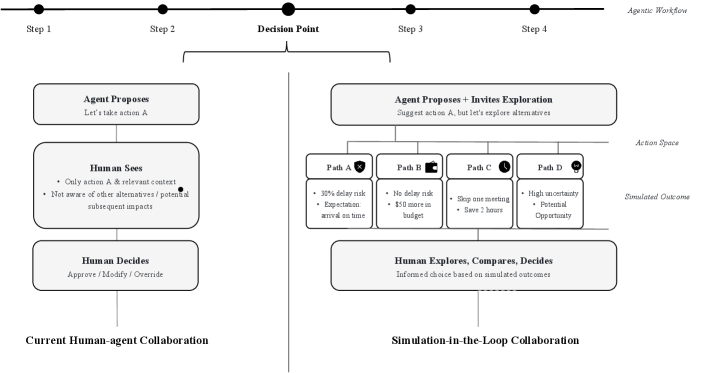
Contrast between current 'reactive' collaboration and the proposed 'simulation-in-the-loop' paradigm using a flight booking scenario
Breakthrough Assessment
7/10
A strong conceptual pivot for human-agent interaction, addressing the critical 'black box' nature of agent planning. Lacks empirical validation in this perspective paper but offers a robust theoretical framework.