📝 Paper Summary
Agentic RAG pipeline
Clinical Workflow Automation
A hospital-specific agent operating system that replaces vector retrieval with hierarchical document manifests and enforces safety through strictly isolated Linux-based execution environments.
Core Problem
General-purpose agents lack the security and longitudinal memory required for hospitals, while existing hospital systems are too rigid to handle variable clinical needs.
Why it matters:
- Standard agents require broad permissions (file/network access) incompatible with healthcare privacy and audit regulations
- Vector-based memory fragments patient history into isolated chunks, losing the temporal and causal structure needed for clinical reasoning
- Fixed-function hospital systems cannot handle the 'long tail' of unique patient comorbidities that fall outside pre-programmed protocols
Concrete Example:
A physician querying a patient's medication history might retrieve a dosage note from three years ago alongside a recent adverse event with no structural signal to distinguish them. Vector retrieval treats these as independent chunks, failing to capture the causal timeline needed for safe decision-making.
Key Novelty
Agentic Operating System for Hospital (AOSH)
- Replaces vector embeddings with 'Page-Indexed Memory': agents navigate a tree of human-readable 'manifest' files to find documents, mirroring how clinicians scan medical charts
- Enforces 'least-privilege execution' by isolating agents in restricted Linux namespaces where they can only invoke pre-approved skills, blocking arbitrary network or file access
- Uses a 'document-mutation' coordination model where agents communicate solely by writing structured updates to clinical records, creating an automatic audit trail
Architecture
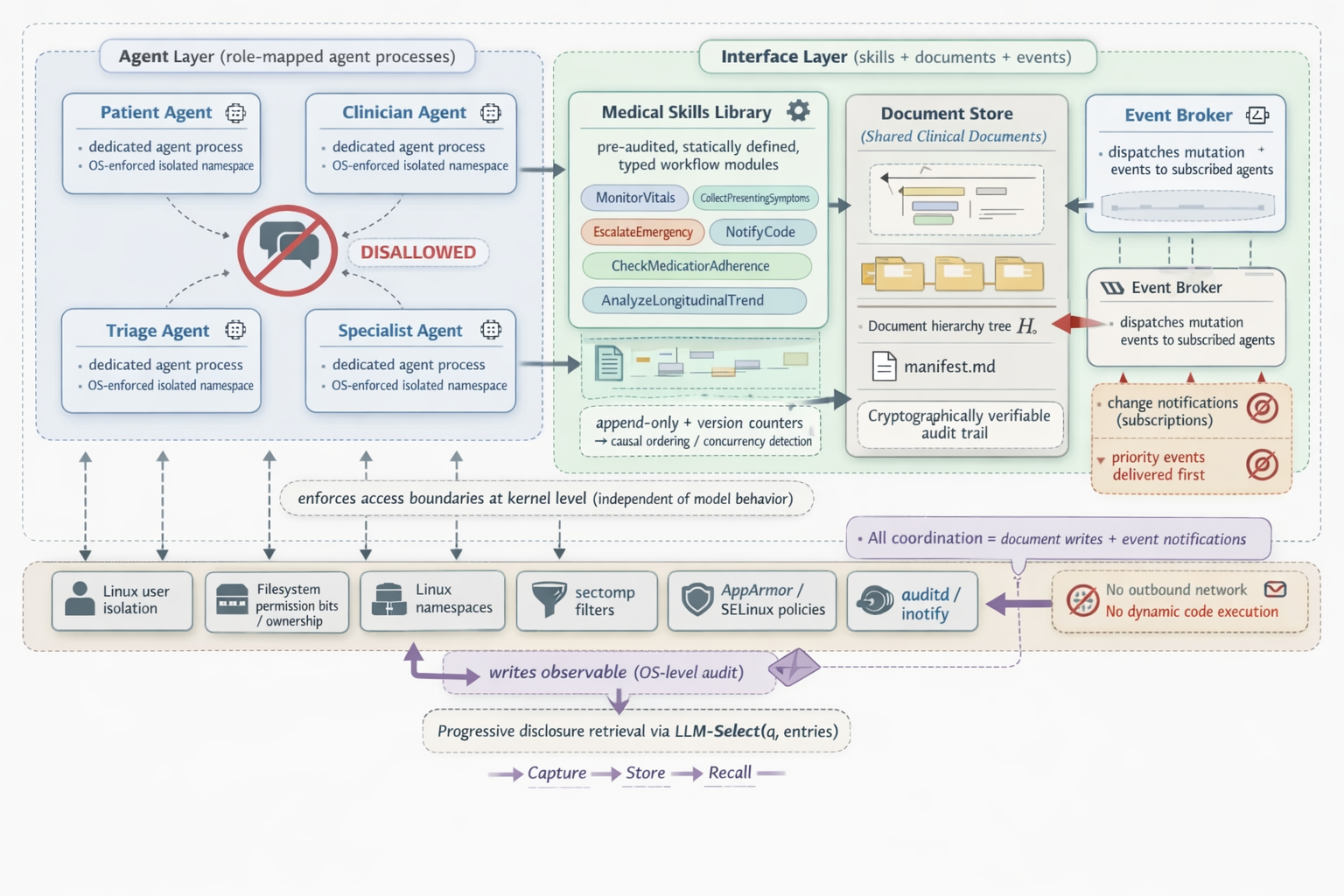
Overall architecture of the Agentic Operating System for Hospital
Breakthrough Assessment
7/10
Proposes a necessary architectural shift from 'model capabilities' to 'infrastructure design' for clinical AI. The abandonment of vector retrieval for manifest-based navigation is a significant conceptual pivot.