📝 Paper Summary
Fairness in Recommender Systems
Academic Peer Review
Fair-PaperRec optimizes academic paper acceptance by incorporating a fairness-aware penalty into a neural network, balancing demographic parity for race and country with paper quality metrics.
Core Problem
Double-blind reviews fail to eliminate systemic demographic biases (e.g., against racial minorities or developing countries), and standard recommendation algorithms trained on this data exacerbate these disparities by optimizing solely for accuracy.
Why it matters:
- High-prestige institutions and certain demographics continue to receive favorable reviews despite anonymization, marginalizing underrepresented groups
- Automated systems for grant distribution and paper selection risk perpetuating historical inequalities if they prioritize predictive accuracy over demographic justice
Concrete Example:
A standard accuracy-focused model might reject high-quality papers from 'underdeveloped' countries because historical training data favors 'developed' nations. Fair-PaperRec adjusts the acceptance threshold to ensure statistical parity without significantly dropping quality metrics like h-index.
Key Novelty
Fair-PaperRec (Fairness-aware MultiLayer Perceptron)
- Uses a specialized fairness loss function during training that penalizes deviations from demographic parity (equal acceptance rates across groups) for multiple attributes (race and country) simultaneously
- Decouples protected attributes from input features during inference to prevent direct bias, while using them during training to guide the model toward equitable probability distributions
Architecture
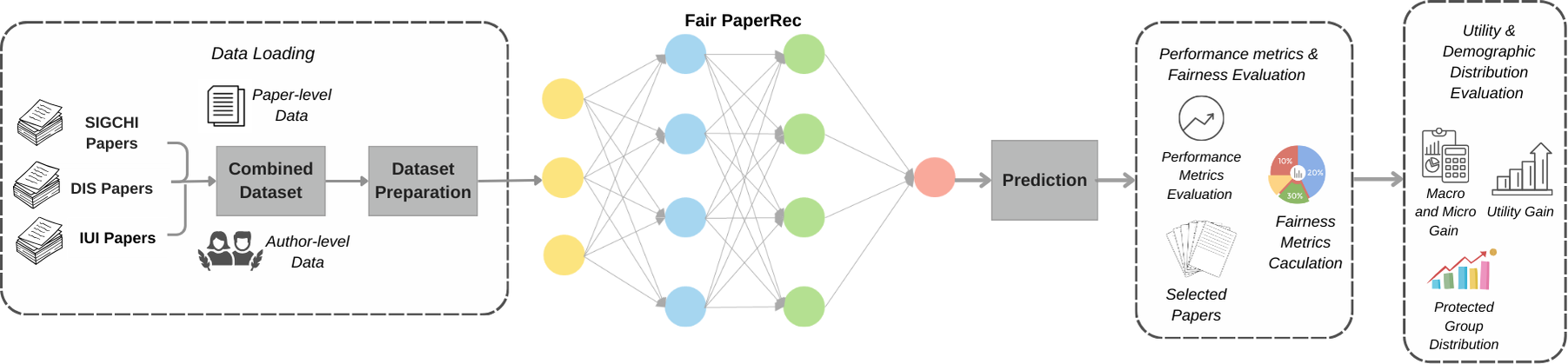
The MLP-based neural network architecture for Fair-PaperRec
Evaluation Highlights
- 42.03% increase in participation of underrepresented groups compared to heuristic baselines
- 3.16% improvement in overall utility (measured by h-index), contradicting the assumption that fairness requires sacrificing academic rigor
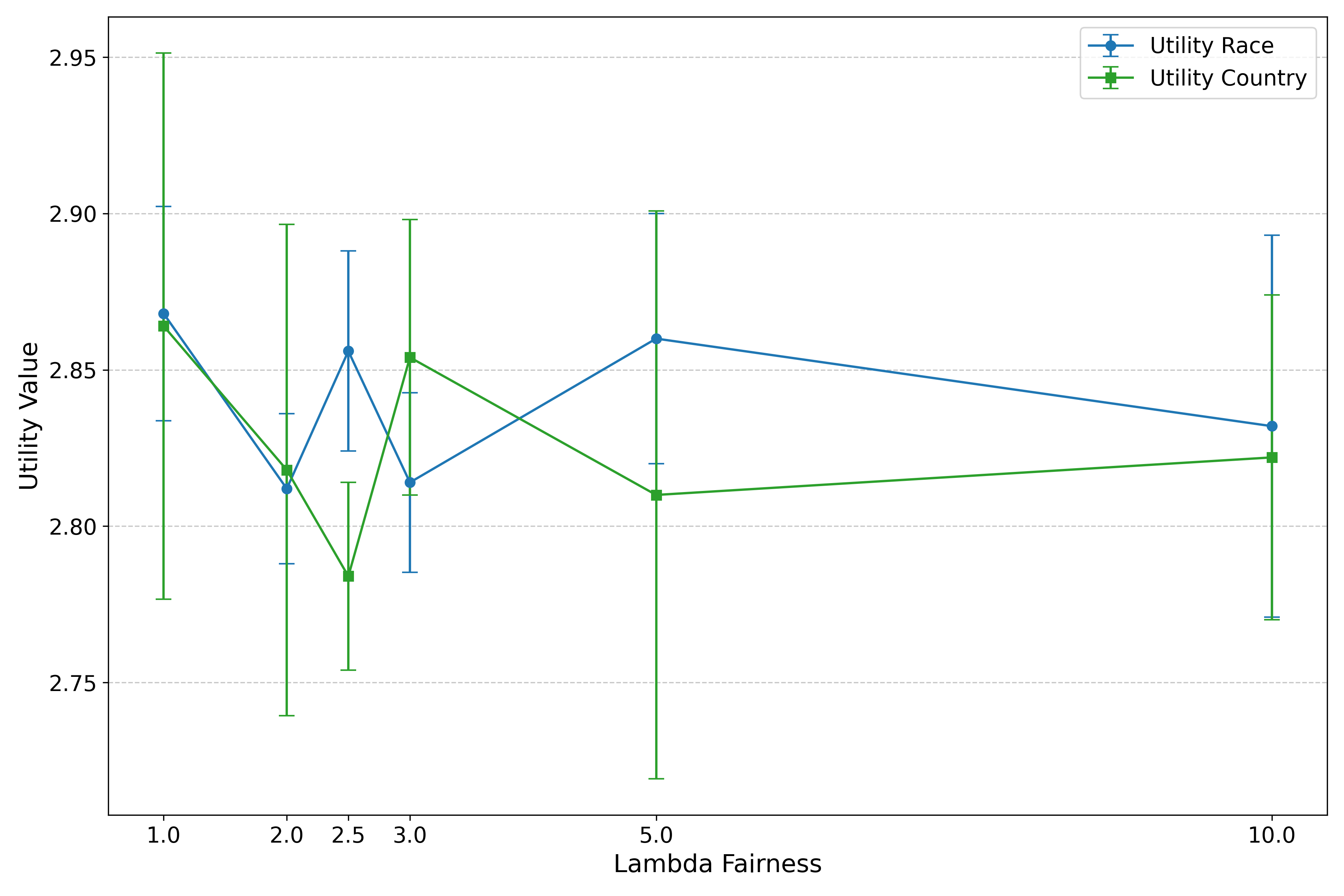
- Achieves optimal trade-off between race/country diversity and utility at fairness regularization parameter λ=2.5 to 3
Breakthrough Assessment
5/10
Applies established fairness concepts (demographic parity, MLP regularization) to a specific domain (academic review). Results are positive, but the method relies on standard architectural components.