FedFew solves the scalability-personalization trade-off in federated learning by maintaining a small set of shared server models that are jointly optimized via smoothed Tchebycheff scalarization to cover the Pareto front of client objectives.
Core Problem
Standard Federated Learning fails on heterogeneous data, while full personalization (one model per client) is unscalable; existing compromises like clustering lack theoretical optimality guarantees.
Why it matters:
In domains like healthcare or finance, data distributions (e.g., patient demographics) vary wildly, meaning a single global model cannot serve all clients effectively.
Existing multi-objective methods typically find only a single trade-off solution rather than personalized optima for each client.
Heuristic methods (like clustering) create non-convex, discontinuous landscapes that are difficult to optimize with gradient descent.
Concrete Example:In a healthcare federation, urban and rural hospitals have conflicting data distributions. Optimizing a single model for urban demographics harms rural performance. Conversely, training separate models for thousands of hospitals is computationally prohibitive. FedFew identifies a small set (e.g., 3) of shared models that cover these distinct groups automatically.
Key Novelty
Few-for-Many (K-for-M) Optimization Framework
Reformulates Personalization as finding a small set of K models to serve M clients (K << M), proving that approximation error vanishes as K increases.
Uses 'Two-Level Smoothing' to transform the discrete, non-differentiable problem of assigning clients to models into a smooth objective, allowing efficient gradient-based optimization of both model parameters and assignments.
Replaces manual clustering heuristics with a principled multi-objective optimization approach (Tchebycheff scalarization) that guarantees Pareto stationarity.
Architecture
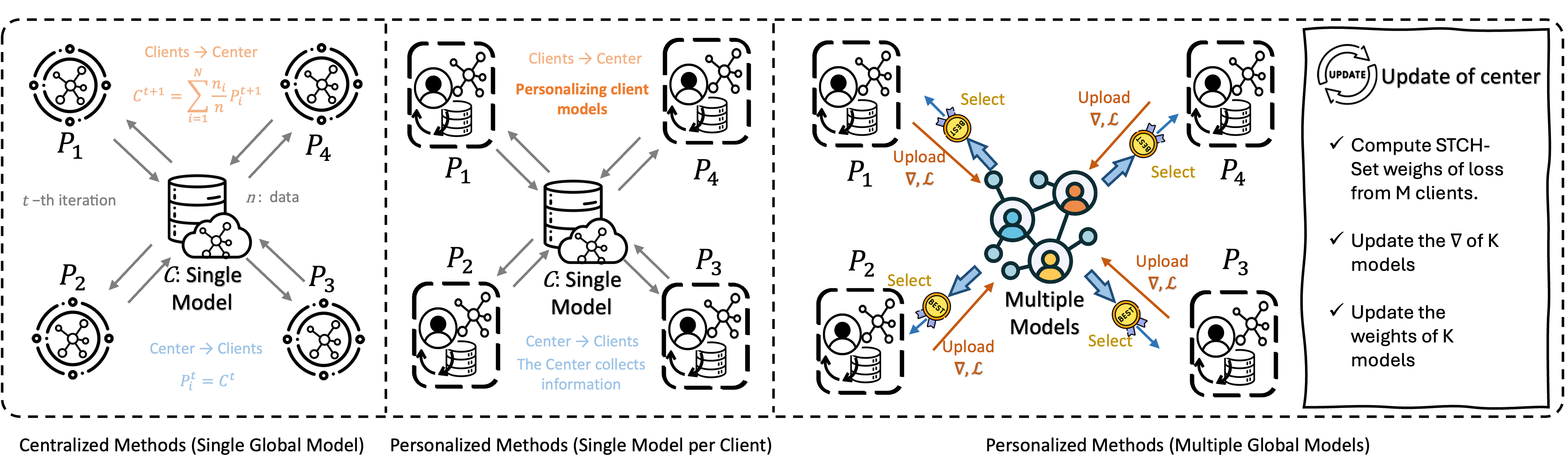
Illustration of the K-for-M framework where K shared server models collectively serve M clients.
Breakthrough Assessment
8/10
Provides a rigorous theoretical foundation (Pareto coverage guarantees) for a problem often solved by heuristics, combined with a practical algorithm that makes discrete model selection differentiable.
⚙️ Technical Details
Problem Definition
Setting: Federated learning with M clients having distinct distributions P_i, aiming to minimize the maximum loss across clients relative to their ideal personalized reference.
Inputs: Distributed datasets D_i from M clients
Outputs: A set of K server models Theta = {theta_1, ..., theta_K} and client-specific assignments
Pipeline Flow
Server broadcasts K models to clients
Client computes gradients for all K models
Server computes soft assignment weights (alpha and w) based on losses
Server updates all K models jointly using aggregated weighted gradients
System Modules
Client Gradient Computation
Compute local gradients for each of the K server models
Model or implementation: Task-dependent (e.g., CNN for vision, Transformer for NLP)
Weight Calculator (Server Side)
Compute aggregation weights based on Smooth Tchebycheff Scalarization
Model or implementation: Analytical formula (Eq. 11 in paper)
Model Updater (Server Side)
Update the K shared models using weighted aggregation of client gradients
Model or implementation: Gradient Descent
Novel Architectural Elements
Joint optimization of K models where the 'assignment' of client to model is treated as a differentiable weight layer rather than a hard clustering step
Modeling
Base Model: Agnostic (can be any differentiable model architecture)
Training Method: Federated Averaging with customized aggregation weights (FedFew)
Objective Functions:
Purpose: Approximate the discrete min-max client assignment problem.
Formally: Smooth Tchebycheff Set Scalarization (g_STCH-Set) using log-sum-exp smoothing.
Key Hyperparameters:
K: Number of server models (typically 3-10)
mu: Smoothing parameter controlling approximation quality of min/max operators
E: Number of local epochs per communication round
Compute: Communication cost is O(Kd) per round; Computation is K times standard FL per client
Comparison to Prior Work
vs. FedAvg: Maintains K models to handle heterogeneity instead of one.
vs. IFCA: Uses smooth gradient-based optimization instead of hard clustering/assignment, avoiding non-convex landscapes.
vs. FedMGDA: Finds a set of K models covering the Pareto front rather than a single trade-off solution.
Code is publicly available at https://github.com/pgg3/FedFew. The paper provides detailed error decomposition proofs in supplementary material. Specific datasets (Vision, NLP, Medical) are mentioned in abstract but specific names (e.g. CIFAR-10) are not in the provided text snippet.
📊 Experiments & Results
Evaluation Setup
Federated learning on heterogeneous data distributions
Benchmarks:
Vision Datasets (Image Classification)
NLP Datasets (Text Classification)
Medical Imaging (Medical Image Analysis)
Metrics:
Not explicitly reported in the paper (text truncated)
Statistical methodology: Not explicitly reported in the paper
Main Takeaways
FedFew consistently outperforms state-of-the-art PFL methods (including clustering and interpolation approaches) using only K=3 server models.
The method automatically discovers optimal model diversity without manual client partitioning or complex hyperparameter tuning.
Theoretical analysis confirms that the approximation error (Pareto coverage gap) vanishes as K increases and statistical error vanishes as local data grows.
📚 Prerequisite Knowledge
Prerequisites
Federated Learning (FL)
Multi-Objective Optimization (MOO)
Pareto Optimality
Key Terms
PFL: Personalized Federated Learning—training models tailored to individual client data distributions rather than a single global model
Pareto Front: The set of all optimal trade-off solutions where no objective can be improved without degrading another
Pareto Coverage Gap: The error introduced by using a finite number of models (K) to approximate the ideal personalized models for M clients
Tchebycheff Scalarization: A technique in multi-objective optimization that converts multiple objectives into a single min-max optimization problem
Log-sum-exp Smoothing: A mathematical trick to approximate the non-differentiable 'max' function with a smooth, differentiable function to enable gradient descent
K-for-M: The authors' proposed framework where K shared models are optimized to serve M distinct clients
Hard-sample mining: Focusing training on data points or clients that currently have the highest loss/error