📝 Paper Summary
Adversarial Attacks on AI
Compound AI Systems Security
Hardware/Software Security
Cascade is a red-teaming framework that chains traditional software vulnerabilities and hardware faults (like Rowhammer) with algorithmic AI attacks to bypass defenses in complex, multi-component AI pipelines.
Core Problem
Current security research treats LLM algorithmic risks (like jailbreaks) in isolation, ignoring that Compound AI Systems rely on complex software/hardware stacks where traditional vulnerabilities can be exploited to facilitate or amplify these algorithmic attacks.
Why it matters:
- Compound AI pipelines manage sensitive data (medical records, emails) and autonomous tools; a compromise in the supporting stack can grant attackers control regardless of model alignment.
- System-level attacks (e.g., bit-flips) operate independently of model architecture and persist across retraining, making them harder to mitigate than pure prompt engineering.
- Defenders often overlook the interaction between stack layers, missing how a low-level hardware fault can be the key to bypassing a high-level semantic guardrail.
Concrete Example:
An attacker wishes to inject a jailbreak prompt, but a 'Query Enhancer' sanitizes inputs and a 'Guardrail' blocks unsafe outputs. Using Cascade, the attacker exploits a software code injection to bypass the enhancer, then uses a Rowhammer hardware attack to flip a bit in the Guardrail's memory, inverting its decision from 'unsafe' to 'safe'.
Key Novelty
Cross-Stack Attack Gadget Composition
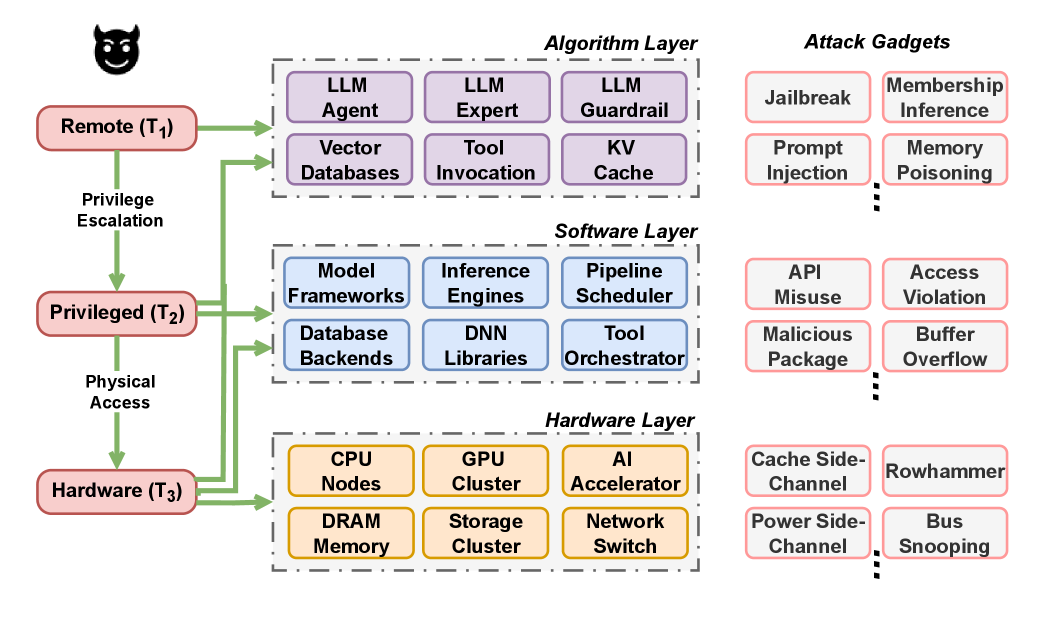
- Systematizes vulnerabilities across three layers (Algorithmic, Software, Hardware) into modular 'attack gadgets' that can be chained together.
- Demonstrates that non-AI vulnerabilities (e.g., memory safety errors, side-channels) can serve as prerequisites to enable successful algorithmic exploitation in robust pipelines.
Architecture
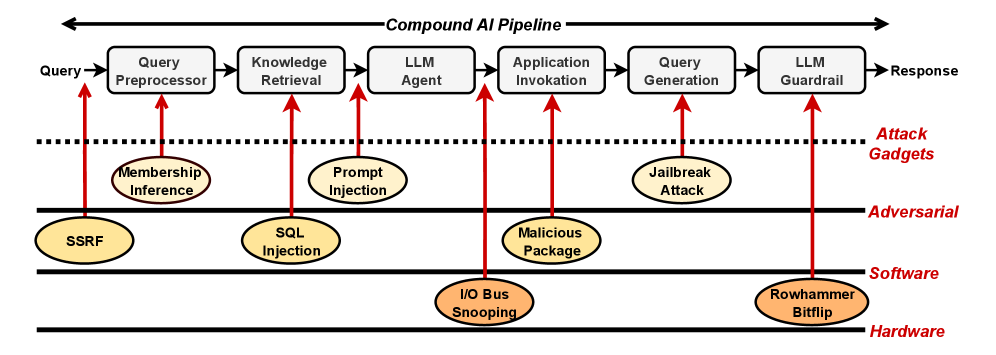
Schematic of a Compound AI pipeline and potential attack points across layers
Breakthrough Assessment
8/10
Highly significant for highlighting the neglected intersection of system security and AI safety. The concept of using hardware faults to flip guardrail decisions fundamentally challenges current software-only AI defense paradigms.