📊 Experiments & Results
Evaluation Setup
Resource Competition Game with varying capacity C
Benchmarks:
- Resource Competition (N=7) (Multi-Agent Coordination / Minority Game) [New]
Metrics:
- System Overload (frequency Demand > Capacity)
- Individual Win Rate
- Statistical methodology: Paired per-seed t-tests for FRD-LOTF differences; Poisson-binomial exact convolution for null model
Key Results
| Benchmark | Metric | Baseline | This Paper | Δ |
|---|---|---|---|---|
| Under scarcity (low capacity), sophisticated tribal agents (L5) reduce overload compared to individual learners (L4), though absolute overload remains high. | ||||
| Resource Competition (N=7, C=2) | System Overload | Not reported in the paper | Not reported in the paper | -11.9 percentage points |
| At extreme scarcity (C=1), the system fails collectively, but tribal followers profit individually. | ||||
| Resource Competition (N=7, C=1) | System Overload | Not applicable | 91.5 | Not applicable |
| Resource Competition (N=7, C=1) | Individual Win Rate | 50.0 | 84.2 | +34.2 |
| Cross-over effect: Sophisticated tribal agents perform worse than individual learners when resources are abundant (C>=4). | ||||
| Resource Competition (N=7, C=4) | System Overload | Not reported in the paper | Not reported in the paper | Positive (worse) |
Experiment Figures
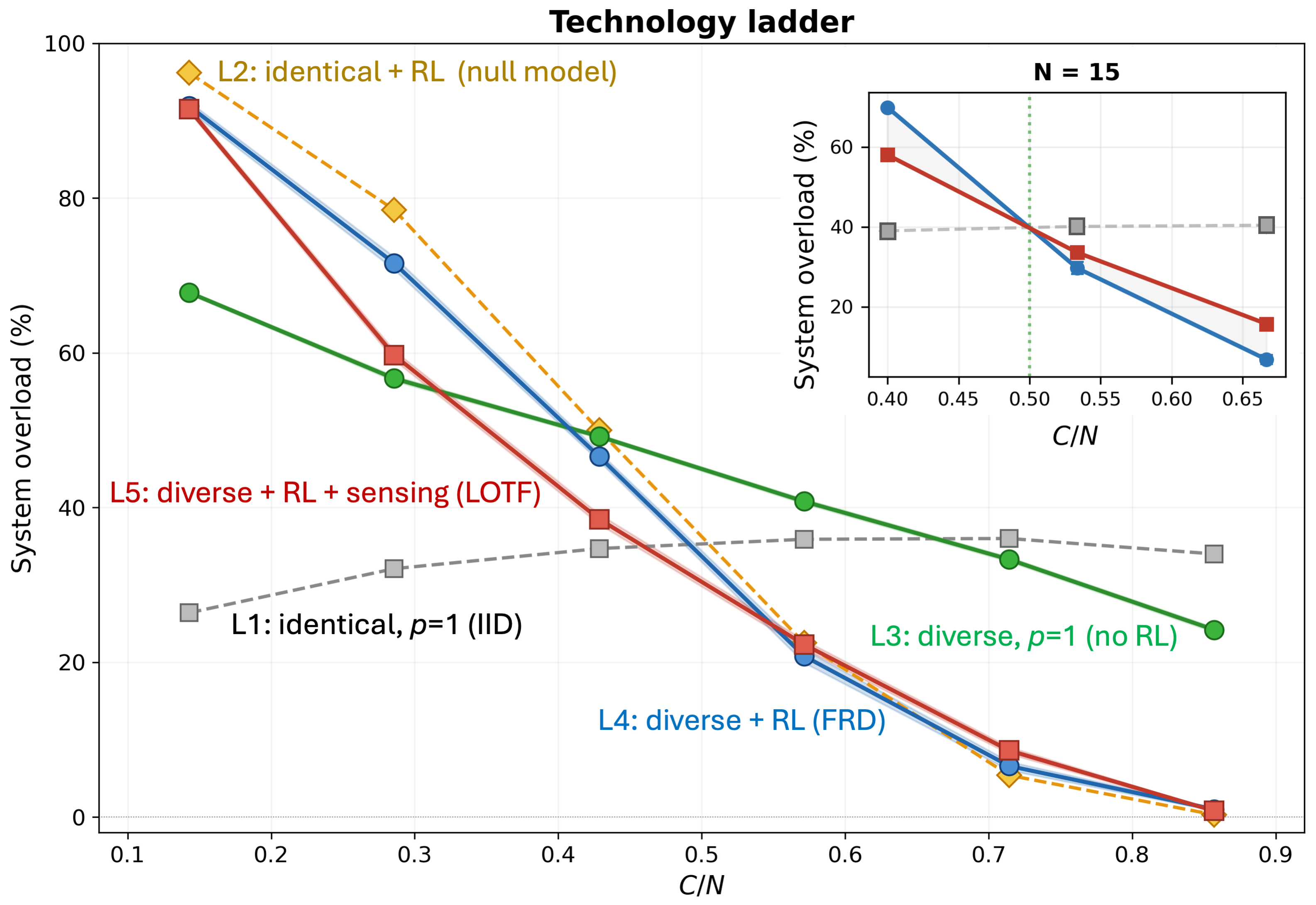
System overload vs. Resource Capacity (C) for different technology levels (L1 to L5)
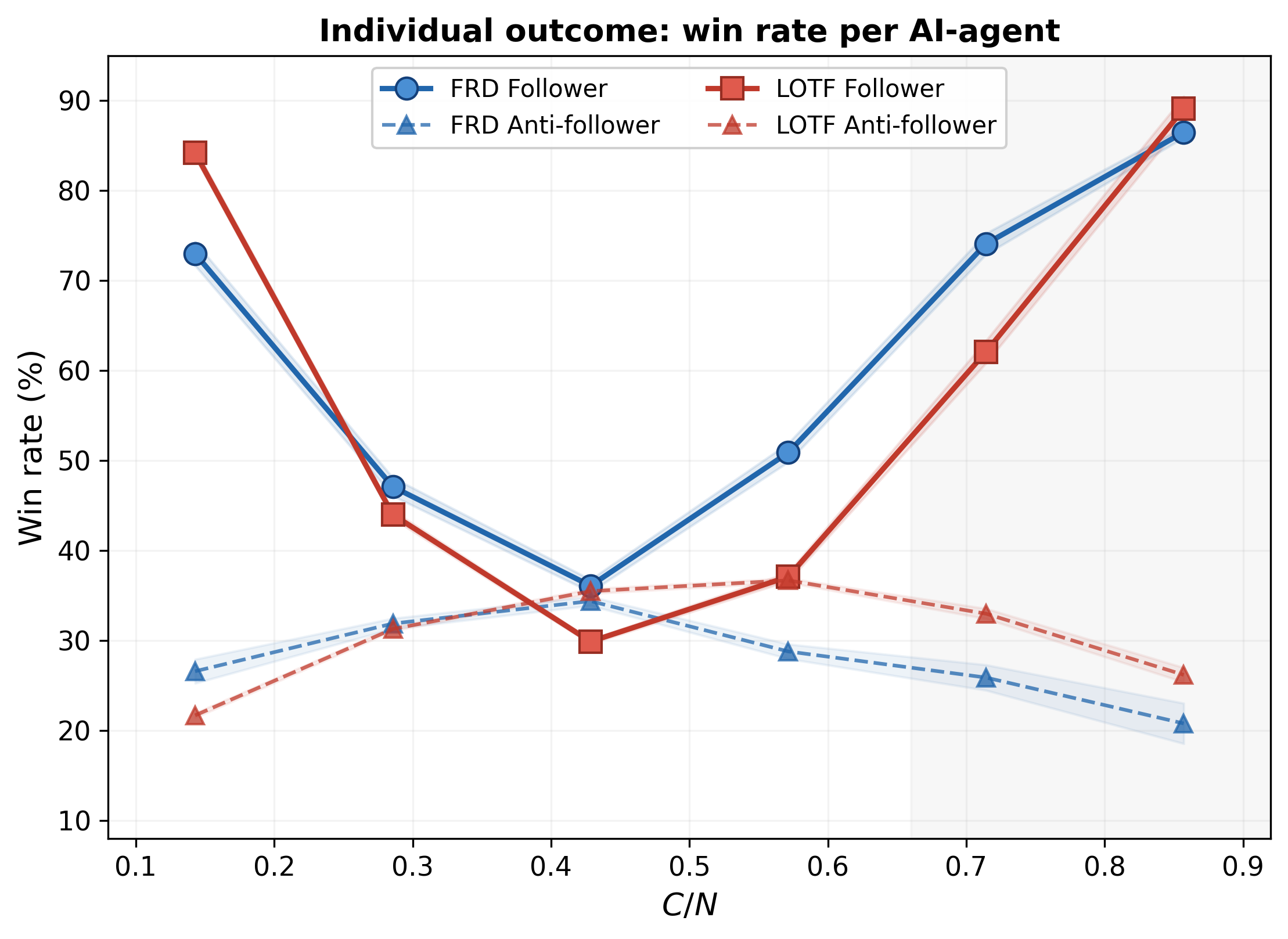
Individual win rates for Followers vs. Anti-followers across capacities
Main Takeaways
- Sophistication is not strictly better: Whether L5 (Tribal) or L4 (Individual) agents are preferred depends entirely on the capacity-to-population ratio (C/N).
- The 'Crossover' occurs at C/N ≈ 0.5: Below this (scarcity), tribal structure helps cap variance; above it (abundance), tribal structure prevents full utilization of resources.
- L1 (Random/Simple) agents actually outperform sophisticated L4/L5 agents in preventing overload under extreme scarcity, suggesting 'dumb' firmware is safer for highly constrained systems.
- Collective failure coexists with individual success: In the L5 system at C=1, the system is jammed 91.5% of the time, yet tribal followers achieve an 84.2% win rate.