📝 Paper Summary
Knowledge Editing
Model Updating
Factuality
μKE improves unstructured knowledge editing in LLMs by introducing a Matryoshka-style objective that ensures early memory updates causally influence all subsequent generated tokens, preventing dependency disruptions found in window-based methods.
Core Problem
Current unstructured editing methods (like AnyEdit) use a window-by-window autoregressive strategy that breaks the causal dependency between early memory updates and later output tokens.
Why it matters:
- Window-based editing treats sequential segments independently, failing to reflect how a fully retrained model would behave where internal states causally affect all future outputs
- Missing dependencies lead to lower editing efficacy and hallucination risks when updating long-form or unstructured knowledge
- Existing locate-and-edit methods were designed for simple triplets and struggle with complex, variable-length text generation
Concrete Example:
When editing a long explanation about 'the critical temperature change of a superconducting magnet', AnyEdit splits the text into windows and updates memories for each window independently. An update for the first sentence doesn't mathematically account for its influence on the third sentence, unlike in a real causal language model.
Key Novelty
Matryoshka Unstructured Knowledge Editing (μKE)
- Conceptualizes an early working memory update as a 'condensed representation shift' that must partially cover all subsequent edit targets (windows), like nested Matryoshka dolls
- Uses a weighted objective function where the update for position i is optimized against targets i, i+1, ..., N, ensuring the memory shift aids in generating the entire remaining sequence
- Introduces adaptive loss coefficients based on the gradient affinity (cosine similarity) between different target figures to balance optimization between easy and hard segments
Architecture
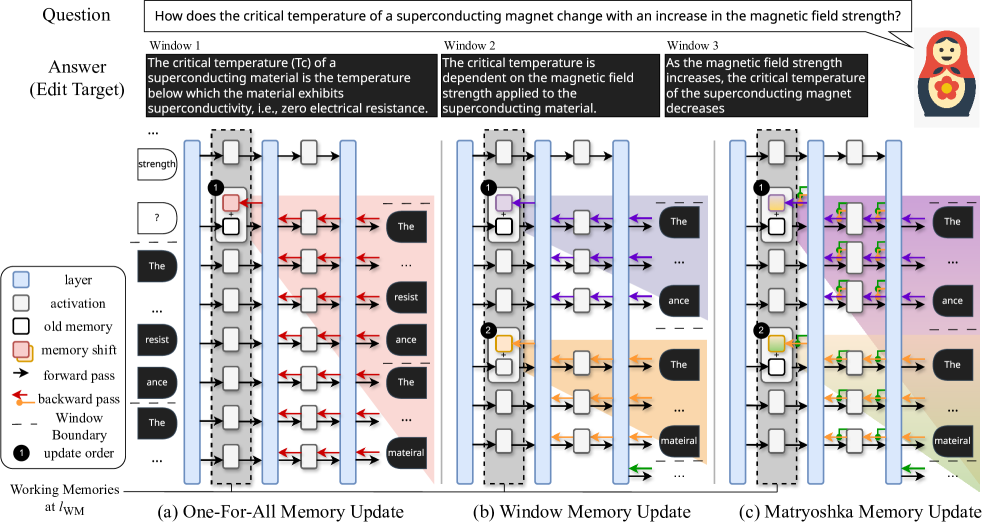
Comparison of One-for-All, Window-by-Window, and μKE memory update strategies.
Evaluation Highlights
- +12.33% BLEU improvement over AnyEdit on UnKEBench (original questions) using Qwen2.5-7B-Instruct
- Achieves up to 99.996% BLEU and ROUGE-L with μKE* (UnKE-based variant) on UnKEBench, effectively solving the editing task
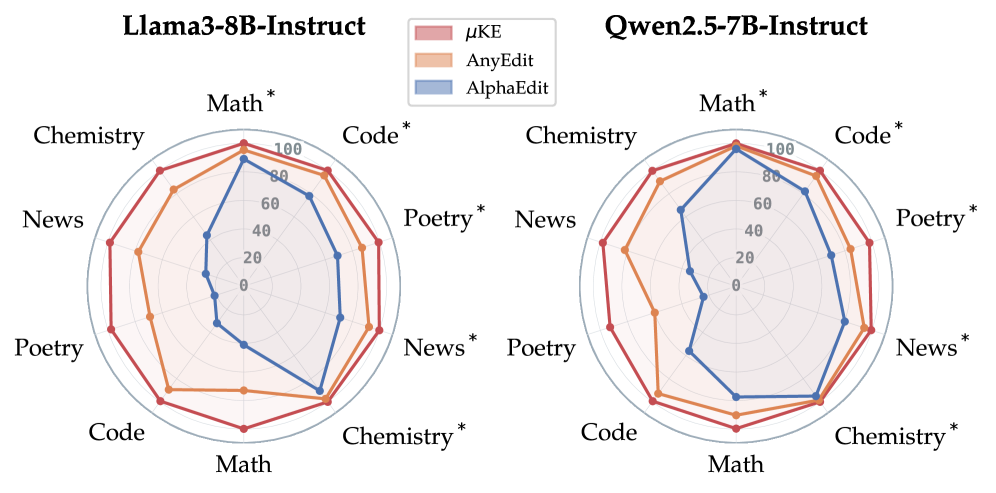
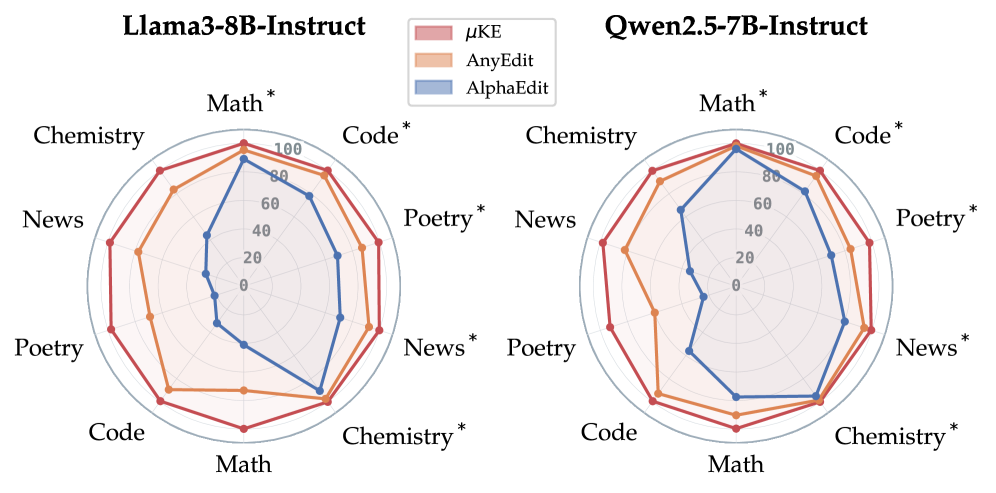
- Robust performance across diverse domains (Poetry, Math, Code) in EditEverything benchmark, where AnyEdit fails significantly on Poetry
Breakthrough Assessment
8/10
Significantly improves unstructured editing efficacy by theoretically addressing the causality gap in window-based methods. The performance gains are substantial (+12%) and the method is robust to format variations.