📝 Paper Summary
Federated Learning in Medical Imaging
Privacy-Preserving Machine Learning
Personalized Federated Learning
PPPML-HMI combines personalized federated learning with a novel cyclic secure aggregation protocol using homomorphic encryption to enable collaborative medical image analysis across hospitals with heterogeneous data and strict privacy requirements.
Core Problem
Standard federated learning fails on heterogeneous medical data (non-IID) due to model drift and remains vulnerable to gradient leakage attacks that can reconstruct private patient images.
Why it matters:
- Hospitals use diverse CT scanners and settings, creating heterogeneous data where a single global model performs poorly locally
- Medical data is highly sensitive; sharing raw data is often legally impossible, and standard FL gradients can still leak private information via reconstruction attacks
- Current solutions rarely address both personalization (for accuracy) and rigorous cryptographic privacy (for security) simultaneously in an open-source framework
Concrete Example:
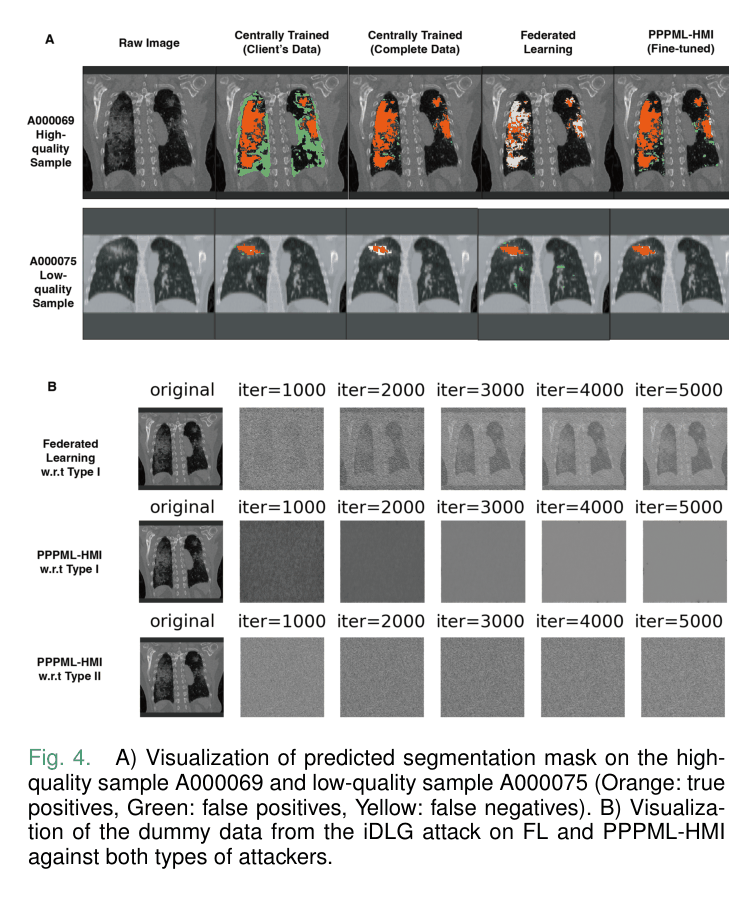
In the paper's case study, a model trained on Hospital C's data fails completely when applied to Hospital D (Dice score 0.28). Standard FedAvg also underperforms on Hospital D (Dice 0.39) compared to local training (Dice 0.46) due to data heterogeneity.
Key Novelty
Personalized & Privacy-Preserving Federated Learning (PPPML-HMI)
- Integrates Per-FedAvg (meta-learning) to train a highly adaptable global model that users fine-tune locally, solving the heterogeneity problem
- Replaces the central server's aggregation role with a decentralized Cyclic Secure Aggregation loop where users pass homomorphically encrypted gradients, preventing the server from ever seeing raw updates
Architecture
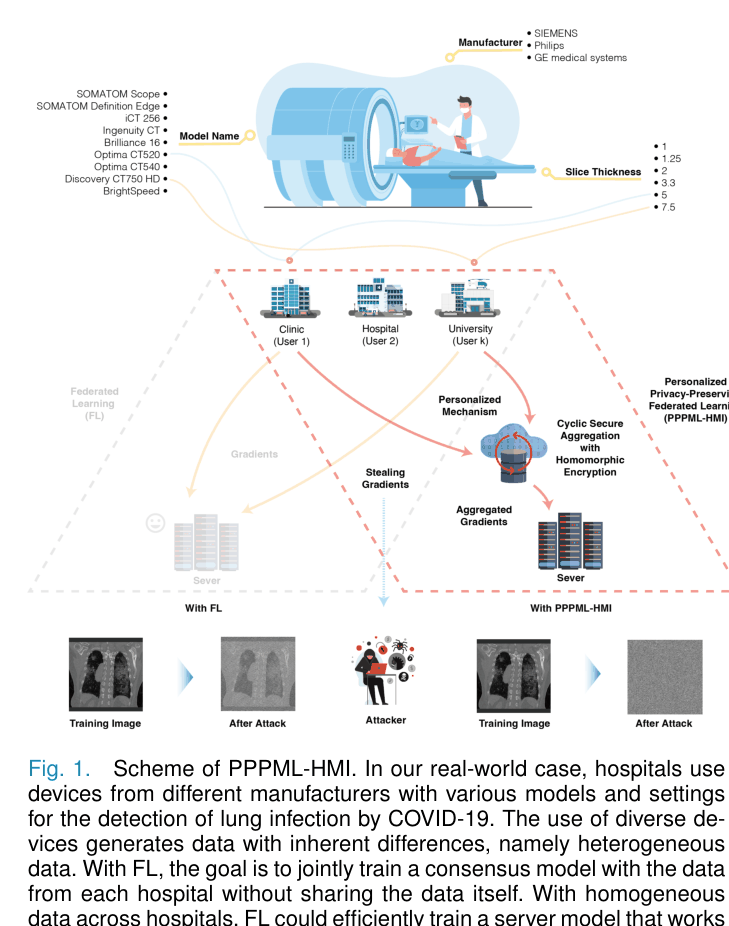
High-level schematic of PPPML-HMI showing the personalized FL process and the Cyclic Secure Aggregation with Homomorphic Encryption (CSAHE) loop.
Evaluation Highlights
- Achieved ~5% higher average Dice score on real-world heterogeneous COVID-19 segmentation compared to conventional FedAvg
- Successfully blocked Deep Leakage from Gradients (iDLG) attacks, preventing reconstruction of private CT images while FedAvg leaked them
- Outperformed independent local training for hospitals with distinct data distributions (e.g., Hospital D: Dice 0.51 vs 0.46)
Breakthrough Assessment
8/10
Strong practical contribution combining personalization and strong cryptographic privacy for a critical medical task. Demonstrates effectiveness on real-world heterogeneous clinical data, though the algorithmic components (Per-FedAvg, HE) are known individually.