📝 Paper Summary
Federated Learning Security
Backdoor Attacks
The paper reveals that personalized Federated Learning methods with partial model-sharing naturally resist backdoor attacks by blocking trigger propagation, motivating a lightweight defense called Simple-Tuning.
Core Problem
Backdoor attacks in Federated Learning allow adversaries to inject triggers that mislead models on specific inputs, and existing defenses often degrade clean accuracy or fail against stealthy attacks.
Why it matters:
- Backdoor attacks are stealthy and hard to detect because compromised models behave normally on benign data
- Federated Learning systems in finance and healthcare face severe security risks from malicious clients injecting hidden triggers
- Current defenses like norm clipping or adding noise force a severe trade-off between robustness and model utility (clean accuracy)
Concrete Example:
An adversary injects a 'hello kitty' stamp into training images of a Stop sign to misclassify it as a Speed Limit sign. In standard FL (FedAvg), this trigger propagates to the global model, affecting all users. The paper shows that pFL methods can prevent this propagation.
Key Novelty
Partial Model-Sharing as a Natural Backdoor Defense
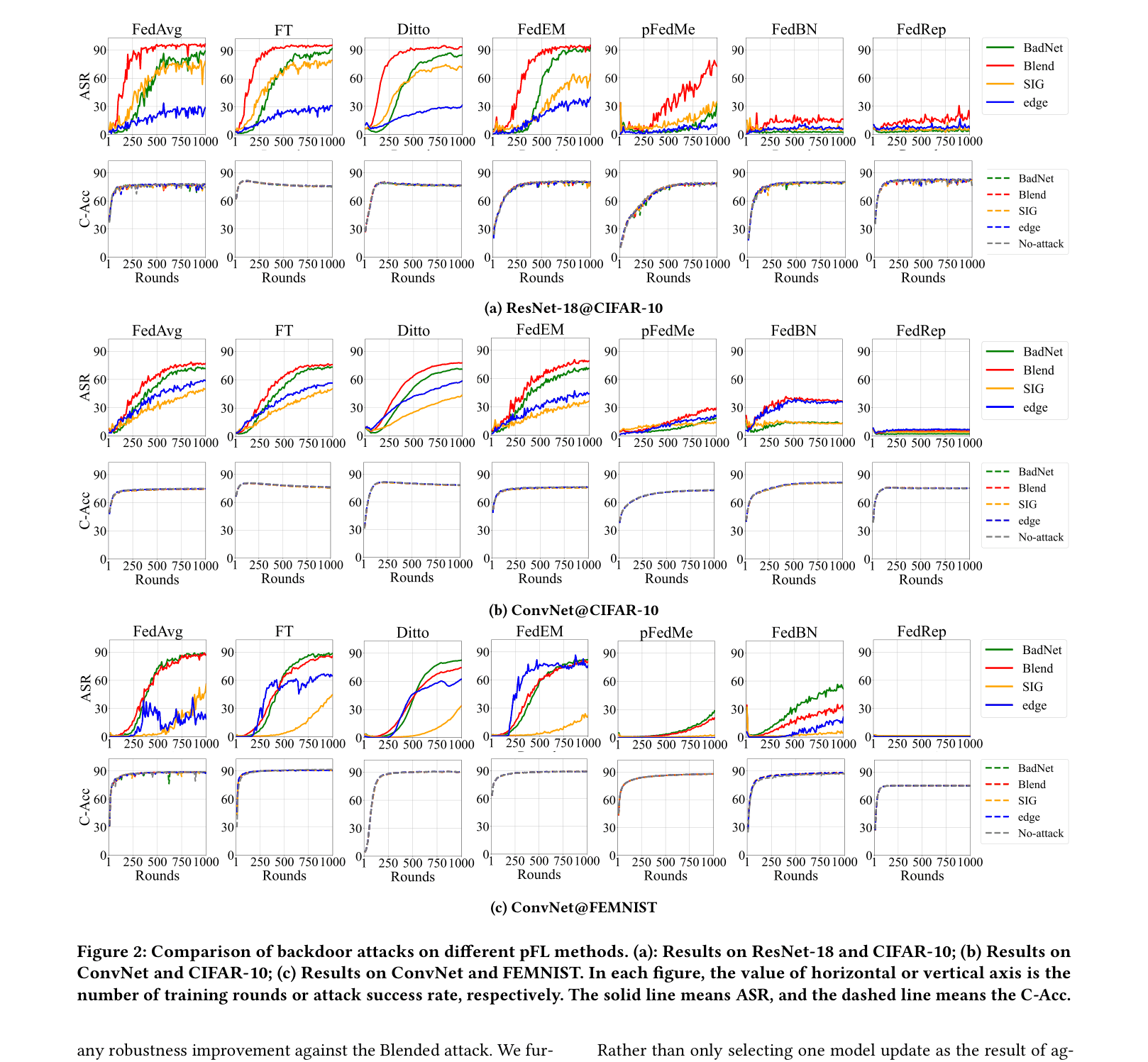
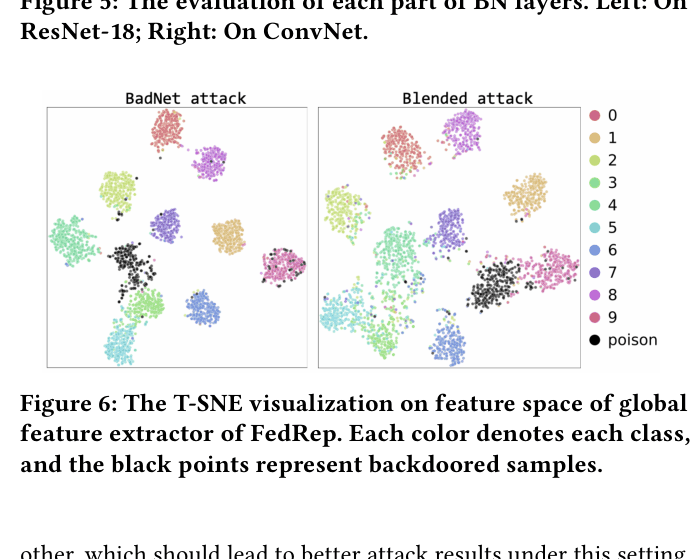
- Discovers that pFL methods which share only parts of the model (like FedRep sharing the encoder but not the classifier) inherently block backdoor features from propagating to honest clients
- Identifies that the degree of personalization is positively correlated with robustness: fully shared models (Ditto) remain vulnerable, while partially shared models (FedBN) are robust
- Proposes 'Simple-Tuning': a lightweight defense that reinitializes and retrains the linear classifier locally, effectively removing backdoor triggers learned during FL
Architecture
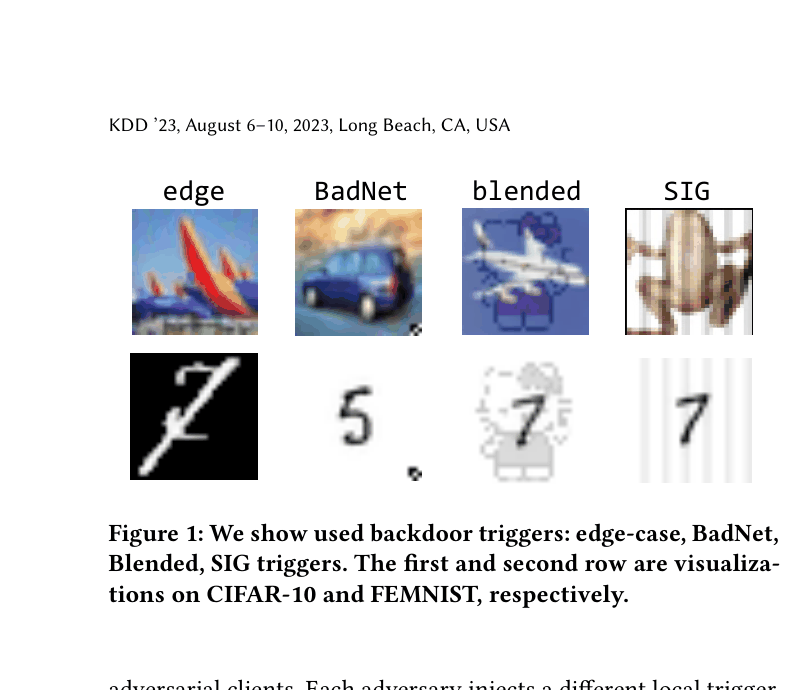
Examples of backdoor triggers used in the study: Edge-case (Ardis 7, Southwest Plane), BadNet (pixel pattern), Blended (Hello Kitty), and SIG (sinusoidal signal)
Evaluation Highlights
- FedRep reduces Attack Success Rate (ASR) of Blended attacks from >90% (FedAvg) to <10% on CIFAR-10 without sacrificing clean accuracy
- Proposed Simple-Tuning defense reduces ASR by ~56.6% on average compared to FedAvg, while maintaining or improving clean accuracy
- Baseline defenses like Krum and Norm Clipping fail to defend against Blended attacks or suffer significant drops in clean accuracy
Breakthrough Assessment
8/10
First comprehensive study linking pFL personalization structures to backdoor robustness. The finding that partial sharing naturally defends against backdoors is a significant insight, leading to a simple, practical defense.