Fiona Draxler, Anna Werner, Florian Lehmann, Matthias Hoppe, Albrecht Schmidt, Daniel Buschek, Robin Welsch
Ludwig Maximilian University of Munich,
University of Bayreuth,
Aalto University
arXiv.org
(2023)
P13NBenchmark
📝 Paper Summary
Human-AI InteractionPsychological Ownership
Users of personalized AI text generators do not feel they own the text (psychological ownership) but still refrain from publicly crediting the AI, mirroring human ghostwriting practices.
Core Problem
Generative AI complicates authorship, yet it is unclear how users psychologically attribute ownership when using personalized AI systems compared to how they publicly declare it.
Why it matters:
Legal and ethical frameworks for AI authorship are emerging, but they lack empirical grounding in how users actually perceive and declare ownership.
Personalized AI blurs the line between user and system contribution, potentially encouraging uncredited use similar to ghostwriting.
Current UI designs for text generation do not account for the psychological disconnect between feeling ownership and claiming authorship.
Concrete Example:A user generates a personalized postcard using GPT-3. They feel the AI wrote it (low psychological ownership) but sign it with their own name and do not credit the AI in the byline (high declared authorship).
Key Novelty
The AI Ghostwriter Effect
Identifies a specific psychological phenomenon where users acknowledge the AI's role privately (low sense of ownership) but hide it publicly (no authorship declaration).
Empirically compares AI support to human ghostwriting, finding that people are actually *less* likely to credit AI than a human ghostwriter despite similar rationalizations.
Architecture
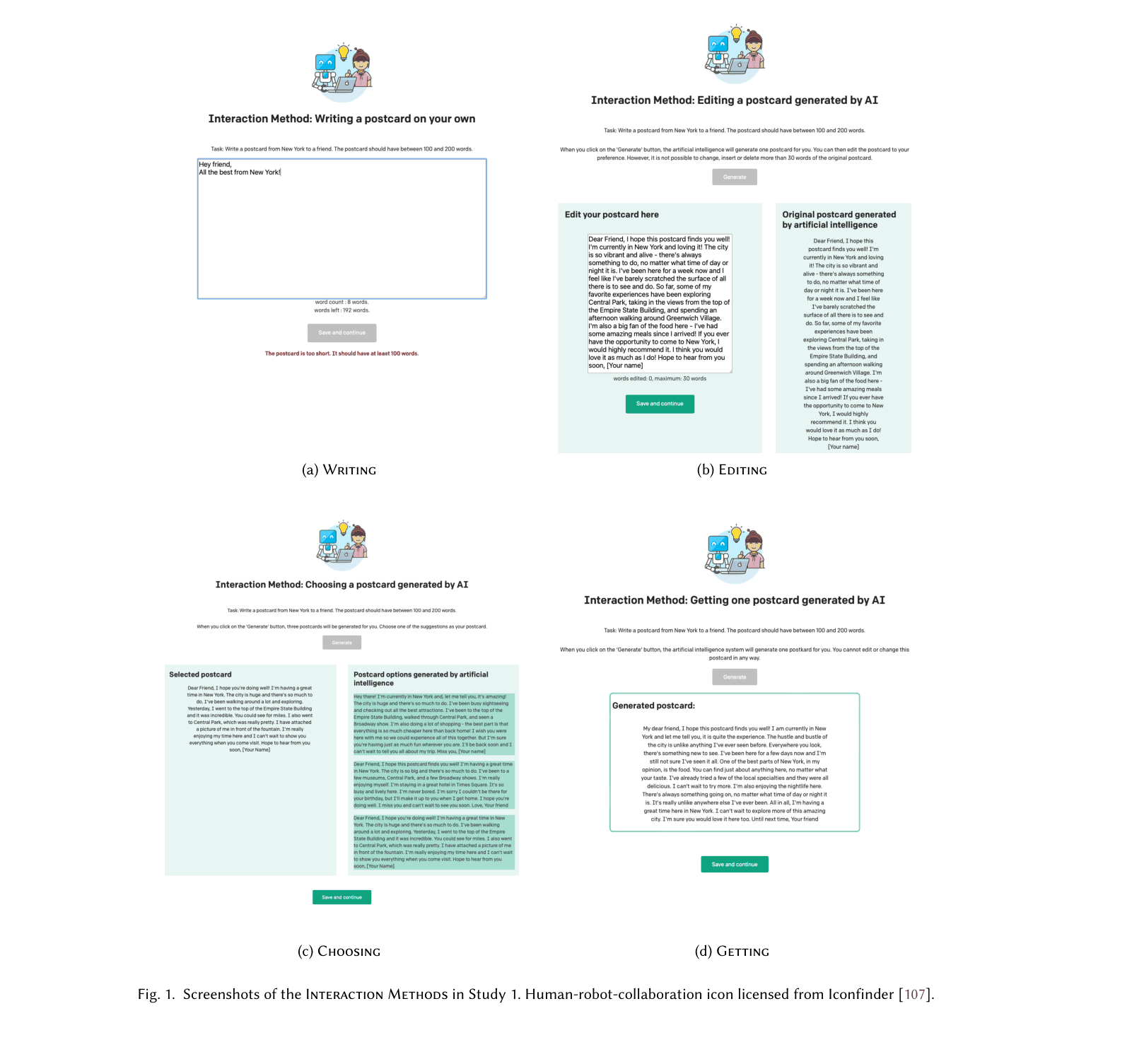
Screenshots of the four Interaction Methods (Writing, Editing, Choosing, Getting) used in the web-based study interface.
Evaluation Highlights
Significant main effect of Interaction Method on sense of ownership: Writing (manual) yielded higher ownership than all AI methods (Getting, Choosing, Editing).
Personalization (fine-tuned vs. placebo) did not significantly affect the sense of ownership, despite users recognizing the personalized text as more similar to their style.
Participants were significantly less likely to attribute ownership to AI ghostwriters than to human ghostwriters (Study 2 results).
Breakthrough Assessment
7/10
Strong empirical contribution to HCI and AI ethics by defining the 'AI Ghostwriter Effect'. It quantifies the gap between internal feeling and external behavior, though the technical novelty lies in the study design rather than new model architectures.
Inputs: User prompts and previous writing samples (for fine-tuning), interaction constraints (Editing/Choosing/Getting)
Outputs: Final text artifact and user attribution/ownership ratings
Pipeline Flow
Fine-tuning Survey (collect user writing samples)
Model Personalization (Fine-tune GPT-3 or select generic text)
Interactive Task (User generates postcard via 4 methods)
Evaluation (Ownership/Authorship questionnaires)
System Modules
Data Collection
Collect writing samples for personalization
Model or implementation: Survey platform
Text Generation Model
Generate postcard drafts based on prompts
Model or implementation: GPT-3 (Davinci)
Interaction Interface
Present text to user under specific constraints
Model or implementation: Web-based UI
Novel Architectural Elements
Study design explicitly contrasting 'Placebo-personalization' (label only) vs. 'True personalization' (fine-tuning) to isolate the effect of technical adaptation on ownership.
Modeling
Base Model: GPT-3 (Davinci)
Training Method: Fine-tuning (OpenAI API)
Adaptation: Full fine-tuning on small user-specific corpus
Trainable Parameters: Not reported in the paper
Training Data:
Responses to 18 prompts (~330-800 characters each)
5 uploaded personal texts
Compute: Not reported in the paper
Comparison to Prior Work
vs. CoAuthor: Focuses on final attribution and ownership psychology rather than interaction patterns or text quality.
vs. WordCraft: Examines the 'Ghostwriter' phenomenon specifically—hiding the AI's role—rather than fostering co-creativity.
Limitations
Sample size for Study 1 was relatively small (n=30).
The 'blog' upload task was simulated; real-world high-stakes publishing might yield different attribution behaviors.
Fine-tuning was done on a very small dataset per user, which might limit the distinctiveness of personalization.
Reproducibility
Study materials (questionnaires, anonymized data) are available on OSF (https://osf.io/n4svx/). The specific fine-tuned models cannot be shared due to privacy/API restrictions, but the method is standard OpenAI API usage.
📊 Experiments & Results
Evaluation Setup
Controlled user study (within-subjects for Interaction Method, between-subjects for Personalization).
Benchmarks:
Postcard Writing Task (Creative writing / Personal communication) [New]
Metrics:
Sense of Ownership (Visual Analog Scale: -50 Me to +50 AI)
Declared Authorship (Open text or selection)
Sense of Control
Cosine Similarity (for personalization check)
Statistical methodology: Mixed ANOVA, Bonferroni-corrected t-tests, Linear Mixed Models (LMM), Bayesian t-tests for null results.
Key Results
Benchmark
Metric
Baseline
This Paper
Δ
Cosine Similarity
Cosine Similarity
0.72
0.77
+0.05
Postcard Writing
Ownership Rating (-50 Me to +50 AI)
-40
20
+60
Main Takeaways
Users distinguish strongly between 'Me' and 'AI' in terms of feeling ownership; any AI involvement (even just Getting) shifts the feeling of ownership to the AI.
Subjective control and 'leadership' in the writing process are strong predictors of ownership feelings.
Personalization (technical fine-tuning) does NOT increase the sense of ownership compared to placebo personalization, suggesting that the label/expectation matters more or that the effect is dominated by the interaction method.
The 'AI Ghostwriter Effect' is confirmed: users feel the AI owns the text but do not credit it.
📚 Prerequisite Knowledge
Prerequisites
Basic understanding of Large Language Models (LLMs) like GPT-3
Concepts of Human-Computer Interaction (HCI)
Psychological Ownership theory
Key Terms
AI Ghostwriter Effect: The phenomenon where users do not perceive ownership of AI-generated text but refrain from publicly declaring AI authorship.
Psychological Ownership: The feeling that an object (or text) is 'mine', often derived from control, investment, or intimate knowledge.
Placebo-personalization: Telling users a system is personalized to them when it is actually using a generic base model.
Fine-tuning: Adapting a pre-trained model on a smaller, specific dataset to bias it towards specific patterns (here, a user's writing style).
Interaction Methods: Specific UI paradigms for generating text: Writing (manual), Editing (modifying AI text), Choosing (selecting from options), Getting (accepting one AI output).
Davinci: A specific size/version of the GPT-3 model family provided by OpenAI.