📝 Paper Summary
Personalized Federated Learning
Federated Neural Architecture Search
PerFedRLNAS uses reinforcement learning to automatically search for and assign personalized neural architectures to different federated learning clients, optimizing for both local accuracy and hardware constraints without manual design.
Core Problem
Existing personalized federated learning methods rely on manual, fixed definitions of which model parts to share vs. personalize, often leading to suboptimal performance or failure to handle hardware heterogeneity.
Why it matters:
- Manual design of shared/personalized layers is brittle and fails to adapt to diverse data distributions (non-i.i.d. data) across clients
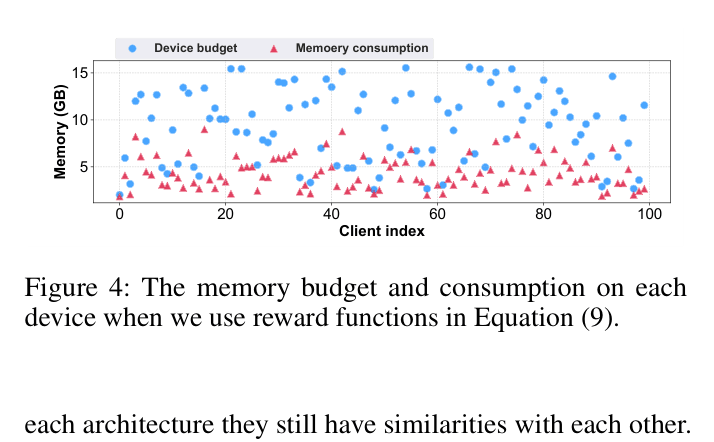
- System heterogeneity (different memory/compute budgets) requires different architectures per client, which standard fixed-model approaches cannot provide
- Previous Federated NAS (Neural Architecture Search) methods are often inefficient or only search for a single global model, missing the benefits of personalization
Concrete Example:
In a federated setting with heterogeneous devices, a small IoT device might crash trying to train a standard ResNet, while a powerful server is underutilized. Furthermore, if Client A has images of cars and Client B has images of animals, forcing them to share the exact same classifier head (or just fine-tuning the head manually) might yield worse accuracy than letting an algorithm automatically decide that Client A needs a deeper convolutional backbone than Client B.
Key Novelty
Personalized Federated Neural Architecture Search via Reinforcement Learning (PerFedRLNAS)
- Maintains a 'virtual agent' for each client on the server that learns a policy to sample architectures from a shared supernet
- Uses policy gradient updates driven by client-specific rewards (accuracy, latency, memory) to automatically tailor the architecture structure for each client
- Eliminates the need for separate search and training phases by integrating architecture search directly into the federated communication rounds
Architecture
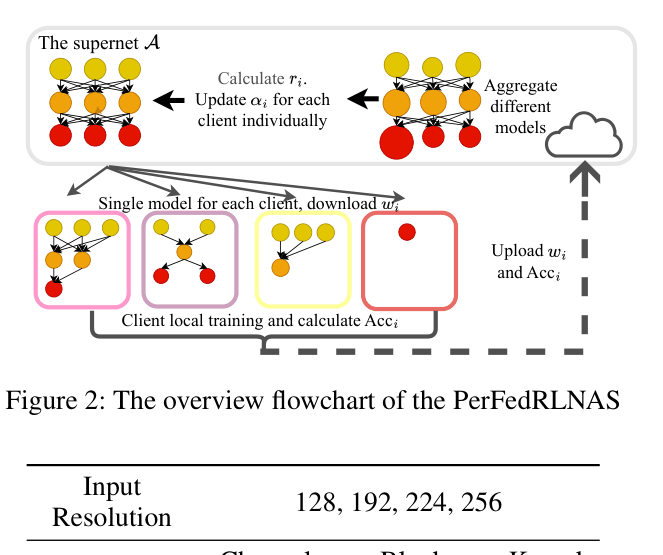
Overview of the PerFedRLNAS workflow including server-side supernet management and client-side training.
Evaluation Highlights
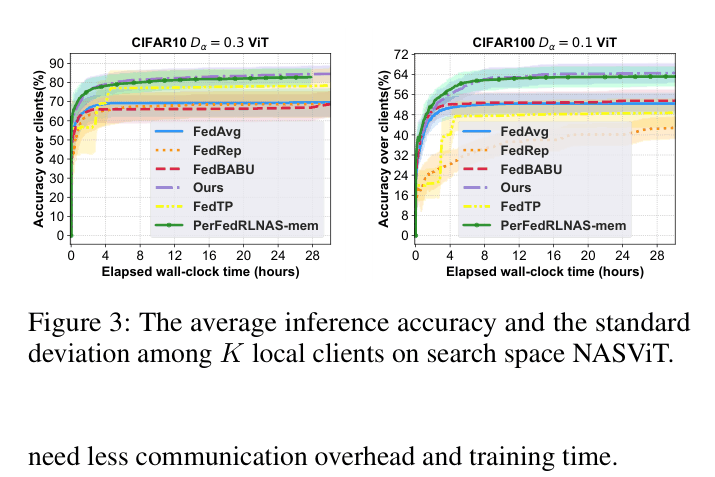
- Achieves 85.02% accuracy on CIFAR-10 (ViT), outperforming state-of-the-art FedTP by +4.75% and FedAvg by +12.8%
- Improves accuracy on the difficult CIFAR-100 task (ViT) to 65.08%, surpassing the best baseline (FedBABU) by +10.73%
- Reduces total elapsed time to reach convergence compared to FedAvg (28.14h vs 34.95h on CIFAR-10) while achieving higher accuracy
Breakthrough Assessment
8/10
Significantly outperforms manually designed personalization baselines and offers a unified framework for handling both data and system heterogeneity via automated NAS.