📝 Paper Summary
Personalized Federated Learning
Feature Representation Learning
GPFL splits the client model into dual pathways using a conditional valve to simultaneously learn global features (guided by shared category embeddings) and personalized features (driven by local tasks) without mutual interference.
Core Problem
Existing Personalized Federated Learning (pFL) methods typically focus on extracting either global or personalized features during local training, failing to achieve both collaborative learning and personalization goals effectively.
Why it matters:
- Focusing only on global features (e.g., FedRoD) neglects personalized objectives, while focusing only on personalized features (e.g., FedPer, FedRep) loses global context crucial for collaboration.
- Prototype-based methods (e.g., FedProto) rely on high-quality feature extractors to generate prototypes, creating a paradox where poor initial features lead to poor guidance, especially for large backbones.
Concrete Example:
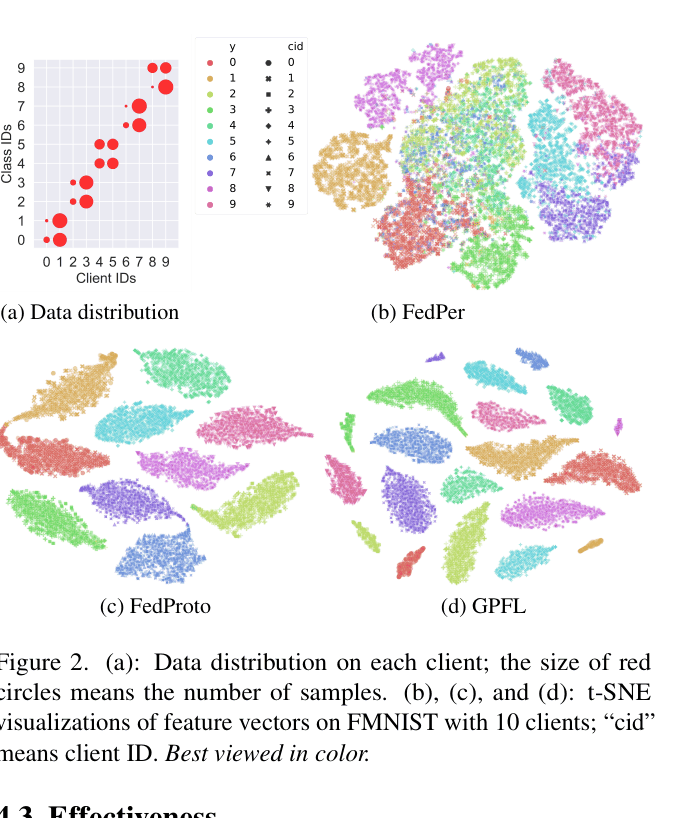
In FedProto, prototypes are averages of local features. If a model (like ResNet-18) is untrained, it produces poor features, leading to uninformative prototypes that mislead training. Additionally, FedProto only pulls features to prototypes without pushing them apart, causing class boundaries to intersect (as shown in the paper's t-SNE visualization on Fashion-MNIST).
Key Novelty
GPFL (Global and Personalized Federated Learning)
- Introduces a Conditional Valve (CoV) that dynamically transforms a base feature vector into two distinct vectors: one for global alignment and one for personalized tasks.
- Utilizes trainable Global Category Embeddings (GCE) shared across clients to guide feature extraction at both magnitude and angle levels, providing stable external information unlike dynamic prototypes.
Architecture
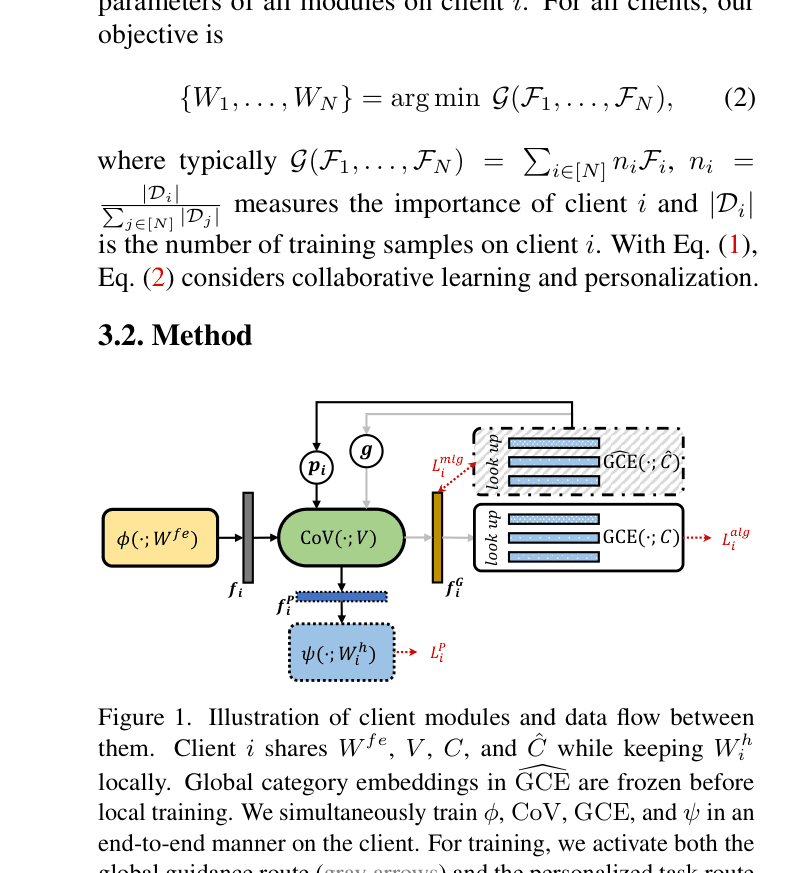
The internal module structure of a client in GPFL, showing the data flow through the feature extractor, Conditional Valve, and dual branches.
Evaluation Highlights
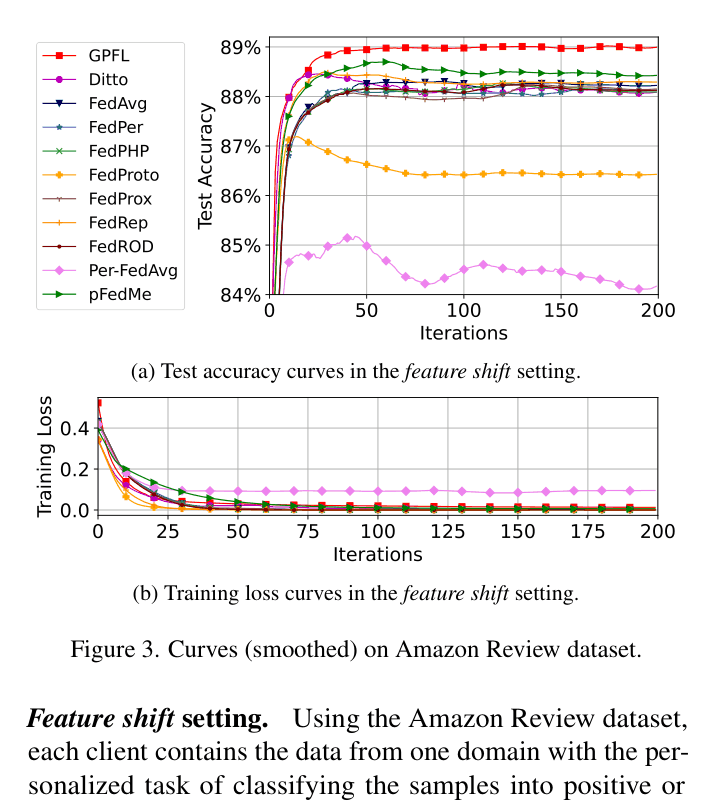
- Outperforms state-of-the-art Ditto by 8.99% accuracy on Cifar100 in practical label skew settings (ResNet-18).
- Achieves 17.32% higher accuracy than FedProto on Tiny-ImageNet with ResNet-18, demonstrating superior scalability to large backbones.
- Maintains privacy integrity (lower privacy leakage PSNR) compared to FedAvg and FedRoD under DLG attacks.
Breakthrough Assessment
8/10
Significantly outperforms SOTA methods (up to ~9-17%) in difficult heterogeneous settings and resolves the conflict between global and personalized objectives via a novel architectural split.