📝 Paper Summary
Backdoor attacks in Federated Learning
Security of Personalized Federated Learning (PFL)
PFedBA is a stealthy backdoor attack that aligns the gradients and loss landscapes of main and backdoor tasks, ensuring poison persists even after personalized local fine-tuning.
Core Problem
In Personalized Federated Learning (PFL), local personalization steps (like fine-tuning on clean private data) often wash out backdoor triggers injected into the global model, making traditional FL attacks ineffective.
Why it matters:
- Current backdoor research overlooks PFL, assuming global model poisoning is sufficient, but personalization acts as an unintentional defense mechanism
- PFL systems are increasingly deployed for privacy-sensitive applications (e.g., mobile keyboards), making them high-value targets for adversaries
- Existing attacks fail against PFL because the 'catastrophic forgetting' during local personalization erases the trigger-target mapping
Concrete Example:
In a standard FL attack, a poisoned global model classifies a trigger-embedded image as 'Target'. In PFL, when a benign client fine-tunes this global model on their clean local data, the model 'forgets' the trigger, restoring correct classification. PFedBA prevents this forgetting.
Key Novelty
PFedBA (Personalized Federated Backdoor Attack)
- Formulates the attack as a joint optimization problem that simultaneously optimizes the trigger pattern and the poisoned model parameters
- Forces the gradient of the backdoor task to align with the gradient of the main task, ensuring both tasks share similar decision boundaries
- Aligns the loss landscape of the backdoor task into the same basin as the main task, making the backdoor robust to local fine-tuning (personalization) and hard to detect
Architecture
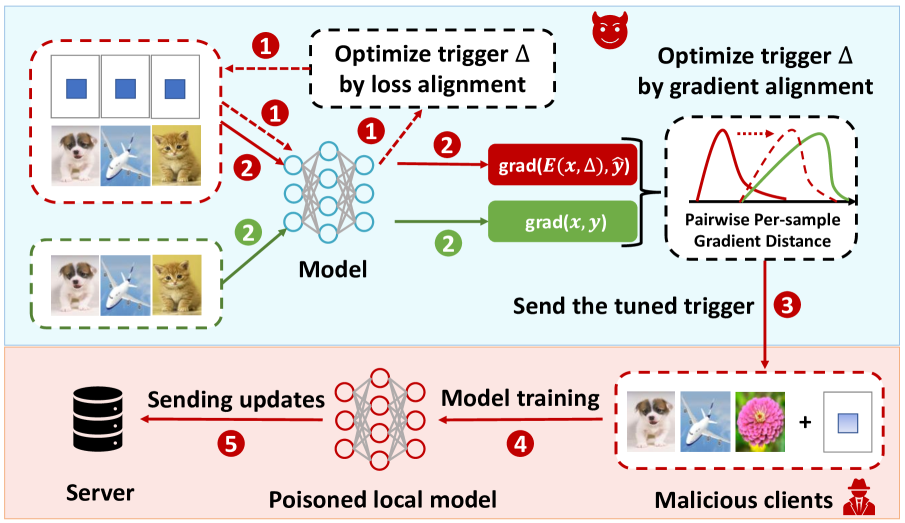
Conceptual flow of PFedBA within a PFL system.
Evaluation Highlights
- Achieves consistently high Attack Success Rate (ASR) across 10 different PFL algorithms (e.g., ~90%+ on Fashion-MNIST with FedAvg-based personalization)
- Maintains ASR above 50% even when facing robust defenses like Trimmed Mean and Neural Cleanse, where baseline attacks drop to near 0%
- Outperforms state-of-the-art attacks (Neurotoxin, PGD) by large margins in defended settings (e.g., +40% ASR vs Neurotoxin on CIFAR-10 with defenses)
Breakthrough Assessment
8/10
Significantly advances the understanding of PFL security by showing that personalization is not a silver bullet against backdoors. The gradient alignment technique is a technically sound and effective innovation for persistence.