📝 Paper Summary
Medical Image Segmentation
Multi-rater annotation
D-Persona is a two-stage framework that first learns a common latent space for diverse medical segmentation predictions and then uses attention-based projection heads to query specific personalized expert opinions from that space.
Core Problem
Medical image segmentation suffers from 'annotation ambiguity' due to inherent data uncertainties (blurred boundaries) and differences in expert preferences, making a single 'ground truth' unattainable.
Why it matters:
- Forcing models to learn a single consensus label ignores valid inter-observer variability, which is critical for clinical decision-making like tumor delineation
- Existing methods either generate diverse but unordered results (generation-based) or specific expert predictions without modeling the full probability space (personalization-based), failing to achieve both simultaneously
Concrete Example:
In nasopharyngeal carcinoma segmentation, different experts may define the Gross Tumor Volume (GTVp) differently due to blurred margins. A standard model averages these into one output, losing the nuance of individual expert styles (conservative vs. aggressive) and failing to represent the uncertainty.
Key Novelty
Two-Stage Diversification then Personalization (D-Persona)
- Stage I (Diversification): Learns a shared probabilistic latent space using a bound-constrained loss that relaxes predictions in uncertain areas (between intersection and union of expert labels)
- Stage II (Personalization): Freezes the latent space and learns individual 'projection heads' that act as queries to extract specific expert-style prompts via cross-attention
Architecture
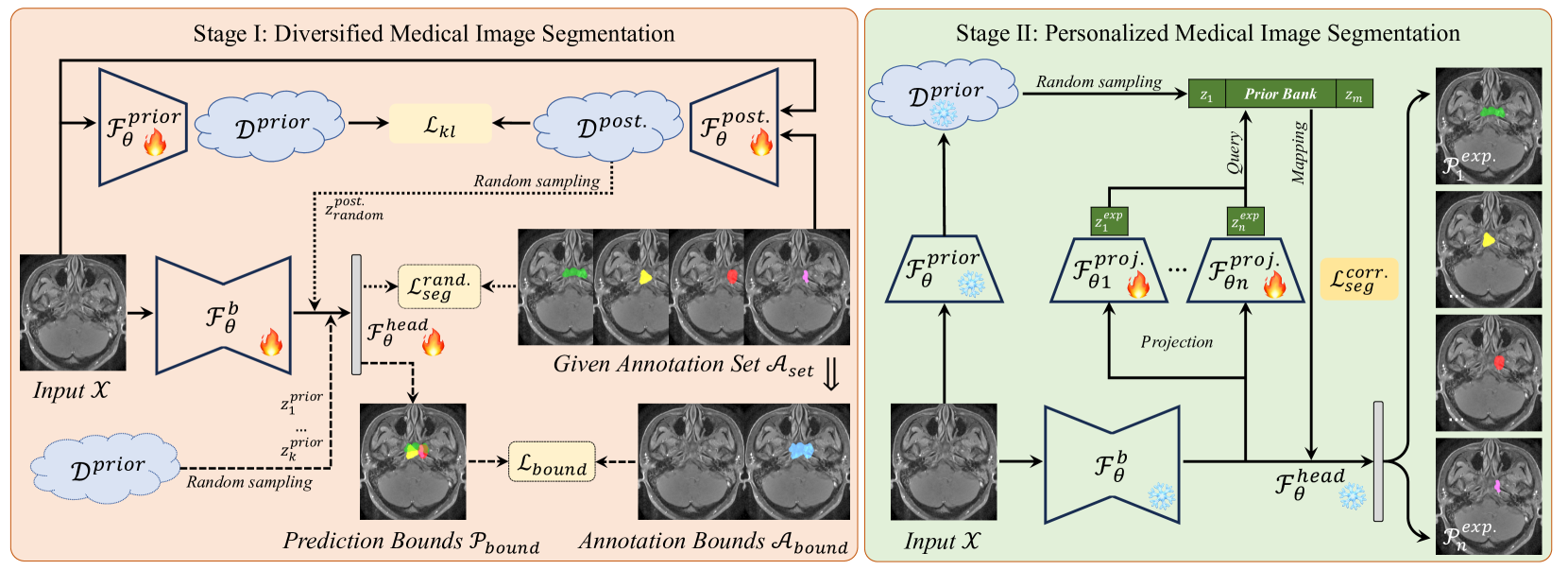
The two-stage D-Persona framework. Left: Stage I (Diversification) using Probabilistic U-Net with bound-constrained loss. Right: Stage II (Personalization) using attention-based projection heads.
Evaluation Highlights
- Achieved state-of-the-art results on LIDC-IDRI dataset, outperforming the best personalization baseline (Probabilistic U-Net) by +2.05% in Dice score.
- On the in-house NPC-48 dataset, D-Persona improved personalized segmentation performance by ~1.5% in Dice compared to single-rater baselines.
- Demonstrated superior diversity generation (GED metric) compared to generative baselines like PHiSeg and Probabilistic U-Net.
Breakthrough Assessment
8/10
Successfully unifies two previously distinct sub-tasks (diversity generation and personalization) in medical imaging. The two-stage design is logical and the bound-constrained loss is a clever, intuitive addition for handling uncertainty.