📝 Paper Summary
Personalized Federated Learning
Representation Learning
DBE addresses representation bias in federated learning by separating client-specific bias into a local memory while regularizing feature extractors toward a global consensual mean.
Core Problem
In statistically heterogeneous federated learning, local training on biased data domains causes the global model to learn biased representations (representation bias) and lose generic representation quality (representation degeneration).
Why it matters:
- Standard FedAvg suffers accuracy drops when data is non-IID because local updates pull the model toward local biases, damaging its generalization.
- Existing personalized FL methods often keep classifiers local but fail to correct the feature extractor, which still learns biased features from skewed local data.
- The conflict between learning client-specific features for personalization and client-invariant features for global aggregation hinders effective collaboration.
Concrete Example:
A client might only have images of 'dogs' and 'cats' but not 'birds'. Training locally makes the feature extractor cluster dog/cat features tightly but degrade the representation space for 'birds', causing the global model to perform poorly on 'birds' for other clients.
Key Novelty
Domain Bias Eliminator (DBE)
- Decouples feature representation into two parts: a client-invariant 'global' representation and a client-specific 'bias' term stored locally.
- Uses a Personalized Representation Bias Memory (PRBM) to store the offset (bias) for each client, allowing the feature extractor to focus on generic features.
- Applies Mean Regularization (MR) to force the local feature extractor's output mean to align with a global consensus mean, preventing drift into local clusters.
Architecture
Comparison of local training processes between traditional FL/pFL and the proposed DBE framework.
Evaluation Highlights
- Outperforms state-of-the-art personalized FL methods by up to +11.36% accuracy on CIFAR-100 (heterogeneous setting).
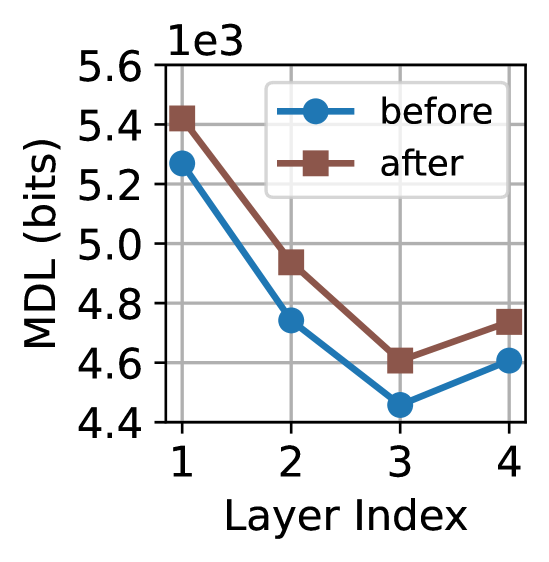
- Improves standard FedAvg by +32.30% accuracy and reduces representation complexity (MDL) by -22.35 bits in heterogeneous scenarios.
- Consistently enhances multiple FL baselines (FedProx, MOON, FedGen) when integrated as a plug-and-play module.
Breakthrough Assessment
8/10
Offers a fundamental structural improvement (bias decoupling) for FL that is model-agnostic and yields large gains over strong baselines. The theoretical grounding in generalization bounds adds significant weight.