SVDiff adapts text-to-image diffusion models by fine-tuning only the singular values of weight matrices, drastically reducing model storage while mitigating overfitting and enabling better multi-subject generation.
Core Problem
Fine-tuning large diffusion models for personalization requires storing massive checkpoints (e.g., 3.66GB) and often suffers from overfitting, language drift, or the inability to disentangle multiple subjects.
Why it matters:
Full-weight fine-tuning (like DreamBooth) is storage-inefficient for users who want to save many personalized models
Models often fail to learn multiple concepts simultaneously, mixing styles (e.g., blending a dog and a sculpture) or losing the ability to edit an image without destroying its identity
Overfitting to few-shot examples degrades the model's generalizability, making it hard to place subjects in new contexts
Concrete Example:When fine-tuning a model on both a 'dog' and a 'sculpture', standard approaches often generate a 'sculpture-like dog'. SVDiff with Cut-Mix-Unmix successfully generates a distinct dog sitting beside a sculpture.
Decompose weight matrices via SVD (Singular Value Decomposition) and freeze the singular vectors, training only the singular values (spectral shifts) to adapt the model
Introduce 'Cut-Mix-Unmix', a data augmentation strategy that constructs collage images (e.g., cut-and-paste) to explicitly teach the model to separate styles/concepts spatially
Architecture
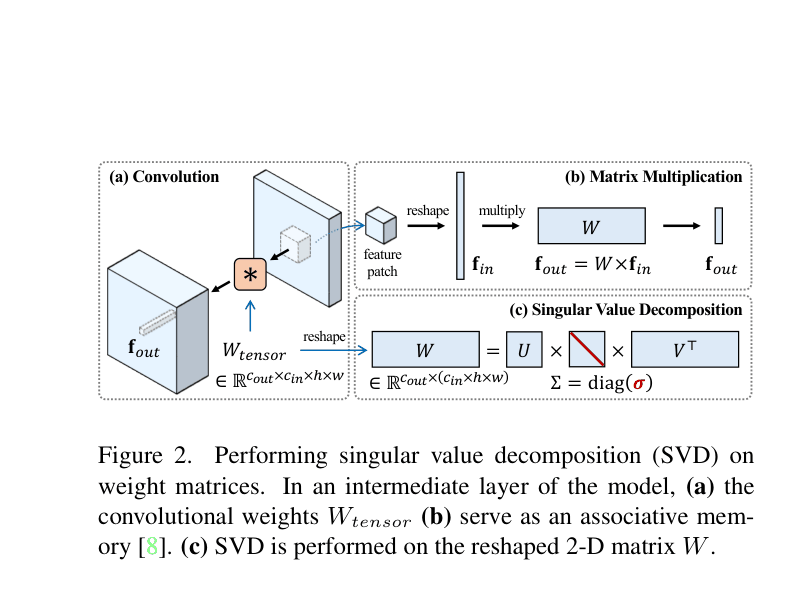
The SVD-based parameterization process. It shows how a convolutional weight tensor is reshaped into a matrix, decomposed into U, Sigma, V, and how only Sigma (singular values) is fine-tuned.
Evaluation Highlights
Reduces checkpoint size to ~1.7MB per subject (vs. 3.66GB for vanilla DreamBooth on Stable Diffusion), a ~2,200x reduction
Achieves 60.9% user preference over full-weight fine-tuning for multi-subject generation quality (consistency and disentanglement)
Maintains comparable text-alignment (CLIP score) and image-alignment (LPIPS) to full fine-tuning while significantly outperforming Custom Diffusion in subject fidelity
Breakthrough Assessment
8/10
Offers a highly practical, storage-efficient solution for personalization that rivals full fine-tuning quality. The Cut-Mix-Unmix technique effectively solves the persistent multi-subject blending problem.
⚙️ Technical Details
Problem Definition
Setting: Few-shot adaptation of a pre-trained text-to-image diffusion model to specific subjects or styles
Inputs: A pre-trained diffusion model (Stable Diffusion) and 3-5 images of a target subject/concept
Outputs: A lightweight parameter update (spectral shifts) capable of generating the target subject in novel contexts
Pipeline Flow
Input Images -> SVD Decomposition of Pre-trained Weights
Spectral Shift Training (optimizing singular value deltas)
Cut-Mix-Unmix Augmentation (for multi-subject)
Inference (Reassembling weights: W = U(Σ + δ)V^T)
System Modules
Weight Re-parameterization
Replaces standard fixed weights with dynamic weights computed from frozen eigenvectors and trainable eigenvalues
Model or implementation: Based on Stable Diffusion (UNet layers)
Cut-Mix-Unmix Augmentation
Creates synthetic training samples combining multiple subjects to prevent style mixing
Model or implementation: N/A (Data Augmentation)
Novel Architectural Elements
Optimization of singular values (spectral shifts) only, freezing all other parameters
Integration of Cut-Mix-Unmix data augmentation directly into the fine-tuning loop for diffusion
Modeling
Base Model: Stable Diffusion (CompVis/stable-diffusion)
Training Method: Spectral Shift Fine-Tuning (SVDiff) with Prior Preservation Loss
learning_rate: Not explicitly reported in the paper (implies standard DreamBooth settings)
Compute: Storage: 1.7MB per model (vs 3.66GB for full weights)
Comparison to Prior Work
vs. DreamBooth: SVDiff updates ~2200x fewer parameters (1.7MB vs 3.6GB) and reduces overfitting
vs. Custom Diffusion: SVDiff achieves better subject identity preservation (Custom Diffusion tends to underfit)
vs. LoRA: SVDiff is even more compact (rank-1 equivalent storage vs LoRA's rank-r matrices) and optimizes singular values directly rather than low-rank adaptors
Limitations
Cut-Mix-Unmix performance degrades as the number of simultaneous subjects increases beyond two or three
Single-image editing can sometimes result in inadequately preserved backgrounds
DDIM inversion improves structural preservation but may limit the extent of large structural edits
Reproducibility
Code availability is not explicitly provided in the text. The paper relies on public Stable Diffusion and DreamBooth implementations. Method details (SVD reshaping, loss formulations) are mathematically defined.
📊 Experiments & Results
Evaluation Setup
Few-shot personalization on single and multiple subjects, plus single-image editing
Statistical methodology: User study reported with standard deviation (6.9%)
Key Results
Benchmark
Metric
Baseline
This Paper
Δ
Multi-Subject Generation
User Preference (%)
39.1
60.9
+21.8
Storage
Parameters (Size)
3660
1.7
-3658.3
Single-Subject Generation
Qualitative Fidelity
Underfits
High Fidelity
Qualitative
Main Takeaways
SVDiff achieves visual quality on par with full-weight DreamBooth while requiring negligible storage (1.7MB).
The Cut-Mix-Unmix augmentation is critical for multi-subject generation; without it, models blend concepts (e.g., 'dog' + 'sculpture' = 'sculpture-dog').
Optimizing spectral shifts acts as a regularizer, preventing language drift and enabling safer single-image editing compared to full-weight fine-tuning.
📚 Prerequisite Knowledge
Prerequisites
Understanding of Diffusion Models (LDMs)
Matrix Decomposition (SVD)
Fine-tuning techniques (DreamBooth, LoRA)
Key Terms
SVD: Singular Value Decomposition—a linear algebra method factoring a matrix into three parts (U, Σ, V); this paper trains only Σ (singular values)
Spectral Shift: The learned difference (delta) applied to the singular values of the weight matrices during fine-tuning
DreamBooth: A technique for personalizing text-to-image models by fine-tuning the entire model on a few images of a subject using a unique identifier
CutMix: A data augmentation technique where patches from one image are cut and pasted onto another; used here to create multi-subject training data
LPIPS: Learned Perceptual Image Patch Similarity—a metric used to measure how visually similar the generated image is to the reference image
CLIP score: A metric measuring the semantic alignment between a generated image and its text prompt
DDIM Inversion: A method to reverse the diffusion sampling process to find the initial noise latent that reproduces a given image