📝 Paper Summary
Federated Learning
Privacy-Preserving Machine Learning
This paper evaluates a framework combining the APPLE federated learning algorithm with Homomorphic Encryption to achieve high accuracy and privacy on decentralized medical data.
Core Problem
Centralized machine learning endangers user privacy, while traditional Federated Learning (FL) often struggles to balance rigorous data protection with the need for high-accuracy personalized models.
Why it matters:
- Sensitive domains like healthcare (e.g., virus detection) require strict privacy that prevents users from sharing raw data centrally
- Existing privacy techniques like Differential Privacy can degrade model utility (accuracy) by adding noise
- Personalized services often fail in federated settings due to the heterogeneity of user data across decentralized silos
Concrete Example:
In a distributed virus classification task (Virus-MNIST), a standard Federated Learning model might aggregate updates that leak patient trends. Alternatively, adding strong Differential Privacy noise could make the model too inaccurate to reliably diagnose the virus, failing the medical objective.
Key Novelty
PPMLFPL (Privacy Preserving Machine Learning with Federated Personalized Learning)
- Integrates the APPLE (Adaptive Personalized Cross-Silo Federated Learning) algorithm with four distinct privacy backends: Differential Privacy, Homomorphic Encryption, Secure Aggregation, and Secure Multi-Party Computation
- Conducts a comparative performance analysis to identify the optimal trade-off between privacy overhead, execution time, and classification accuracy on medical imaging data
Architecture
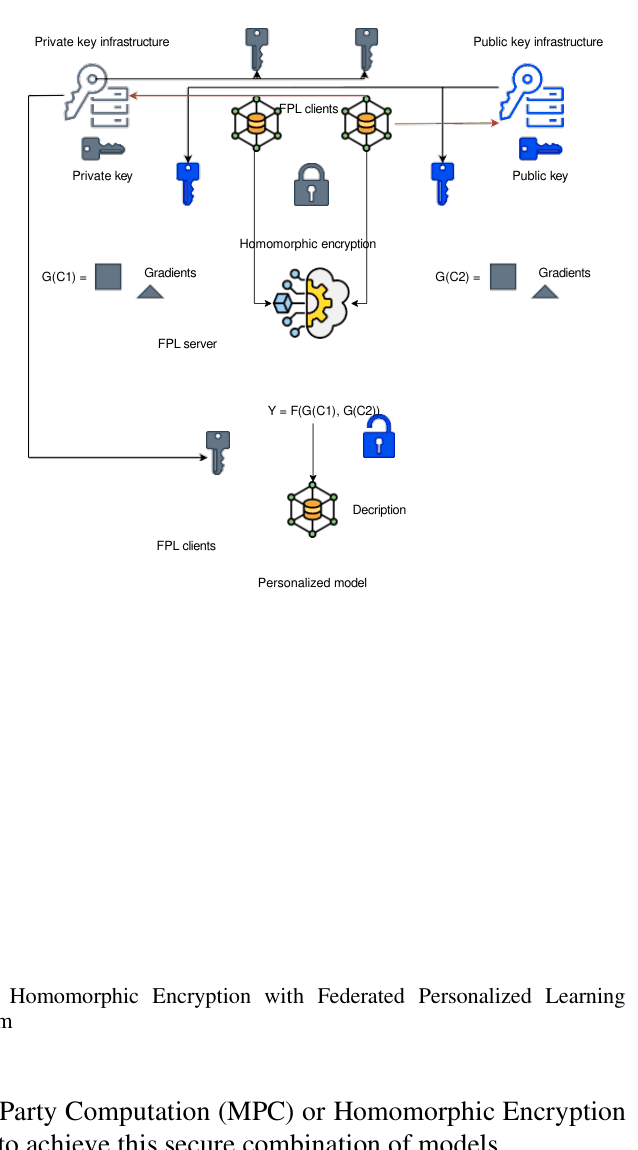
The workflow of the APPLE algorithm integrated with Homomorphic Encryption (APPLE+HE)
Evaluation Highlights
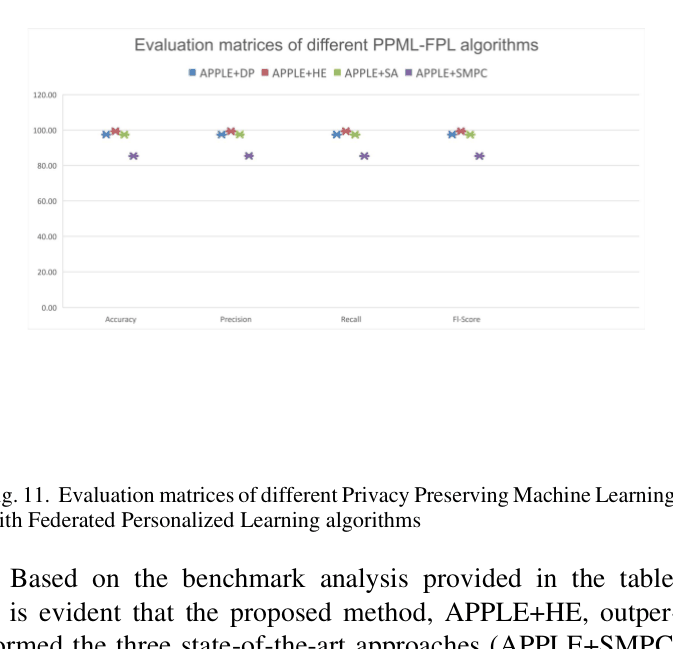
- APPLE+HE (Homomorphic Encryption) achieves the highest accuracy of 99.34% on Virus-MNIST, outperforming the non-private APPLE baseline (97.41%)
- APPLE+DP (Differential Privacy) offers the fastest execution time (22,119 ms for 200 clients) while maintaining 97.48% accuracy
- The proposed APPLE+HE method significantly outperforms the Secure Multi-Party Computation variant (APPLE+SMPC), which reached only 85.38% accuracy
Breakthrough Assessment
4/10
The paper provides a useful benchmark of combining existing algorithms (APPLE + HE/DP) rather than proposing a fundamental new architecture. The results are strong but the method is combinatorial.