📝 Paper Summary
LLM-based recommendation
Robustness against shilling attacks
Retrieval-Augmented Generation (RAG)
RETURN protects LLM-based recommender systems from malicious interaction noise during inference by retrieving collaborative item subgraphs to identify and purify inconsistent user behaviors.
Core Problem
LLM-empowered recommender systems are highly vulnerable during inference to minor perturbations (e.g., clickbait items) in user history, which mislead the model into generating poor recommendations.
Why it matters:
- Existing defenses focus on training-time purification, failing to protect well-trained models from noisy inference-time interactions caused by clickbait or attacks
- A single irrelevant item in a user's sequence can drastically alter LLM outputs due to its sensitivity to input prompts
- Current LLM-RecSys rely on internal knowledge, often missing the collaborative signals (item co-occurrence) needed to verify if an interaction is genuine or noise
Concrete Example:
If a user shopping for 'suits' and 'dresses' accidentally clicks on 'ties' (a perturbation item inserted by attackers), the LLM might fixate on the 'ties' and fail to discern the user's true intent, recommending irrelevant accessories instead of the main clothing items.
Key Novelty
Retrieval-Augmented Purification (RETURN)
- Constructs collaborative item graphs from external datasets to capture item-item co-occurrence patterns (e.g., items frequently bought together)
- Retrieves subgraphs for a user's interaction sequence to score the consistency of each item; items with low collaborative support are flagged as noise
- Purifies the user profile by deleting or replacing flagged items and uses an ensemble strategy to combine predictions from multiple purified profiles
Architecture
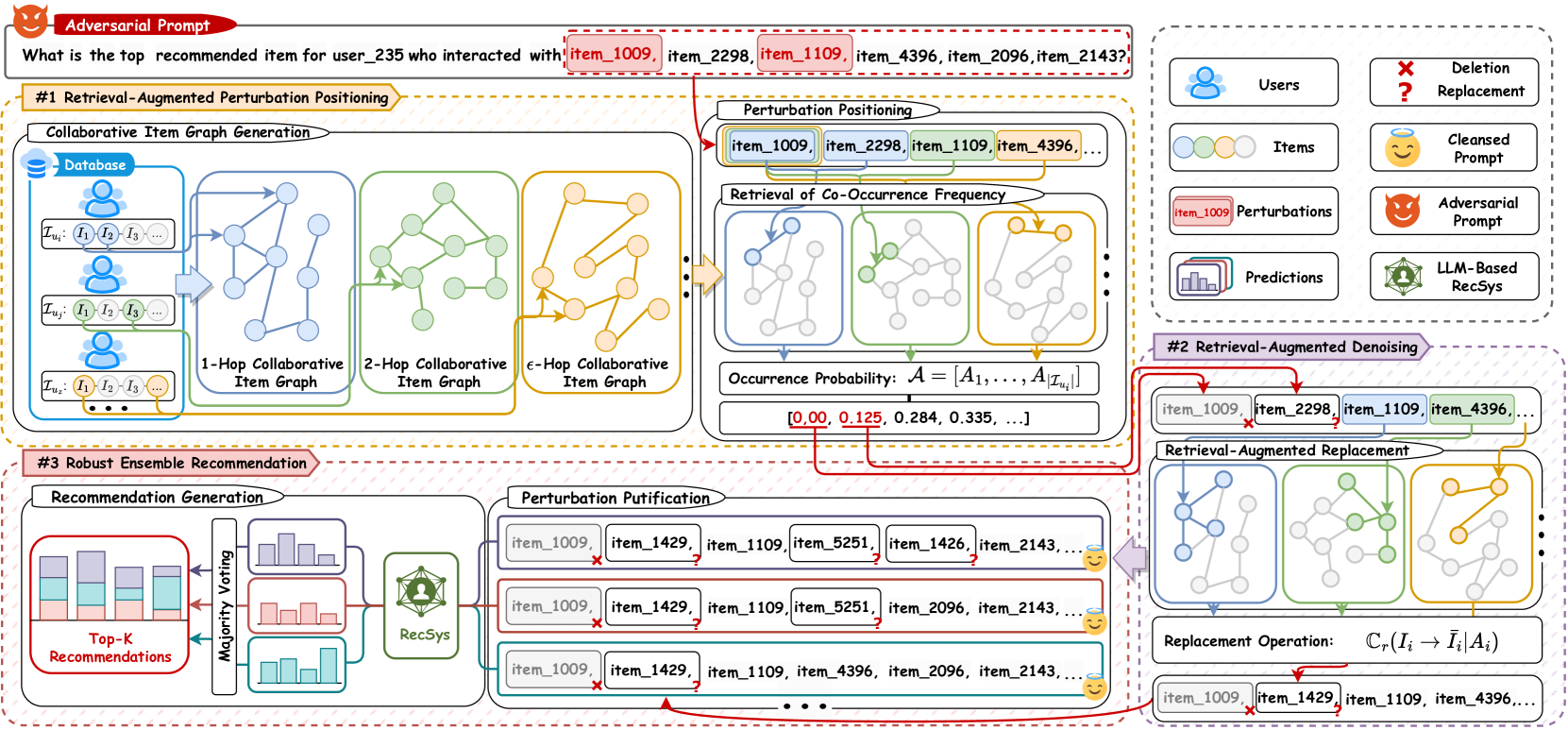
The overall framework of RETURN, illustrating the flow from a perturbed user sequence to robust recommendation via collaborative graph retrieval.
Evaluation Highlights
- Significantly outperforms baselines like TALLRec and various defense strategies on three real-world datasets (Amazon Beauty, Sports, Toys)
- Demonstrates robustness against both random noise and adversarial perturbations, maintaining high Hit Ratio and NDCG where other models degrade
- Plug-and-play capability allows integration with existing LLM-RecSys without retraining the LLM backbone
Breakthrough Assessment
7/10
Novel application of RAG for inference-time purification in RecSys. Addresses a critical vulnerability (inference noise) that training-time defenses miss, with a practical, training-free approach.