📝 Paper Summary
Personalized Federated Learning (PFL)
Out-of-Distribution Generalization
FedSoup improves both local personalization and global generalization in federated learning by selectively averaging historical global models into a client-specific 'soup' and interpolating this with local models to find flat minima.
Core Problem
Current Federated Learning algorithms face a severe trade-off between local performance (personalization) and global performance (generalization) when handling heterogeneous data distributions.
Why it matters:
- Personalized FL methods (like FedRep) often overfit local data, leading to sharp minima that fail to generalize to out-of-distribution (OOD) data.
- Medical imaging scenarios suffer from significant distribution shifts (e.g., different scanners/hospitals), requiring models that work well locally but also robustly across institutions.
Concrete Example:
In a cross-silo setting with multiple hospitals, a model trained on Hospital A's data (personalization) might perform poorly on the joint distribution of all hospitals (generalization) because it settles into a sharp, narrow valley in the loss landscape specific to Hospital A.
Key Novelty
Federated Model Soups (FedSoup)
- Adapt 'Model Soups' to FL by using historical global models from different training rounds as ingredients, rather than training many models from scratch.
- Each client maintains a personalized 'soup' by greedily selecting global models based on local validation performance.
- Interpolate (patch) the local model with the client-specific global soup during training to encourage the model towards flat minima, bridging the local-global gap.
Architecture
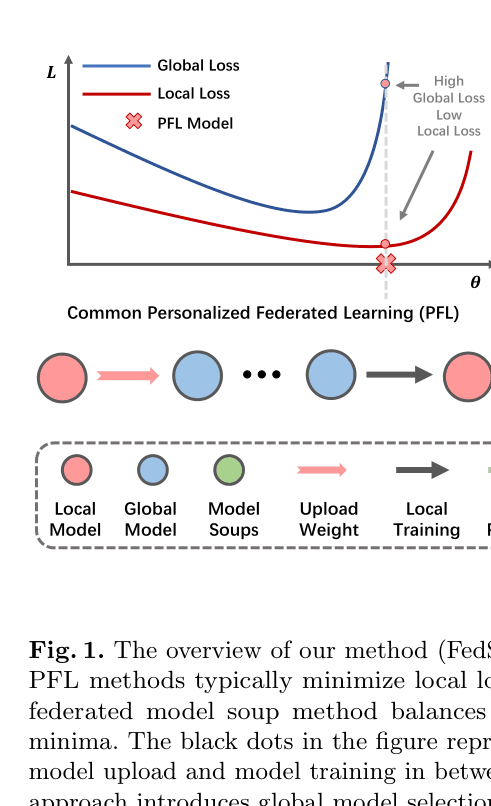
Overview of the FedSoup method compared to common PFL methods. It illustrates the 'sharp valley' vs 'flat minima' concept.
Evaluation Highlights
- +2.87 AUC improvement on unseen domain generalization for pathology image classification compared to FedAvg.
- Achieves competitive local personalization accuracy (90.92%) while significantly outperforming baselines in global generalization AUC (96.00%) on Retinal Fundus datasets.
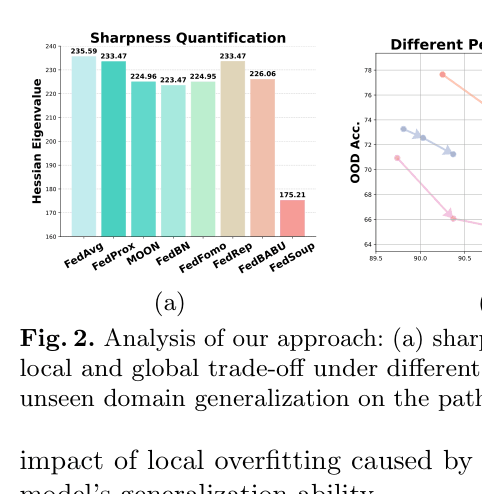
- Reduces the sharpness of the loss landscape (measured by Hessian eigenvalues) compared to FedAvg and FedProx, confirming the method finds flatter minima.
Breakthrough Assessment
7/10
Offers a practical, compute-efficient solution to the personalization-generalization trade-off in FL using model interpolation. Strong empirical results on medical data, though the core 'soup' concept is adapted from centralized learning.